

Flight Design CT has the lion’s share of the Light Sport Aircraft market, with approximately 1,500 aircraft flying around the world. The airplanes, manufactured in Germany, are especially popular with the LSA crowd in the United States.
The versatility of the airplane was recently expanded with the addition of amphibious floats.
“This is the only one so far,” noted demo pilot Tom Gutmann at this year’s U.S. Sport Aviation Expo in Sebring, Fla. When he is not providing demonstrations of the CT at air shows or to potential customers, Gutmann is vice president of Airtime Aviation in Tulsa, Okla., the force behind putting the LSAs on floats.
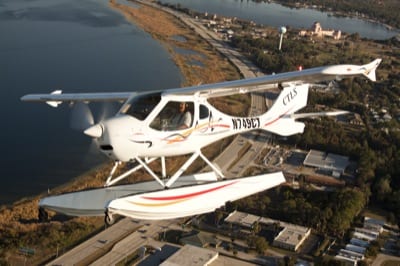
“The project is owned by Airtime Aviation,” said Tom Peghiny, president of Flight Design USA. “They funded the plane, floats and the attachment. Flight Design supported it with the engineering for the certification and the test pilot for the flight test part of the program.”
At Sebring, Gutmann was eager to share details, noting that the float-equipped CTLS was brought to last summer’s AirVenture for static display. “But we didn’t get FAA certification until a few days before the Sebring show,” he smiled proudly.
Gross weight of an LSA is limited to 1,320 lbs., while an LSA float plane is 1,430. Many manufacturers have struggled with the idea of creating an amphibious float that doesn’t eat up the useful load of an LSA.

“There aren’t a lot of other special light sport float planes out there,” Gutmann said. “But when you start with a great airplane like the CT, you can’t go wrong.”
The Clamar 1400 LSA floats, manufactured by Clamar Floats in Ontario, Canada, are made from carbon fiber, Kevlar and S-glass with a displacement of 1,430 lbs.
“They are lighter and stronger that aluminum floats and they aren’t prone to corrosion or leaks from popped rivets,” said Gutmann. “We needed something that would support the weight without giving up the speed we wanted.”

The floats measure 14 feet, 5 inches in length and are 22-5/8 inches wide, which should you give you ample space to move around should you need to step onto the float to net the fish you just caught in a lake where the fish normally die of old age. There are four compartments in the floats with spin-off caps. The top of the float has a non-skid surface for better traction.
Position of the landing gear, wheels up or down, is critical when flying an amphibious aircraft, so Clamar has built multiple redundancies into the system.
 First is a visual notification system, which is standard equipment. “The control box is inside the cockpit,” Gutmann said. “When the wheels are up, you get a blue light for water landing, when they are down you get a green for land.
“There are two mechanical posts that manifest when the wheels are down, and there is a mirror beneath the wings for the pilot to visually verify their position,” he continued. “The tags on the end of the floats match the lights on the indicator box — blue for water landing, green for grass.”
There is also an option for an audio gear warning system. The audio system incorporates a computer-generated female voice stating “gear up for water landing” or whatever is appropriate for the type of landing selected.
Although the tires pull up and into the floats for water landing, don’t call the gear retractable, warned Gutmann. “It’s repositionable gear,” he said.
The tradeoff of having an aircraft that can operate safely from both land and water is usually a reduction in cruise speed. Floats create a lot of drag, sometimes a surprising amount.
Gutmann noted that the Clamar design has kept drag to a minimum. “On the standard gear airplane, cruise is usually in the neighborhood of 118 knots,” he said. “The one equipped with floats is about 101, 102 knots. A floatplane doing that kind of speed is very, very good.”
The floats are now approved and available for $42,000, including a new Sensenich three-blade prop that gets the plane out of the water in 15-20 seconds at full gross weight. The floats can be added to CTLS that are already in the hands of customers.
“As long as you have a CTLS, we can retrofit it to have floats,” said Gutmann. “There are no structural changes that have to be made to the aircraft. We merely bond a few pieces to the firewall, add a mechanism to the original landing gear socket and add the floats to it.”
Conversion back to a standard land airplane is also a simple process that can be done the first time in about a day and a half, then back and forth in about six to eight hours, he added.
In many cases, the pilot who is used to flying an airplane on wheels might get a rude shock when that model is put on floats, because in addition to a reduction of cruise speed, there can be a reduction in maneuverability. The CTLS is not one of those airplanes. Gutmann proved this when we took the Amphibious CTLS out for a demonstration flight.
DEMO FLIGHT
The first challenge, for me at least, was getting aboard. Amphibious float planes, when they are on the ramp, are tall. Vertically challenged pilots such as myself cannot step up on the float. Gutmann demonstrated the appropriate way to get aboard: Back up to the float, sit on it, and swing your legs over it. Grab the landing gear to steady yourself and stand up straight.
The CTLS has wide gull-wing doors held open with a gas strut so entry into the cockpit is easy. Grab the edge of the door, step inside, slide yourself into the seat. The CTLS does not have adjustable rudder pedals, but I could reach them if I stretched.

As I had not flown a floatplane in years, Gutmann did the takeoff. When he brought the throttle forward I expected the airplane to require much more runway than it did to get airborne. We were flying before I knew it, and soon the wheels came up and we headed away from the airport. If you want to do a demonstration flight during an event like Sebring, keep your head on a swivel and your ears open. Although there are detailed NOTAMs published about air operations at the shows, there always seems to be someone who gets confused or who hasn’t done their homework, and therefore tries to enter the pattern in a way contrary to what has been published. Keeping an eye out for these folks is easy in the CTLS because of wide windows and turtle deck.
Once we were clear of the show grounds the demo flight began in earnest. I like to start these with turns, so I can see how an airplane is rigged, and what kind of control pressures it requires. Other floatplanes I have flown felt heavy on the controls and I could definitely feel the weight of the floats during maneuvers. The CTLS wasn’t really one of these. With the exception of a quicker return to wings level as I pulled out of a turn, it was hard to tell the floats were there.
Our next stop was Lake Jackson a few miles away from the airport. Gutmann took the controls for a water landing. We started by circling the lake looking for other traffic and debris in the water.
Gutmann went through the pre-landing checklist, making sure the wheel position indicator showed blue. “Wheels up for water landing,” a female voice intoned. He pointed out the posts on the bow of the floats that indicated gear position and the mirrors beneath the wings that helped the pilot check the gear.
“You are looking for the tires under the floats,” he said. Once he was satisfied the gear was indeed up, we made our approach.
Landing on water is done much the same as on land, except on water if you don’t have the nose up high enough, there is the chance of getting the bow of the floats caught in the water and the airplane flipping. This is especially true in glassy water conditions.
On that day there were ripples on the lake and Gutmann skillfully slid the floats onto the water and we were a boat.
He opened his door and took off his shoulder harness instructing me to do the same, saying it was floatplane procedure “just in case” something happened so we would be able to get out of the aircraft quickly.
 He pointed to the paddle that lay strapped to the floor. Paddles are required equipment aboard floatplanes because if something goes wrong, such as the engine quits, it may be the only way to maneuver on the water. “I have a long extension on that and I can sit in here and paddle if I have to,” he told me.
We taxied around the lake with the water rudders down…and then up…and then down again so I could see how the airplane handles when it was in boat mode.
After clearing the area, Gutmann brought the throttle forward and we were up on step and airborne in about 10 seconds. The floats were, as a vintage Navy pilot of my acquaintance likes to say, “slicker than snake snot” and came off the water quickly.
We played around on the water for a few minutes, then reluctantly headed back to the show as Gutmann had many more flights to do that day.
“It’s been very popular,” he said.