

Air traffic controllers at the Minneapolis Terminal Radar Approach Control (TRACON) are using a next generation tool developed by Lockheed Martin and the FAA to help maintain safe separation between aircraft on final approach. The advancement enhances the Common Automated Radar Terminal System (CARTS), a program Lockheed Martin primes for the FAA at more than 100 TRACONs nationally.
Known as Automated Terminal Proximity Alert (ATPA), the tool automatically lets controllers at the Minneapolis-St. Paul International Airport know what the distance is between aircraft that are flying inline instrument approaches. Another feature is that the system will visually alert a controller when a trailing plane is predicted to get too close to an aircraft ahead of it, allowing the controller to take action before a loss of standard separation occurs, according to company officials. The tool is an example of how the FAA is applying applications today that are tied to its next generation air transportation strategy, officials add.
 “ATPA is a tool that will help controllers optimize performance using existing separation standards,” said Sandra Samuel, vice president of Lockheed Martin’s IS&GS-Civil Transportation Solutions business. “Being able to roll out ATPA now demonstrates Lockheed Martin’s commitment to providing the FAA with NextGen improvements today, not tomorrow.”
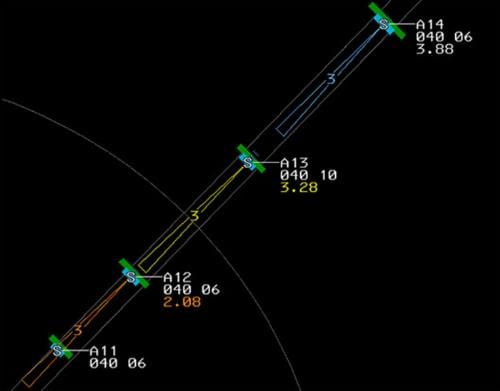
One useful feature of ATPA is distance processing. The controller’s radar display will show the distance between two aircraft on final approach, placing the amount of separation next to the track of the trailing flight.
Another feature controllers at the Minneapolis TRACON are finding helpful is the ATPA’s warning and alert cones. The cones show up on a controller’s radar display when the trailing plane is predicted to get too close to the aircraft ahead of it. The narrow end of the cone starts at the trailing plane, with the broader end extending toward the leading aircraft. The colors of the cones are changed when the aircraft are projected to get closer than the minimum required separation, prompting the controller to take action.
“Controllers had a previous tool that required them to enable graphics manually, but their desire for automation led to the development of ATPA,” Samuel said. “This new capability will support increased arrival rates by helping controllers consistently maintain the precise minimum aircraft separation standards.”
The St. Louis TRACON is also using the tool, and it should be available at the Chicago and Denver TRACONs soon. Current plans are to bring ATPA to other CARTS facilities that have color displays by the end of the year.
For more information: LockheedMartin.com, FAA.gov
