

Performing in an airshow is on many a pilot’s bucket list. Twelve young men from all over the world had that special opportunity at AirVenture this year through the Flying Cup Challenge.
The young men competed against one another in a Redbird FMX, a full-motion flight simulator placed on the main stage in the center of the biggest aviation gathering in the world.
The challenge, created by Redbird Flight Simulations, was introduced in April at SUN ’n FUN.
 Participants who registered at FlyingChallenge.com were issued a five-digit personal identification number (PIN). That PIN interfaced with a USB headset in a Redbird flight simulator.
There were three levels of competition: Licensed Pilot, Student Pilot, and Everyone Else (non-pilot). The challenges were designed to showcase basic stick and rudder skills, including precision landings, steep turns and Lazy Eights. Each maneuver was scored using the criteria contained in the Practical Test Standards.
Some 8,000 pilots from around the world registered for the event and spent thousands of hours flying the maneuvers in Redbird simulators.
The four top scorers from each category won a trip to AirVenture to compete in the finals.
According to Charlie Gregoire, a Redbird vice president, the idea was to give the finalists the sense that they were performing at Oshkosh as airshow pilots. Cameras inside the Redbird allowed the crowd to watch the finalists fly and the event was broadcast to a large video monitor next to the stage. The finalists were dressed in tan flight suits covered with sponsor patches, so they looked every inch airshow performers.
Each contestant was introduced by means of a short video detailing where they came from and what their experience level was. The pressure was on as they climbed into the darkened box, their faces illuminated only by the light from the computer screens and instrument panel.
The final scenario consisted of a short field take off and Vx climb followed by a steep 180° turn and then a spot landing at a virtually generated Wittman Regional Airport (OSH).
Patrick Webb from Colorado took home the prize for Licensed Pilots. The student pilot winner was Kevin Sandoval from South Carolina, while Matt Smith from Michigan took home the trophy in the Everyone Else category.
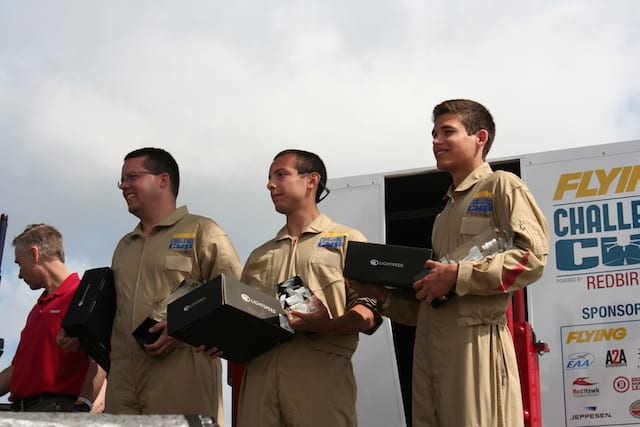 In addition to the trips to Oshkosh, each participant took home a Garmin D2 watch. Smith, Sandoval and Webb also took home trophies and Lightspeed headsets.
“The challenge was a demonstration of how you can use game design theory to deliver actual flight training,” said Gregoire. “People are learning things without even realizing it. We think that it is important to really engage people and that it is a good way to learn when you absorb the technology. The days of throwing a book on the table and saying ‘memorize everything in this book and then we’re going to learn to fly’ are over.”
The challenge was made possible by Trace Technology, which develops software that makes it possible for the sim to track each pilot’s progress, he said.
“You can see real detailed scores and you can start analyzing that data for patterns, like if a student is having a problem with altitude,” he explained. “Because I can see the data, I see that he’s having a problem with altitude because he’s having a problem with trimming the aircraft. It’s not just ‘here is the symptom,’ it is ‘here is the symptom and here is the core problem.”
Gregoire noted that the challenge was such a success Redbird plans to develop Trace Missions for the private pilot missions on the sim.
“It is essentially a complete private pilot course, so you will be able to take your private students, put them in the sim and they will learn the maneuvers before they even touch an airplane,” he said. “That will be expanded on for both instrument and commercial curriculums as well.”
Gregoire anticipates that the challenge will be repeated next year, beginning in April at SUN ’n FUN.