

PORT MANSFIELD, Texas – Texas A&M University-Corpus Christi conducted test flights this week (June 1-5) from a Port Mansfield airport through the university’s Lone Star Unmanned Aircraft Systems Center that included an early morning launch in the dark and shoreline flights that matched on-the-ground surveying.
The missions were at altitudes up to 3,000 feet and over a distance of 18 miles. The craft, an RS-16, is the university’s largest remotely piloted aircraft (RPA), with a wingspan of nearly 13 feet and a maximum weight of 85 pounds. It launches with a pneumatic catapult and lands on its belly. The university has conducted regular flights of its RS-16 since 2011.
[youtube http://www.youtube.com/watch?v=HjMGUYieL0Y&w=560&h=315]
On Tuesday, the crew launched the RPA in the early morning hours, said Dr. David Bridges, Associate Professor of Mechanical Engineering and Director of the University’s Unmanned Aerial Systems (UAS) Program.
 This flight used an infrared camera, and tested how drones could be ideal for wildlife inventory, monitoring populations that are more active at night, such as ocelots, an endangered species with fewer than 130 in Texas, he noted.
On Wednesday, the RS-16 was in the air for 6 hours and 20 minutes, marking its longest flight yet.
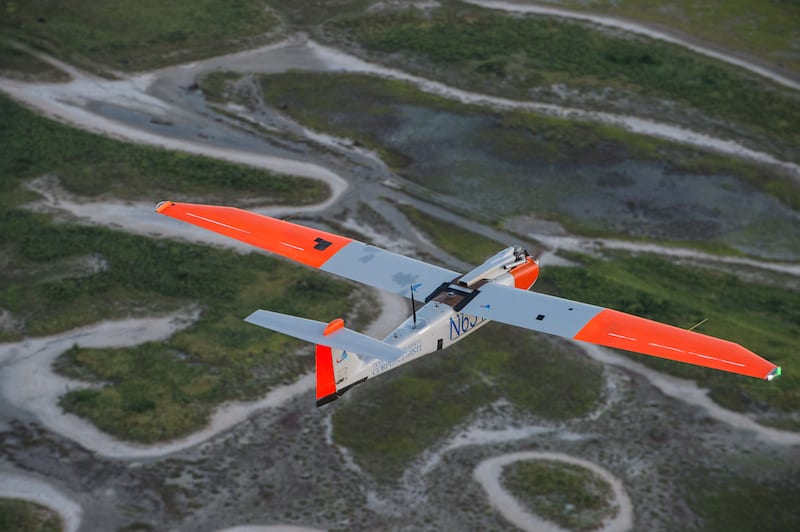 On Thursday, the drone flew over the Gulf of Mexico and the Laguna Madre, while Dr. Paul Zimba, Director of the Center for Coastal Studies at A&M-Corpus Christi, and his crew of student researchers were at the water’s edge to see how drone-collected imagery compared with shoreline surveys traditionally used to determine property lines. This research seeks to further define a hot topic in Texas, determining the exact line between private and state land in property disputes.
Using RPA data can expand the scope of what his crew of five is able to do, he noted.
“We could map 18 miles of the beach using the UAS,” he said. “We couldn’t do that on the ground without an army of 10 crews working simultaneously!”
Zimba’s crew visually inspected the algae lines and collected biological samples to determine if there are specific algae that can be used to indicate the high water line, a key marker in figuring the property line. The drone captured images of the same area, and a larger area, allowing Zimba to later compare if that data is equally as accurate as a ground survey.
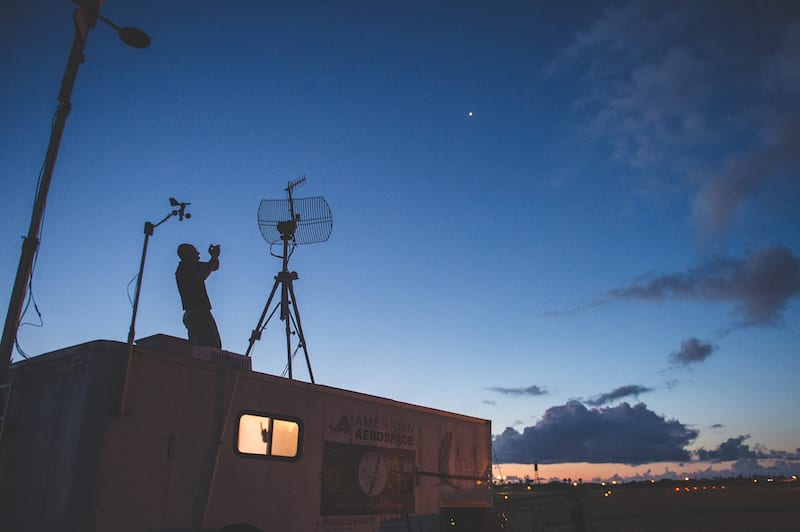 Students from the Geographic Information Science and Geospatial Surveying Engineering Program also took measurements along the Gulf shoreline and of the dune height for comparison with aerial data collected from the RS-16.
“The capabilities of UAS are particularly relevant with hurricane season upon us. Imagine being able to send a swarm of UAVs to map a coastal community hours before an approaching storm and immediately after impact,” said Dr. Michael Starek, Assistant Professor of Geospatial Surveying Engineering. “We could rapidly assess damages to guide rescue and repair efforts, even allowing crews to be sent right away as opposed to hours or days delay. In hurricane response scenarios where time is of the essence, this is critical information to help mitigate loss of life and property.”
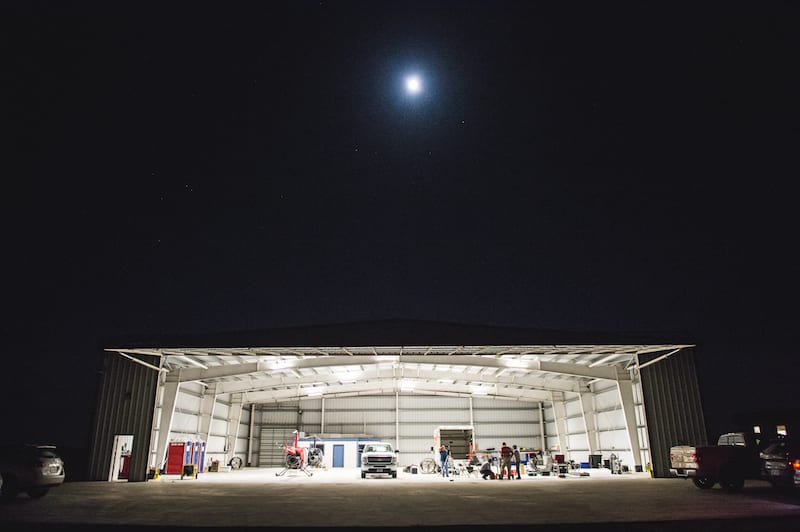 The Lone Star UAS Center will report the results of the latest tests to the FAA as part of its duties as a federal test site. The tests are designed to safely integrate RPA into the national airspace, including air traffic control and communications, developing protocols for dealing with runways in use by piloted craft and ensuring air traffic control communications between the RPA and Mission Control Center.