

Dino Karagozian, a Bonanza owner, fulfilled a dream in 2011 when he flew his 1964 Bonanza from Buenos Aires, Argentina, to Fairbanks, Alaska, over 35 days.
Joining him on the trip was Juan Carlos Bisi, also known as JB, a professional pilot.
Dino put together a daily report on his adventure, as well as took many photos.
We’re running his report in three separate installments. (Read Part I and Part II). This installment follows the travelers home from Alaska, including a stop at the Grand Canyon and a visit to the Beechcraft factory in Wichita.
Day 25: Sunday Aug. 7, 2011
Dan, George’s cousin, came on time to the blind date at our hotel. He would be our non-rented guide to go and see Vancouver.
In our modernized Cadillac we rented, we travel there. It is very close, but you have to cross the border. This is quite simple, but sometimes there are queues.
Imagine the toll stations on the freeways. Here are the controls to enter Canada. One lowers the window of the car, stretches the hand with the passport, passes the questioner on the turn, he looks at you, verifies that you are the same person in the passport or similar and, if everything is okay, lets you pass.
With this procedure you are inside Canada (to leave U.S.A do not do anything).
Then the turn is the other way round, but it is the Customs and Border Protection officer of U.S.A that controls your entry. Canada does not control you.
Everything was very fast, but it can take a long time if there are queues.
Dan, who turned out to be a nice guy, was very clear about where to go.
We arrived about 11 a.m. to Vancouver. It is large, clean and tidy. We went to the coast and walked around. What struck me most was looking at the water. There were boats, boats, boats, ferries, sailboats, people paddling and planes. In 10 minutes, we must have seen 10 planes taking off and landing.
What struck me the most? That all shared the same space without any problem and with absolute normality in what seemed a complete chaos for the observer with third world experience like us.
In this place there were two airlines with many large hydroplanes (even Twin Otters). It seems that here when you need to go from place to place, you go sailing or flying.
As noon passed the automotive traffic became more unbearable. After looking for an alternative to the road that we wanted to follow to get to know a little more, we checked the way back to our place in Bellingham. So it was that we escaped the Vancouver Sunday traffic.
We returned to our Hampton Inn, and again checked in. We had checked out that morning because in the afternoon we planned to go to Boeing Field near Seattle. During the day JB and I decided to fly direct to San Jose, near San Francisco in California, where George lives to visit. We will do that tomorrow very early.
Tomorrow we will meet the sky on the side of the coast of Washington and California (to San Francisco) and fly with the Pacific Ocean under the wings.
Day 26: Monday, Aug. 8, 2011
I’m already starting to think seriously about the return and missing my family a lot more. However the trip is still spectacular and I would not change anything. And there are still some places we want to go.
Today we fly from Bellingham (KBLI) to San Jose (KSJC) in California. It is 740 nautical miles and we estimate about five hours non-stop (piece of cake).
San Jose is southeast and very close to San Francisco. We came here to greet George Deeter, who helped me with part of the trip planning well before actually starting it. He also accompanied us via the Internet and Skype as a logistical aid and gave us many suggestions, which have all been very successful.
In some places they charge money for parking the plane. In Bellingham they charge $5 a night. How do I pay? They leave you a small yellow envelope and inside you put what you should and you have to put it in a mailbox and you’re done. No idea what to do if you want a receipt for payment. But someone has to be trusted!
The suggestions of the FSS and the tower when we took off was not to make this a visual flight (VFR) but to do it IFR. With the data that we had, we decided to do it VFR. In the case that we needed to, we would change to IFR in flight.
We have noticed that in U.S.A they are very conservative with the weather and the suggestions they make. Obviously this is perfect and so avoids many accidents or unintentional suicides.
We took off towards the sea and were immediately flying over the water again … and I’m getting used to it!
As we climbed we crossed a thin layer of clouds about 700 feet thick and flew VFR “on top.” For a long time that would be what we would see as landscape, that is clouds below and unpolluted sky above (I always wanted to write the word “unpolluted”).
To our left, and far away, sometimes mountains rose above the clouds. Impeccable. It looked like an advertisement from PhotoShop.
Seattle was on our way and we skirted the city to avoid the more congested traffic zone. From the air, Seattle is very beautiful. Unique landscapes and also there are giant companies located in this area, Boeing for example. I’m sure it’s very pretty, that’s what they told us. But I cannot tell you anything because all places are the same when you look down and only see clouds, however beautiful they are. We will have to believe.
We fly to different heights. First 5,500, then 6,500 and later 7,500 feet. Speed 150 kts, little more. Very even the whole flight. At no time did we fly on instruments, except when we crossed the cloud layer and it was only for two or three minutes.
The flight was the most serene, the clouds rarely opened below us so there was not much that we could visually enjoy “by the coast.”
Every so often we found a hole and there we saw the Californian coasts with their beaches and the entire Pacific Ocean to our right. I say this because both in Alaska and in Canada, the whole sea is between the fjords, straits and mountains and, where we were, it was all very different. There was no “great sea” that turned out to be the Pacific Ocean in all its breadth and immensity as here.
At one point we measured the distance and calculated the time that would take us to reach Hawaii. It was only 14 hours! No. For now, I will not go there.
Arriving in San Francisco we got below the clouds and we flew first with 1,000 feet, then with 700 and not to get into the clouds we went down a little more, 500 feet.
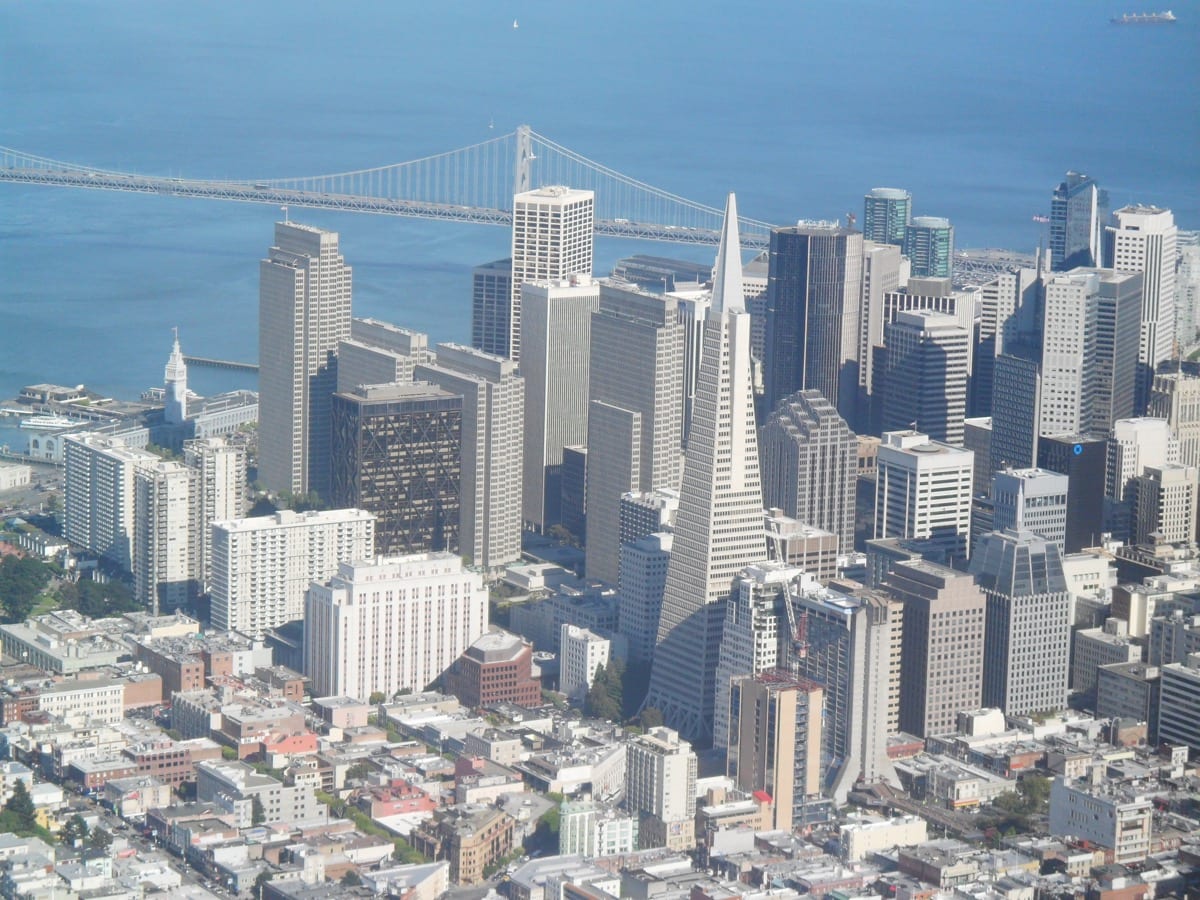
The San Francisco area is hyper-congested with aircraft and many are full of passengers. There is a “visual corridor” in which you can fly less than 2,100 feet and you are authorized without problem. We were at 500 and in legal form.
Arriving at the height of the Golden Gate Bridge was something we were sure would hit us. Another milestone in this trip. Not every day you fly your plane through such famous places.
We followed the sea parallel to the coast, following this visual corridor and we ascended a little to pass over small mountains that were the ones that did not really let pass the clouds inland. As soon as we passed these mountains, there was no shade and the temperature even raised slightly.
We landed in San Jose at a very important airport (three parallel landing strips) and left our continental trans ship at Atlantic Aviation and there waiting for us was George. It was very good to greet him, after so many conversations by mail and Skype. The last time I saw him, it was at my house about six weeks ago.
In this city are the big companies: Google, Apple, and Oracle. There’s a lot of money in this place. All these corporations also have large machines to get where they want to go. The Google hangars are more than impressive.
We went for lunch and then to fly again in George’s Bonanza. But this time we saw something crazy. We flew first on the vertical of the impressive San Francisco International Airport while taking off two planes at the same time on two parallel lanes, then over the entire city of San Francisco as only a local pilot can do.
We did it at 1,500 feet, and above the buildings that in themselves are soaring.
We did a couple of laps through Alcatraz and the Golden Gate, which by this time was already super clear and the small clouds that had filtered the image to us, had already disappeared. It was unique. Very exciting.
Day 27: Tuesday, Aug. 9, 2011
George made us wake up early to meet his pilot friends at breakfast. They meet once a week, between 7:30 a.m. and 9 p.m. Some are relatively young and some quite mature. We met a man of 96 years named Gerald Mahan. This person, who still drives his car and says that the last time he flew was two years ago, was a pilot of those huge hydroplanes of Pan Am. He knew Argentina very well since he had been many times to our country.
In the afternoon he invited us to his house and showed us a DVD with part of the history of Pan Am and the flying boats of the company. I was impressed by his lucidity and the good humor of this man, who lived in a house up a hill with a privileged view, with his lady much younger than him. She is only 90 years old.
He told us several stories. This person, if made of wood, aluminum or clad in cloth, would today be in a museum, as he is part of the history of aviation itself.
Among other things, he told us that he was in Buenos Aires when France was liberated from the Germans and still remembers how many people there were in the “France Square” celebrating.
Later George walked us through several places. Among them a large forest of giant sequoias and the beach in a place called Santa Cruz.
We could verify that in these places the climate is very benign, and it seems that this is the whole year.
Tomorrow our intention is to leave very early for the Grand Canyon. To get there, we fly over Las Vegas!
I get anxious on the days when I do not fly.
Day 28: Wednesday, Aug. 10, 2011
George picked us up at the hotel at 7:30 a.m. to take us to the airport. Today we will fly to Grand Canyon. This part of the route replaces the one we were going to do to Los Angeles, Torrance more precisely. The idea was to visit the Robinson helicopter factory. We would also test the R66, which is the new turbine development. JB suggested the alternative to fly to the Grand Canyon and I found it formidable!
We will have to pass up to the mountains of Sierras Nevadas (if you want to see them really snowy, come here, but in winter!) And some are very high, so we will ascend to 11,500 feet. The day is exceptional to do so and we are leaving at the best time. As we cross, the heights of the hills are between 8,000 and 12,000 feet.
The flight began very serene and our speed was optimum, the humid winds of the sea benefited us.
As usual in the ship, breakfast consisted of cereal bars, the ones that are so dry that they dehydrate you inside.
These mountains frighten me much less when I fly them than when I studied them in letters or GPS. They are tall, very tall. Of course, it is mainly because there was no turbulence at any time, not even slight. These hillsides have relatively soft reliefs and the whole area is high.
You may also see them more “friendly” after flying through Alaska and Canada.
Finally, this is also relative, the whole area looked very dry. After crossing the mountains, the plateau was flat with some movement, but very dry. It really was desert. However, every now and then there appeared some people, totally detached from the landscape.
Our ride to the Grand Canyon took us through the vertical of Las Vegas.
That, nothing more. We did not go down and we had no interest in doing so. From the top to 11,500 feet there is not much I can tell you, except it is very large and it is true what they say, it is in the middle of the desert. How awesome all that can be done with the silver that people lose!
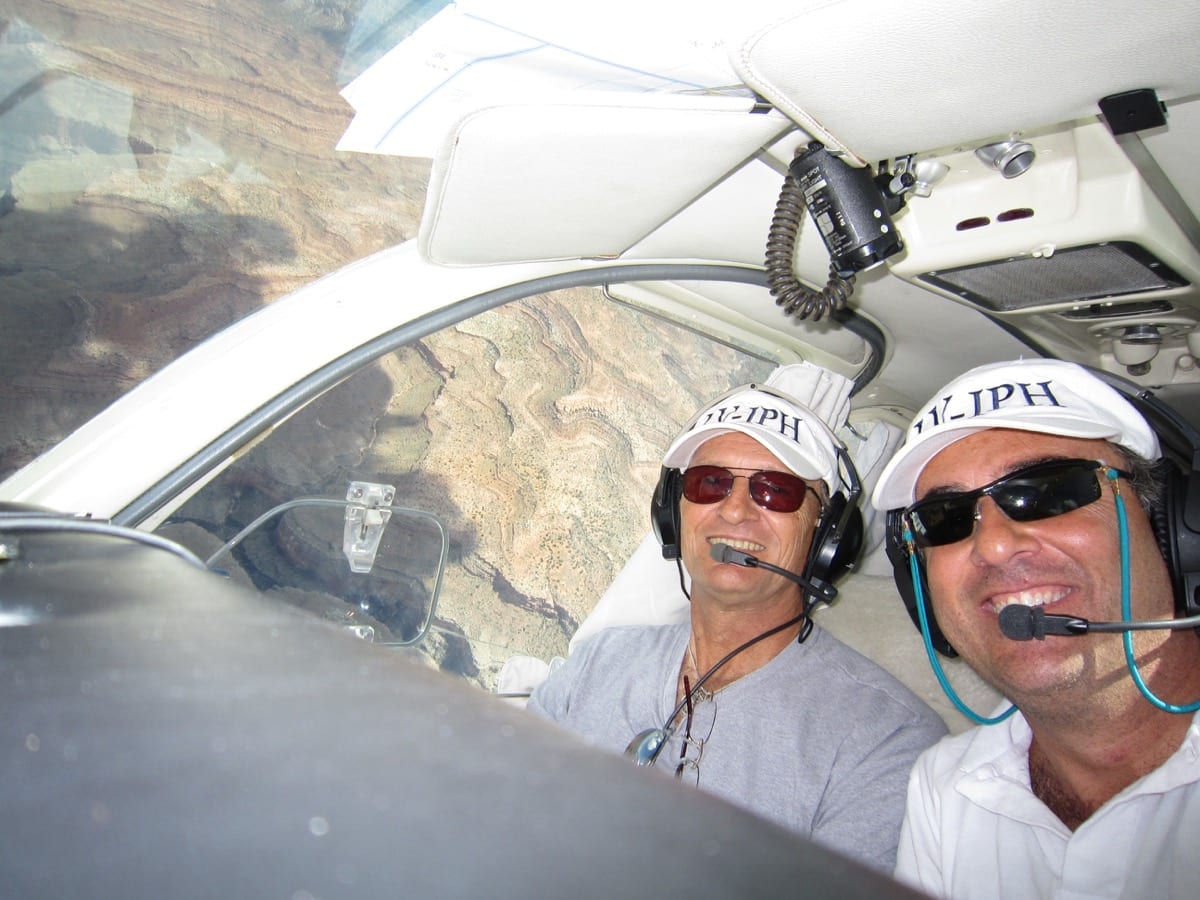
Getting to the Grand Canyon was awesome. To fly it, something sublime. I knew it was something fabulous, but not of this dimension. Somehow it’s like looking into the interior of the planet.
And also to be able to fly it with your own airplane, practically where one wants. There are certain rules that have to be respected, such as heights and meanings of the route, because there are many airplanes and helicopters that run with passengers.
It is one of the reasons so many pilots fly. We have the privilege of seeing part of the planet from another place.
As I told my friends when they asked me why my plan was to fly so far in such a short time. The answer is that I wanted to see part of America in “3D.” And that’s what we’re doing.
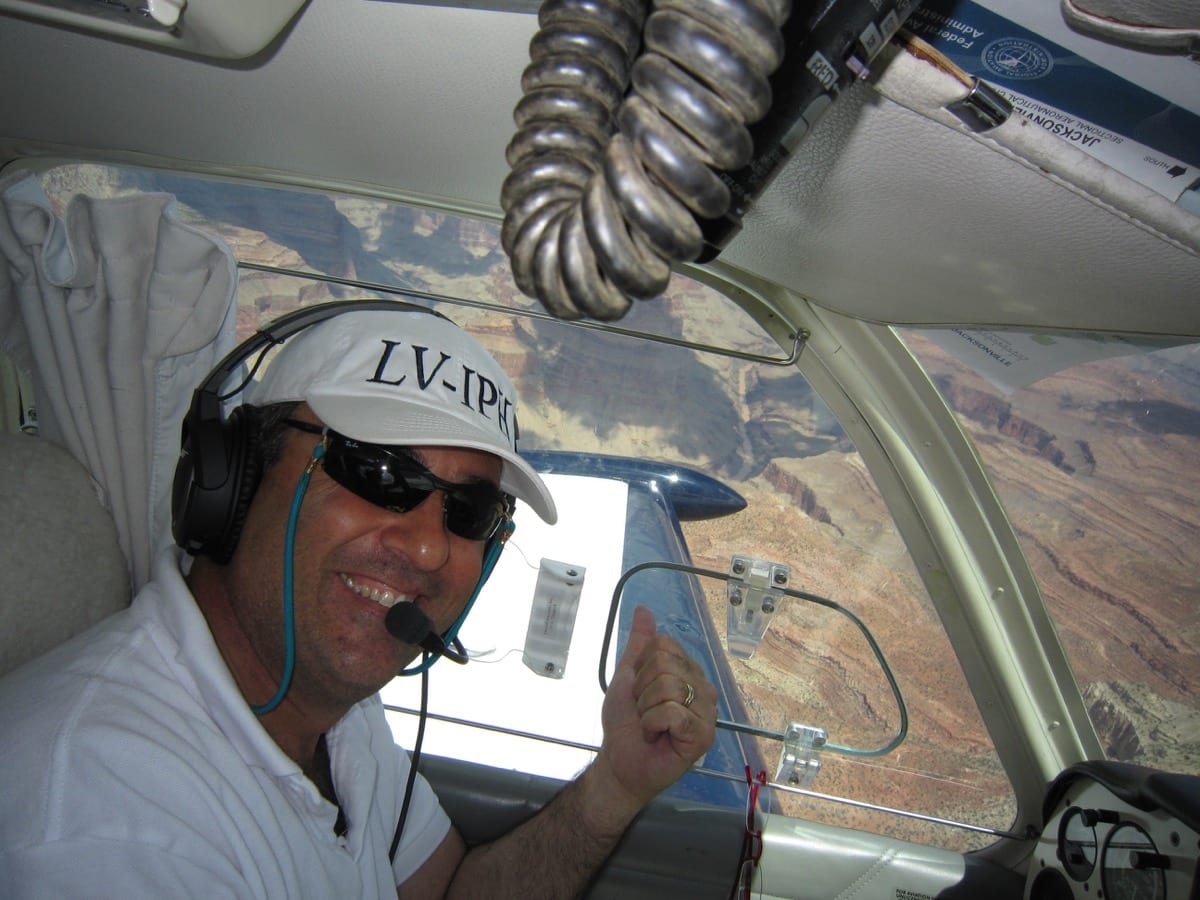
Flying over the Canyon, we were not satisfied with the four hands we put together. We took pictures, we filmed, we flew the plane, we went around and around and around without getting tired.
Luckily, and also because we left very early, we had no turbulence, which made everything much more enjoyable. Generally in the afternoon and in summer the winds can become strong.
If someone is going to board one of those passenger planes, do it early in the morning. I know people who had a bad time and now cannot look at a postcard of the Grand Canyon without remembering the arches that produce the desire to vomit.
At some point on this tour we were approaching the airport at 6,600 feet. I had never landed in one so high.
The interesting thing about this landing was that a few meters from touching down on the pavement (and doing it smoothly, of course), the accelerator was locked (about 13 inches, for the connoisseurs) with which it could not land! The lever did not move.
I realized immediately, so I continued with the landing. It was not indicated to make an escape and here was much pavement ahead. I cut the mixture and “put” the mixture again. It turned off and on again the engine, in this way it reduced the power. The idea was to land and turn off the engine once the runway was cleared. With this “little game” we left the runway and cut the engine.
From the tower they asked us what happened and we told them. We were asked to run the plane over to the taxiway, and we did it by hand. Then came the fire truck to see what happened and asked us to run it a little more, which was done (it was a single person, there was no siren, no foam, no lights, or anything more exciting than that).
What happened? For the connoisseurs: The Bonanza has a “Vernier” type accelerator. They are those that in addition to “push” and “take out” can be “screwed up.” These have a button on the end. Inside that button is a nut, which has no braking or something like that. That nut was unscrewed and the accelerator did not move anywhere.
The solution was very simple and I fixed it in 10 minutes. Nothing had broken. Everything is fine. And the truth is that, for some reason, it was very funny.
We parked the plane where they call transient parking here and the Bonanza was alone. We tied him to the floor and I felt sorry for leaving him alone.
When we left the cabin, the noise reminded me of Vietnam movies. Helicopters were continually taking off for the Canyon. There is one company that has 23 helicopters. We saw the same thing in Juneau, Alaska.
The people that came with fuel took us to the hotel and from there we took a bus to the Grand Canyon Park. We walked along the trails and walkways that are everywhere.
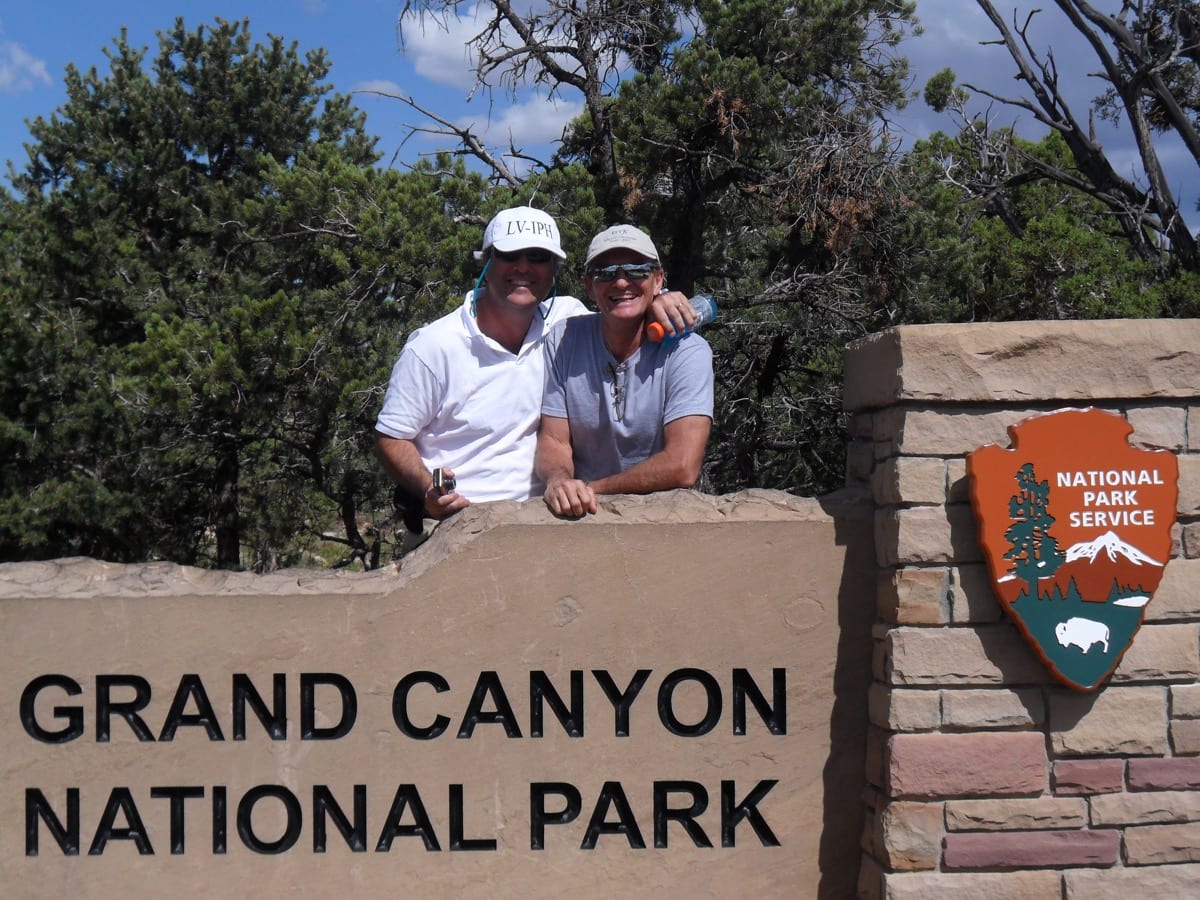
Doing this tour is just as impressive as flying it, no doubt. It is unique and beautiful. Also it they do not put limits where you are allowed to walk and where not. Not at all. Even if you want to play Superman or Astro Boy and throw yourself, you can do it. They only warn you that if you fall, you can die.
Tomorrow we have the stretch to Wichita, which is where the Beechcraft aircraft factory is. From where my Bonanza would have left 47 years ago. There’s my friend Jimmy Smith. And with him we will visit the facilities. We will fly about 730 nautical miles (five hours).
Day 29: Thursday, Aug. 11, 2011
The hotel cost us as if we had slept suspended from the Grand Canyon by Claudia Schiffer (at her best).
It was very close to the airport and we came to find a “van,” managed by Gustavo who works at the service station and other aeronautical tasks at the airport. He took us to the plane and then we took off for Wichita at 8:25 a.m.
The sky was very clear, with a few soft cumulus.
We took off from this runway that is 6,600 feet above sea level and the maximum manifold pressure we got was 23 inches. Loaded with 422 liters of fuel, packages (including a lifeboat) and both travelers, the plane took off with much comfort. The runway is long and not hot yet. It was a nice experience.
We went straight up to 11,500 feet.
After the Grand Canyon comes a relatively flat plateau — at 6,000 feet above sea level — with some ravines and rivers bowed and enchanted. It is very striking because of the depth of the walls of these water lines, besides everything is very desert and immensely large. It seems that it has not rained in these places since the universal flood.
However, further to the east, there were some circular irrigation fields that called attention to the color changes, although these did not even look like shrubs, not even in the yellowish desert context.
At some point we climbed to 13,500 feet. A while ago I had connected my nose to the oxygen tube to awaken me for a while. We ascended because we had to pass through the Rocky Mountains. Also by the area we were flying, the time of day and temperature started to have some slight turbulence.
Do you remember that I told you about the sexy and circular movement of the Bonanza with “V” tail? This becomes more noticeable when there is some “movement” in the air.
At this point the manifold pressure was only 18 inches, the consumption of 40 liters hour (against 53) and the nose attitude was almost 5° above the horizon.
As we approached the mountains, the ascendants and soft descendants began. As we had the “hold altitude” connected to the autopilot, the speed of the airplane increased when the ascendant came (here the plane is “low” to maintain the same altitude, it does it inside the rising airstream) and decreased when we got in the descending (here the plane “goes up” to maintain the same altitude and it does it inside the stream of air that goes down).
After the high mountains we went back down to 11,500 feet. The air was very serene again and our speed increased to 150 knots, aided by a tailwind.
From the air, I texted Jimmy and told him about our arrival. We landed after several hours of flight and feel the heat that we suffered at the beginning of the trip, as a sample of what is to come later and to the south, in this our journey. It will be so until at least Iguazu Falls.
It was nice to find Jimmy after several weeks of not seeing him and it is always especially nice to meet good friends abroad. He drove us to the hotel and then to FlightSafety. This place is a great center of instruction and training with lots of simulators. Courses can cost up to $25,000, depending on the type of airplane and whether the course is “initial” or “recurrent.” Looks like NASA. Worth every dollar of what they charge.
We are also getting closer to our own time zone. For example today we are only two hours apart from our legal address. This makes it easier to communicate with our families. It means that when I see, on Skype, that Alison, Fran or Meli are tired and sleepy, I am too. With six hours of difference this does not happen!
Tomorrow at nine we will have a tour inside the factory where the Bonanza was born.
If the plane demonstrated his warm emotions, he would spend the night crying. From here it came out 47 years ago and it is the first time it returns.
Day 30: Friday, Aug. 12, 2011
Some clients of Jimmy, Brazilians residing in Paraguay, Jimmy and JB and I arrived at nine in the morning to the Beechcraft factory.
This would be a guided tour of the aircraft production plants. Then the Brazilians would take their new Bonanza and fly it to Paraguay.
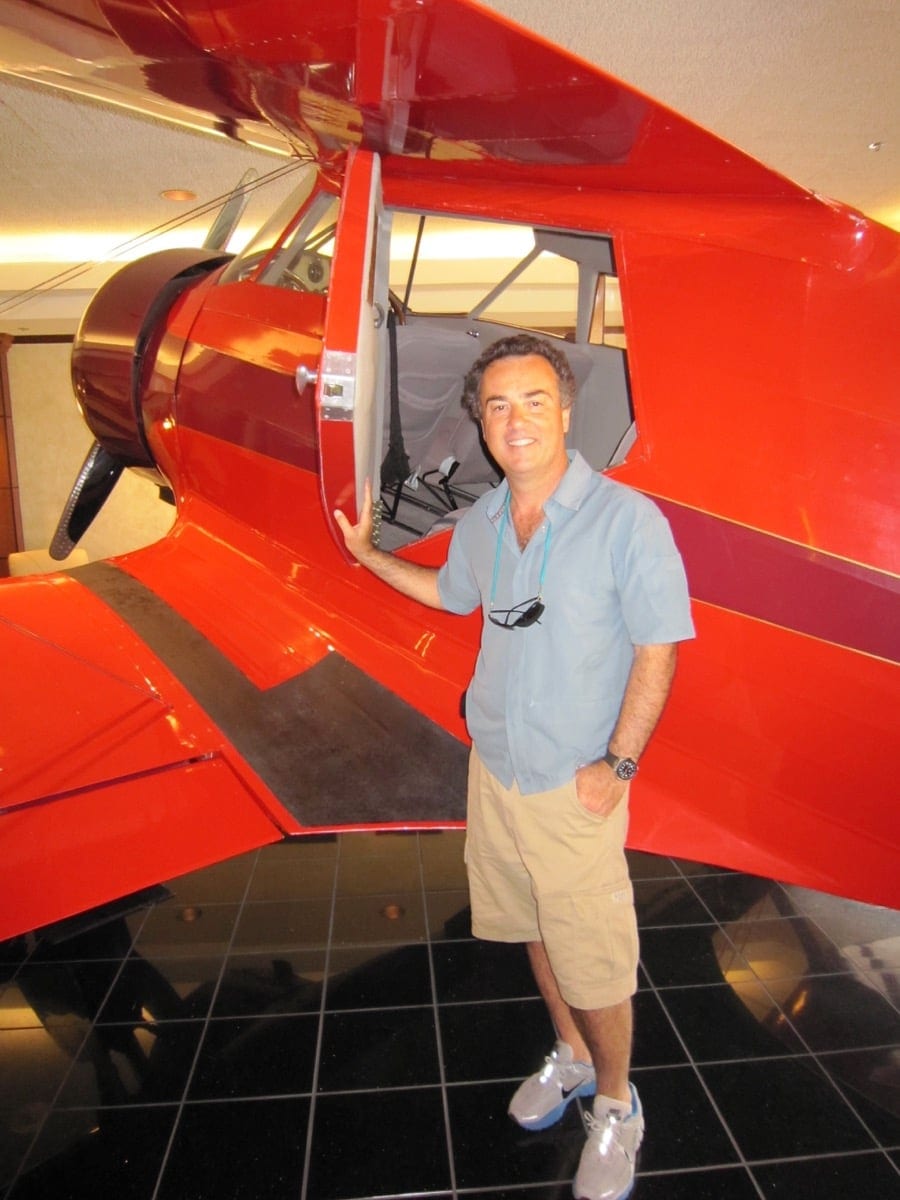
The tour was spectacular and instructive for me. Still almost everything is made by hand. In the plants men and women work with all kinds of tools.
Unfortunately there were areas where there was not much activity because of the low demand that certain aircraft have because of the economic situation.
Our guide was John. A retired man who joined the firm in 1963 and now does this job he loves.
After the mini-tour industry, Jimmy took us to Jabara airport, where our vintage plane had to take us home.
It was very hot and close, but at the side of our route, there was a big active storm that was getting bigger. It was not a problem if we strayed a little to the right, and that we did. The rest was free of clouds. These storms are normal for these areas at this time of year and further south, towards Florida as well.
The enormous amount of crosses that marked the Stormscope I had never seen. But again this was to our left. We also saw it on the GPS (do not come to the USA without one of these!)
Our final destination today would be Fort Lauderdale, but with an intermediate stop in Greenville, Alabama, to fill the fuel tanks.
We fly to 9,500 feet, always free of clouds. The air was tame and quiet. At a certain moment of the flight, I took a nice one-hour nap. And I rested.
We flew over the Mississippi River, but that was a little while before I woke up … I guess it was wonderful. I could see a lot of other rivers that seem to meet the other.
The whole area is very green with well-worked fields. Then the vegetation became very bushy and we were too high to see what it was.
Our speed was very good and varied between 150 and 170 knots.
On the satellite weather page we saw that Florida had electrical activity everywhere. It seemed that bypassing in zigzag formations we could make it. The subject was the arrival time. We were landing past five at this place and then we had three hours left. We had the option of staying around, but we thought we could make it to our destination.
Anyway around the area there are more airports than McDonald’s and freedom to choose was what we had. Or is not this the country of “freedom”?
While we were studying the GPS situation, we were struck by the fact that the cumulus nimbus cells had different, even opposite, senses being very close to each other. It seemed that they played “La Calesita” between them.
Getting to the first stop took us until 4:05 p.m.
It turned out that there was no one in this place. Absolutely no one. There were hangars, closed. A yellow fumigating airplane with wheels in rim and abandoned. And a little wooden house. There we just parked the plane. Of course, there was WiFi!
JB approached the entrance and read a sign that said it closed at 4:30 p.m. and a few phone numbers. He called one of the numbers and they told us that in less than an hour they would be with us. We evaluated whether to go to another airport, but decided to stay.
At some point people came and we used the fuel ourselves. We paid and left. And the gentleman, very kindly, gave us a discount, which I think was due to the “waiting.” So far, so good.
At 6 p.m. we take off to the city that saw us enter the USA. This meant that our arrival time would be past 9 p.m. and at that time it is night time here. This is not Alaska where there is light until 11:30 p.m.
We went in search of 9,500 feet where we got 165 knots.
When we flew over the coast, from our heights, we took some photos of the sunset and the west coast of Florida. That’s where the curve turns to the west.
The flight continued very serene and was a pleasure. Before we got to Tampa, JB opened an instrument plan to make our arrival in Florida easier. Storms were on the left for more than 30 miles and the lightning show was starting (at night they look better and the light it produces is “repeated” in the rest of the clouds).
After passing Tampa we lined up to our destination, but zigzagged to avoid the zones with cells. Despite being night, these stormy cells were quite visible by the moon, lightning, Stormscope and GPS. Where these storms were not, there were no clouds and the moonlight lit the way. Except for a few seconds, we never got into clouds. And there we had to turn off the strobe lights, because our light was reflected in the clouds (it is like a white flash that turns on and off all the time) and this bothers and confuses a lot.
Control took us towards the end of Runway 8 and we made an instrument landing but in totally serene and visual conditions.
We arrived at Banyan at the Fort Lauderdale Airport, very happy because it was so much fun. It is the first place we “repeat” throughout the trip.

Tomorrow we’ll see what we can do, but we do not fly.
On Sunday we will do it a lot. We will cross the Caribbean through the air, to Grenada.
Day 31: Saturday, Aug. 13, 2011
We spent the night in the same hotel from a few days ago when we passed through here. Later we went to Banyan to see airplane themes and did some shopping for the Bonanza. We had lunch there.
The idea for tomorrow is to reach Grenada with a stopover. We are flying around 10:30 am and 1,500 nm.
Day 32: Sunday, Aug. 14, 2011
Just a month ago we took off from San Fernando to Alaska, this day we will do from Fort Lauderdale to Punta Cana in Santo Domingo (MDPC), but as a stopover. We want to get to Grenada and spend the night to continue to the south. The flight will be very long, about 10:30 hours (1,509 nm, about 2,700 km).
Before 9 a.m. we were in the air.
We ascended to 9,500 feet. (154 kts and then 145 kts). After the Bahamas we had to go down through clouds and rain. We flew zigzag to evade formations and we hardly got into any other clouds. Then the star landscape opened up, with isolated Caribbean rains. We were already flying between 1,500 and 2,500 feet above the water.

After 5:50 hours of flight (829 nm) we landed in Punta Cana, just to eat a sandwich and get fuel. Throughout the trip, this was the only place someone asked for the pilot’s authorization. No other country or airport did. And the person who asked us (he took a photocopy) was not actually from a public office, but from a private place. I have no idea why.
The people seemed quite friendly, but we did not stay long enough to make sure. When we were ready, we flew on to Grenada.
We went straight to 11,500 feet, but our speed was very poor (135 kts). During the cruise, we talked with each other about the possibility of landing and staying overnight in Martinique (TFFF). It is an island that is an hour before Grenada. We were late and did not want to fly at night over the water. It is very beautiful if everything is going well. If something goes wrong it can be the worst nightmare and this nightmare would be nocturnal.
So we did. It was on our same course, so it was all easy. We’ll let the control know, and that’s it.
The sky was pleasantly calm. For the first time in the whole flight since we left a month ago I put music on to listen. Not because I was bored, but because I wanted to try some headphones I bought in Florida. Meli had also made me a special playlist for me.
Forty-five minutes before arriving, it was night time and it was a sight to fly through the Caribbean and watch the sun exit over the Atlantic.
The landing was very beautiful. This airport is big and is one that you want to avoid…for administrative and other little fun activities.
On this island I discovered that my partner, besides speaking Portuguese and English, also speaks French.
We ate at the hotel, exhausted and happy. Very happy. As a detail of color: In the hotel restaurant we were the only ones with different skin color.
When we got up from the table, a native asked me in French if we were pilots. I told him yes. Then he told me that he noticed the shirt I was wearing (a Banyan gift). He was the person who was supposed to have fetched us at the airport. He apologized for not being there when we arrived and offered to stop by the hotel in the morning and take us to the airport and help us with what we need. Amazing. Just what we needed. We have a new best friend in Martinique.
Day 33: Monday, Aug. 15, 2011
Our new friend was very punctual and took us quickly to the airfield.
First we went to see the weather forecast and saw on the monitors a large tropical storm that would attack the island in a couple of hours.
What I saw on those screens, I did not like anything. I did not like the guys’ faces when they looked at the screens. They told us that we had an hour to go out and that probably that storm would stay on the island for two days.
We still had paperwork to do. This is not USA, where you go up and no one stops you and no one checks you and when you leave they wish you a good day.
About what was coming: JB obviously did not feel the same as I and we decided not to waste another minute. It is in these moments where one appreciates the new best friends like the one that we have now (I still do not know his name) because he took us back and forth through this very large airport that has all the offices scattered and our plane on the other side.
Finally we arrived at our Bonanza and we gave him money to pay the landing fees. I asked him how much I owe him for his services, and he told me that I owed him nothing.
We took off at 7:30 am, despite everything and our bow pointed to Grenada to cross Venezuela and arrive at Boa Vista to make the entrance to Brazil.
As soon as we took off, we looked east (from where the great storm came) and it was horrible. Very ugly. For the other side (the west) it was spotless and clear (like a good picnic day on the beach with the kids). Where we were going was good, so I calmed down a lot.
As we looked forward to the horizon, (we were at 9,500 feet) the clouds looked like a cotton swatch carpet. When we made it down, we saw these clouds all separated from each other without touching. It did not look like they were “arming” anything and had no vertical formation. They were just down there, easy.
We arrived at the Venezuelan coast after two hours flying. We were already in South America.
Crossing Venezuela took us an hour, and just a few minutes we flew over Guyana.
As we entered Brazil, the cumuli were rising and if we kept our eyes on them for a little while, we watched them grow and grow. It was beautiful and there was no risk. It is normal in the area and it is also the time where this happens.
As we approached Boa Vista, I already felt that the whole trip was far behind and, I began to miss all that hyperactivity of these days and at the same time (and above all) I was very happy to be returning with mine.
We landed after 4:40 hours of flight (715nm). Here we would do customs, migrations, and receive papers and above all waste time. Long time. Several people here are useless. It is ugly, but it is my point of view (I will try not to complain about the people of San Fernando, as before.This seems much worse!).
For example: They charge you for the landing (not cheap, but it does not matter). I stayed almost 20 minutes just to make the bill. I counted 12 stamps plus eight signatures (plus two signatures of mine!). I do not know how many copies he made. At this rate they will soon end up with all the Amazon trees.
The customs guy went to lunch, and he came back when he wanted to. We were there three hours!
Finally they let us take off towards Manaus.
We headed straight to 10,500 feet where no air conditioning was needed.
Now the formations were huge, but isolated and not frightening. Neither did they have electric shocks. You could tell that we were in the Amazon area, it’s different.
We flew only 2:40 hours to reach Manaus.
Tomorrow we will fly to Cuaiba, there we want to do customs (departure) and fly to Iguazú Falls in Misiones.
So far of the 10 points that I thought the trip would be, I catalog it 11 points. So far, so (very) good!
Day 34: Tuesday, Aug. 16, 2011
Very punctual at 7:30 a.m. we had the wheels in the air, we fled Manaus with its high temperatures and we headed straight to Cuiabá (SBCY), where we would leave for Argentina. From there we want to go to Iguazu Falls today.
To escape the heat, we headed straight for 11,500 feet. Our course will be south. The sky was clear and the speed 145 to 155 kts.
The landscape was still the same as when we flew north a month ago. Amazon rainforest and few places to make a forced landing. These are also very strong and intense landscapes.

In a moment I closed my eyes to sleep a little and I still saw clouds and sky in my mind. I thought then that despite so many flying hours in a single month I was not tired of flying and I still enjoyed it. Maybe I can be a bit tired of changing hotels so much (I did not count them yet, but I calculate more than 20).
I could not sleep, I think I’m anxious for the return.
In Cuiabá we were served by a pleasant temperature of 37°C that felt like 57. We loaded fuel and made the respective formalities and payments. We could not do customs or migrations to leave. So we cannot spend the night in Iguazu Falls, but it will be in Foz de Iguazú where we will sleep.
Tomorrow will be the day we return to our reality that we left behind for just over a month.
We got six ice packs and put them in a portable air conditioner for airplanes I bought in the USA. It works great and blows cold air for a couple of hours. Enough to reach the altitude where the air cools, disconnect it above and then go down (with the equipment connected) to ground.
We took off for Foz then. Happy because everything was going as planned.
The climb was very difficult for the Bonanza. The heat and weight of the plane (including the six bags of ice) made it very difficult to climb. I’ve never seen him like this. At one point it had an indicated speed of 100 kts, the airplane nose 6° above and zero vertical speed. And I was not on a descending!
We had to go up like stairs. Leveling the nose. Increasing speed, then climbing until you reach the chosen level.
The idea was to go to 10,500 feet, but leveled to 8,500 until we consumed about 50 liters of fuel, which allowed us to continue climbing now a little more comfortable.
We flew a few hours without clouds in the sky (there was not even shade) and we arrived very happy to Foz de Iguazú. This was at night. The landing was very nice, but on the windshield we saw (better said: we did not see) it was all very blurry. The propeller is losing grease or clear oil that stains it and during the night everything looks like it is through a filter, especially when there are exterior lights. On land we had to open the door to look out and ahead.
We chose a hotel near the airport to return home tomorrow.
We have some paperwork and four hours of flight ahead.
The last four hours of an amazing emotion.
Because flying to Alaska and returning with the Bonanza was much more than an adventure, it was an extraordinary feeling.
Day 35: Wednesday, Aug. 17, 2011
We went on the air in Foz de Iguazú in Brazil, only for a short time and a very short flight (less than 10 minutes) to Iguazu Falls, in our Argentina.
The most beautiful thing was to fly near the falls and see the cloud of water drops forming in the river fall.
From both sides we had to do numerous paperwork, always with the “happy face,” while filling up papers that are useless. In addition, a Labrador dog got into the plane and then, as if this were not enough, the customs came to inspect.
It was in the only country and in the only place that checked the plane or luggage. This did not happen in any country of all we visited.
When taking off, San Fernando was reporting a 500 foot roof and some rain, so we would probably have to open an instrumental flight plan sometime during the flight.
The sky and the weather was very nice and quiet and while we were flying it I wanted to sleep, but I could not do it. I think because of the joy of returning to my home and seeing my wife and daughters in a little while.
The sky was still clear to 210 nautical miles from San Fernando. From here a large carpet, very even with clouds, covered the earth. Above all, a serene and impeccable sky.
In San Fernando the cloud ceiling was 700 feet and visibility of 4,000 meters, so an instrument approach (DME VOR arc) would have to be made.
JB opened an IFR flight plan by radio so we could approach and land on our final destination (final!) of the trip to Alaska.
Already very close to San Fernando, in a point of notification called PAGON, they had us making several waits (one 20 minutes) and then they let us proceed with the procedure.
We made the DME arc at 10 mn and flew the radial that would take us to the 23rd head, until landing at home.
The joy was tremendous. JB and I were euphoric, very euphoric. The Bonanza was very happy too.
We rolled up to the general platform and there we saw Marcia (JB’s girlfriend), Gonzalo (JB’s son), Jorge B (JB’s brother), Alison and Fran who came to meet us and were behind the wire fence jumping and jumping from joy.
They were totally excited about our arrival. Almost as much as we were.
After spending some time with Alison, Fran and Meli (who could not come to meet me because she was studying), we went, Alison and I, to see my Dad.
It was the person I most thought of all these days. And he was the one I craved and needed to see more than anyone on my return. When I was with him, I also cried with emotion. When I returned, I could not speak for the first 20 minutes in the car. Infinite thoughts and feelings filled my mind and heart. Tears of joy kept falling.
How beautiful it is to live and with what luck I feel.
As never in life and at 48 years of age I was so excited to be with my Dad.
Some numbers
- Total days: 35 (34 nights)
- Total landings: 35 (one was “local”)
- Total hours flown: 120.9
- Total nautical miles: 17,720 (32,800 km)
- Average total speed: 147 Kts (271 km / h)
- Total fuel: 6,600 liters
- Most northern location reached: 200 kilometers from the Arctic Circle.
- More hours flown non stop: 5:55 am (KFXE to I9)
- Longest distance flown: 831 nm (1,530 km), also (KFXE to I9)
- Total dreams fulfilled: One, but very big!