

Chicago Executive Airport (KPWK), which is about 10 miles north of O’Hare International Airport, is always open — even in the snowy winter, when it’s not uncommon for up to a foot of snow to accumulate in a day.
That makes it imperative for the KPWK crew to keep the GA airport’s runways clear as airport operations demand surfaces as close to dry as possible so aircraft landing and departing can stop in the available distance when necessary.
That led officials at the airport — which sees approximately 77,000 operations every year — to spend some time figuring out how many cubic feet of snow the airport crews moved during the last big storm, which dumped about 10″ on the airport.
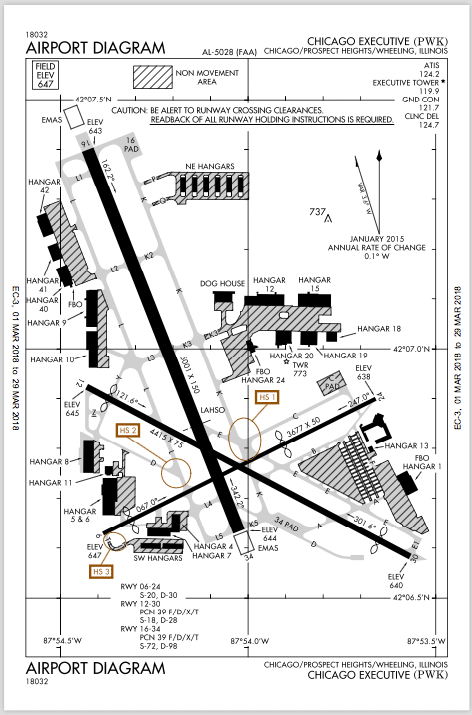 Time to pull out the airport diagram and a fully charged calculator.
“We assumed the best way to figure the problem would be by multiplying all the airport’s surfaces in need of plowing — length x width — and then by the 10″ of snow we used as our guideline,” officials said.
They note they didn’t include the ramps at the airport’s major tenants since Signature Flight Support, Priester Aviation, Atlantic Aviation, and Hawthorne Global Services take care of clearing their own ramps.
Runway 16/34, the airport’s longest landing surface is 5,001′ by x 150′, while runway 12/30 is 4,415′ by 75′.
Officials didn’t add in the airport’s shorter runway 6/24, because that surface is often not plowed to save time.
Next there are parallel taxiways “Lima” and “Kilo” that shadow runway 16/34. They are 50′ wide, as are the two taxiways that parallel Runway 12/30. Additional taxiways and crossovers, as well as ramps near the airport’s individual T-hangars and portions of the tie-downs, add approximately 1 million square feet of additional space in need of clearing.
When the snow begins, airport crews swing into action to operate removal equipment for as long as the snow continues. That might be a few hours or 24 hours a day under blizzard conditions. To make it all work, crews operate in shifts for food and rest breaks.
The airport owns quite a bit of equipment to handle plowing duties, including four Oshkosh Twin-Engine Broom trucks and two Oshkosh 20’ Plows trucks. Other snow removal equipment includes a twin-engine Idaho-Norland Snow Blower, Bob-Cat Skid with a blower, a Case Front-End Loader with a 20’ snow box and four light plow trucks.
Think You Know the Answer?
If you’re wondering how much snow airport crews cleared during the recent 10″ accumulation, you can check your math against the airport’s in the quiz below.
Which answer below is the most accurate?
Did airport crews clear:
A. 754,456 cubic feet
B. 1,964,605 cubic feet
C. 1,074,122 cubic feet
The answer is B, according to airport officials.
Approximately 1,964,605 cubic feet of snow was cleared during that most recent storm.

Officials note a more precise total is nearly impossible to calculate because crews began plowing as soon as the snow began and never really quit for two days. At times, they may have run over the same surface more than once, perhaps even four or five times during the course of the storm.
And, of course, as the snow is removed, crews can’t simply shove the white stuff along the edge like you might with your driveway, because piles of snow near the runway’s edge create a safety hazard should an aircraft ever slide off the surface. Striking even a 6″ snow bank could tear off the aircraft’s landing gear.

To put the airport’s snow problem in perspective, consider that the average commercial dump truck carries just shy of about 400 cubic feet of material. Grabbing the calculator again means just one 10″ snowfall would shove around enough of the fluffy white stuff to fill approximately 4,914 truckloads.
And when the next storm begins, whether that’s a few days or a few weeks later, airport crews begin the job of clearing the runways all over again.
Airport officials give credit to the airport crews and the airport’s tenants when they report that Chicago Executive has almost never been shut down because of the inability to clear the runways.