

Santa Ana winds tracking out of the northeast make for interesting takeoffs and landings at Santa Monica Airport (KSMO) in Southern California. Prevailing winds there are normally out of the southwest, so Runway 21 is almost always in use. Runway 3 is rarely used.
One winter day, the Santa Anas came howling down into the LA Basin from the north, somewhere in the 340° to 355° range. Not just straight-line winds either — big gusts that kept pilots on the ground grounded.
It was dangerous. All of us in the FBO knew it the moment we saw a Learjet go around, twice. My commercial instructor flying a Cessna 172 still needed to land, though, due to low fuel.

The FBO sat about 1,500′ down the threshold of Runway 3. Hearing his landing clearance, we all ran out to the taxiway to watch his attempt. The wind whipped the windsock perpendicular to the runway. It blasted us directly in our faces.
If a 19,000-pound jet couldn’t handle the crosswind, why did my instructor in his rinky-dink, one-ton Cessna think he could make it?
In he came in a crazy crab, nose pointed well left of the Runway 3 center line. Crossing the numbers, we saw the nose slide right and center up while the left wing dipped perilously. He flared in that position and touched down on the left wheel only, smack in the middle of the 1,000 yard markers.
He rode that centerline for another 500′, left wheel on, right wheel up. He looked like a stunt car driver, motoring along on two wheels. As he passed us, he eased in right aileron and let the plane down onto its right wheel. He followed with slight forward yoke pressure, gently letting the nose gear kiss the runway.
The way we whooped and hollered you’d have thought my flight instructor had single-handedly brought down Hitler’s Germany. His crosswind landing was a thing of singular beauty.
But he didn’t stop there. He taxied to the ramp using crosswind and downwind technique until engine shutdown.
“That,” he told me as he walked past to the FBO, “is called flying the airplane all the way to the tiedown spot.”
Soccer players live to score impossible goals. Baseball players live to turn the triple play. And pilots live to make the perfect, illusive crosswind landing.
All three require equal parts situational awareness, ideal conditions, perfect timing, and a high skill level. Soccer and baseball practice provides players a chance to develop these particular skills. Not so with pilots and crosswind landings.
Runways are aligned with the relative wind, to make it relatively simple for aircraft to take off and land. Some airports have multiple runways, either to accommodate high traffic flow or wind patterns, but getting permission to use a different runway from all other traffic isn’t easy.
Pilots who want to practice crosswind landings either must wait for those conditions to exist at their home airport or go on a fishing expedition. Plus, flying costs money. A pilot’s practice time is constrained by his wallet.

A Cessna 172 pilot was cleared to land on Runway 8 of an unnamed airport. Winds were from the southeast (120°) at 10 knots, gusting to 18 knots. The pilot chose to use sideslip technique on final approach to remain aligned with the runway’s extended center line. He also chose to add half the wind gust (four knots) to his airspeed for an added safety margin.
“Immediately prior to or upon touchdown of the right main, a strong gust caused the plane to turn to the right while lifting it back into the air,” wrote the pilot in his report to NASA’s Aviation Safety Reporting System.
The plane settled back onto the runway with both main landing gear. The pilot still held the plane in a crab, so the Cessna ran across the width of the runway instead of down the length of it. He tried to correct using heavy left rudder and brake, then abandoned that idea for fear of a tire blowout.
He managed to slow the plane, but not before it departed the runway. He navigated between runway lights and stopped the plane under control about eight feet into the grass. Neither the airplane nor any airport property sustained damage during this incident.
The pilot concluded his report by attributing his problems to failure to maintain control during the crosswind landing.
He wrote, “I should have better anticipated the gust from the right and used stronger left rudder and right aileron. I should have initiated a full power go-around immediately at the first indication of a wind change.”
Another pilot, also flying a rented Cessna 172, didn’t fare as well. He wrote in his report that he chose to use 10° of flaps and to touch down with the left gear — due to a left crosswind — before bringing the right wheel and nose wheel down.
The report reads like this pilot employed the same technique as my commercial CFI back at KSMO. Things quickly went awry in this case, though.
“I believe I experienced a gust from the left, which caused my tire to jump off the rim, and the rim struck the runway. The plane proceeded to balloon off the runway and then touch again, except on the rim instead of the tire,” he wrote.
I once saw a sign on a refrigerated case in an ice cream shop that read, “Please don’t tap on the glass. You’ll frighten the gelato.”
Maybe in this pilot’s case a sign in the cockpit should have read, “Please don’t land in a gusty crosswind. You’ll scare a tire off the landing gear.”
Just as it’s not possible to scare gelato, it’s improbable that the wind caused the tire to jump off its rim.
Landing wing down on the upwind wheel while maintaining runway centerline in a crosswind means putting the plane into a sideslip. Putting a plane into a sideslip means doing two contradictory things simultaneously.
On the one hand, the sideslip allows the plane to track straight down the runway and, if done properly, avoid drifting across it. On the other hand, putting a plane into a sideslip exposes more of its fuselage to the relative wind, which increases drag, which increases the aircraft’s sink rate.
The pilot sacrifices vertical control for directional control unless he arrests the increased sink rate by adding or keeping the power in.
This pilot did not indicate in his report that the airplane ever drifted across the runway.
Crosswind drift can occur with either too little rudder or too little aileron input. Instead he reported that the plane began what he referred to as a “wave” pattern.
“After striking the runway two times, the plane settled on the third,” he wrote.
The wave pattern of bouncing off the runway he described is indicative of an excessive sink rate.
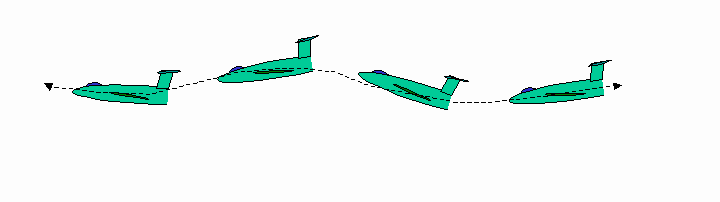
The plane lands hard, with sufficient energy to launch it back skyward. This is called a phugoid oscillation. This pattern continues until the energy dissipates and the plane finally settles on the runway — or until the aircraft breaks. If the nose gear plants first and the pilot overreacts, it’s called “porpoising.”
Landing on one wheel, with some side load pressure stemming from the crosswind, with an excessive sink rate is like skidding in a car at high speed around a tight street corner. The high speed, combined with the skid, exacerbated by the tight turn sets up a side load, sometimes causing a hubcap to depart the vehicle.
In like fashion, an excessive sink rate, combined with the side load of a sideslip, exacerbated by bouncing the full weight of the airplane onto the runway on one wheel sometimes causes a tire to separate from the rim.
Another general aviation pilot wrote about needing to perform a go-around at Chino Airport (KCNO) in California. He flew there to build time toward his commercial rating. KCNO Tower cleared him to land on Runway 26R. Tower then proceeded to vector all arrivals behind the pilot to Runway 21 due to new weather information.
“I was unable to stick the landing as the wind was gusting hard at the surface. I announced a go-around,” wrote the pilot.
He did and was subsequently vectored to Runway 21 for an uneventful landing.
A Piper Seneca pilot reported a 20° left crosswind, blowing 12 knots steady at his destination. Within limits for his PA-34, he elected to land.
He wrote in his NASA report, “A porpoising action was noted with the left wing low due to crosswind, while the aircraft drifted towards the right side of the runway.”
He then executed a go-around. His post-flight inspection revealed that the left prop had struck the runway.
Crosswind landings require finesse, situational awareness, and good judgment. The plane must be set up just right on final approach for the procedure to have a chance of going well.
Crosswind landing practice is crucial for knowing if the attempt is going well. It’s also critical for learning when to go around. It’s worth the price to practice.
