

General aviation’s efforts to reduce fatal aircraft accidents produced encouraging results in 2015, according to a new report.
The 27th Joseph T. Nall Report from the Aircraft Owners and Pilots Association (AOPA) Air Safety Institute (ASI) showed that the overall accident rate per 100,000 flight hours declined even as total flight hours increased.
Named after Joe Nall, an NTSB member who died as a passenger in an airplane accident in Caracas, Venezuela, in 1989, the annual report analyzes data from the most recent year for which at least 80% of accidents have had the probable cause determined, ASI officials note.
In 2015, the fatal accident rate fell below one fatal event per 100,000 hours. That year there were 1,173 total accidents, of which 221 were fatal, with 375 total fatalities, according to the report.
The fatal accident rate declined to 0.84 per 100,000 hours for the year. The FAA estimated flight time in 2015 of about 23.98 million flight hours, a 3.6% increase over 2014.
The decline in fatal accidents reversed a slight uptick in 2014 to 1.19 per 100,000 hours, according to the report.
“So we’re flying more and having fewer fatalities,” said Air Safety Institute Executive Director Richard McSpadden.
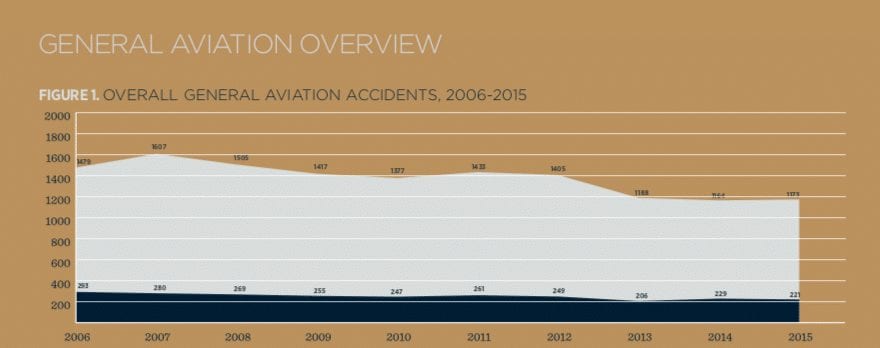
Noting that the increased flight hours likely were the reason total accidents increased by 10 from 2014 to 2015, the report was highlighted by data that appeared to confirm that the general aviation industry’s extensive outreach on safety was making its mark, ASI officials said.
“While the number of total accidents increased from 2014 to 2015, the number of fatal accidents saw a 4% decrease, down from 229 in 2014 to 221 in 2015,” the report said. “This decrease in GA fatal accidents can be attributed to numerous industry initiatives designed to reduce those accidents by 1% every year from 2008 to 2018. Meanwhile, the safety community is working to reduce accidents throughout all of GA.”
According to ASI officials, the 2015 data analyzed for the most recent Nall Report includes qualifying accidents for which the National Transportation Safety Board had determined more than 94% of probable causes. The remaining accidents were categorized based on preliminary information.
The rate of accidents and fatal accidents, not totals of the accident types, is used in data analysis because total flight activity nationwide can vary substantially from year to year, ASI officials explained.
Flight activity is estimated based on the FAA’s annual General Aviation and Part 135 Activity Survey, which tabulates aircraft activity by category and class, and purpose of flight, as well as other characteristics.
Probable Cause of Aviation Accidents
The 2015 data on accident causes confirmed that the industry’s emphasis on training is correctly focused, ASI officials said.
The data shows that pilot-related causes remain the major causes of non-commercial fixed-wing aircraft accidents, at the root of roughly 74% of total accidents and fatal accidents.
However, the 714 pilot-related accidents in 2015 reached its lowest level in 10 years, after spiking in 2014.
Mechanical-related accidents accounted for about 16% of pilot-related accidents, and 8% of fatal accidents.
Other and unknown causes accounted for 10% of accidents and 17% of fatal accidents.
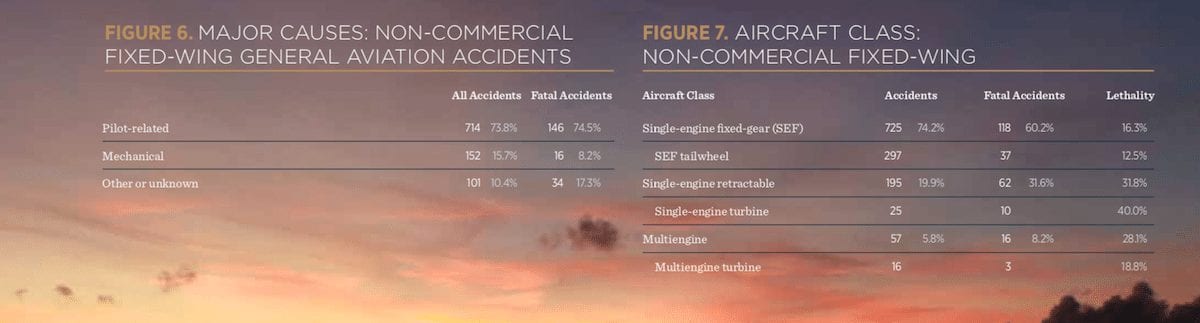
“While these numbers follow a long trend of data and appear consistent year to year, progress is being made to reduce the types of pilot- and mechanical related accidents,” the report notes.
It adds that over the past 10 years, “we can see a general downward trend from 2012 onward.”
GA Accident Scorecard
The Air Safety Institute also released the 2016-2017 GA Accident Scorecard, a brief statistical summary that supplements the Nall Report’s detailed examination of 2015 data.
It noted that for the third consecutive year, the overall GA fatal accident rate declined.
“Initial data from 2017 indicates that 2017 will reveal a fourth straight year as well,” it said.
The Air Safety Institute provides free educational resources and supports initiatives that improve general aviation safety and grow the pilot population, including online courses, in-person seminars, flight instructor renewal courses, and accident analysis.