

The 31st edition of the Aircraft Owners and Pilots Association Air Safety Institute’s Joseph T. Nall Report shows that general aviation accidents decreased in 2019.
However, the overall accident rates rose during 2019 due to a reduction in flight hours, resulting in a total accident rate of 4.88 per 100,000 hours and a fatal accident rate of 0.88 per 100,000 hours.
The report shows an improvement for non-commercial helicopter accidents, which after spiking for two years decreased slightly with the fatal accident rate declining to 0.98 and the total accident rate decreasing to 5.68.
“Another area where we see improvement is the commercial fixed-wing total accident rate, which decreased for the second year in a row,” said Robert Geske, ASI’s Manager of Aviation Safety Analysis. “The commercial fixed-wing fatal accident rate remains low and largely unchanged.”
Non-Commercial Fixed-Wing Aircraft
Non-commercial fixed-wing aircraft had 988 total accidents, of which 179 were fatal.
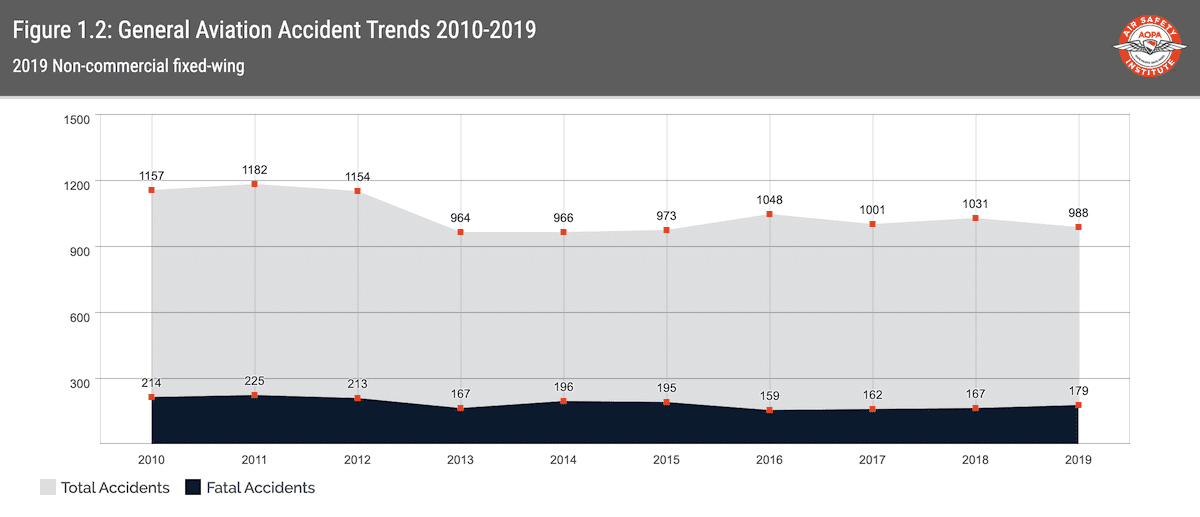
With overall accidents (988) trending downward, a decrease in flight activity for this category nudged the accident rate (5.62) upward.
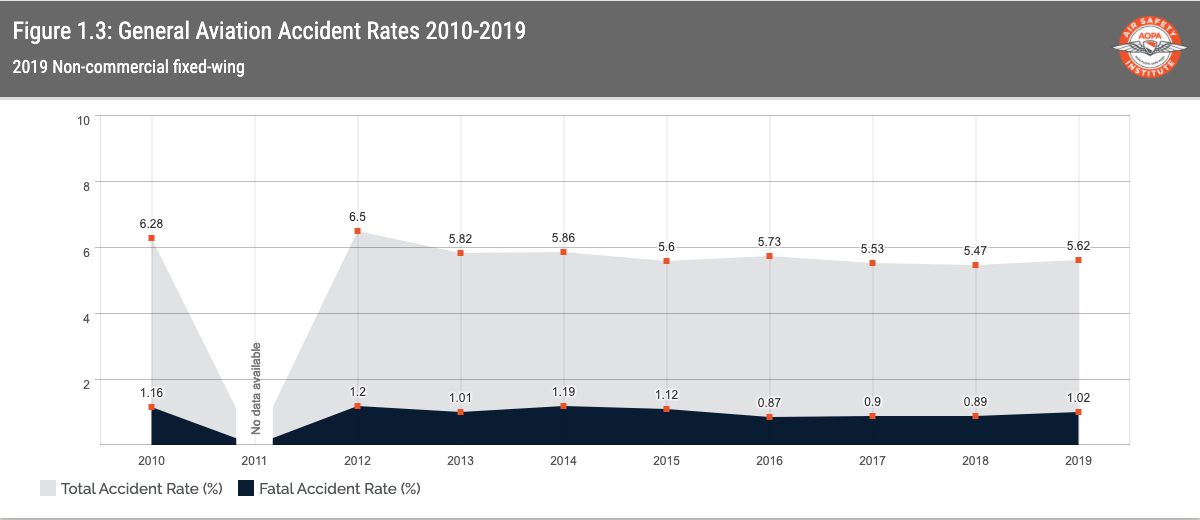
Non-commercial fixed-wing showed a slight increase in fatal accidents (179), with the fatal accident rate (1.02) rising due to the decreased flight activity.
The percentage of pilot-related accidents fell below 70%. There were 614 pilot-related accidents, of which 88 accidents were fatal.
Landing accidents accounted for the largest number (308), but suffered few fatal accidents. Loss of control (163) continued to dominate as the leading cause of landing accidents.
Takeoff and climb accidents (115) declined from the previous year. The largest number of accidents (39) were loss of control, followed by stalled or settled on takeoff (38).
Fuel management (58) dropped slightly from the previous year, with flight planning accounting for the largest total number of accidents (32).
Maneuvering accidents increased in both total (36) and fatal (20) from the previous year. Stall/LOC had 22 accidents, of which 12 were fatal.
Descent and approach accidents decreased sharply (34) while fatal accidents (11) dropped from the previous year.
Collisions (16) had the most accidents, while stalls/spins (11) lead in fatal accidents (6).
Weather accidents rose slightly in total (34) and fatal (30) accidents. VFR into IMC led the cause category with 19 accidents, of which 18 were fatal.
Mechanical increased in total accidents (194) and had a small increase in fatal accidents (15) from the previous year. Powerplant issues (132) continued its lead, followed by gear and brakes (27), and airframe (15), which accounted for the majority of mechanical accidents.
Sport/Experimental Accidents
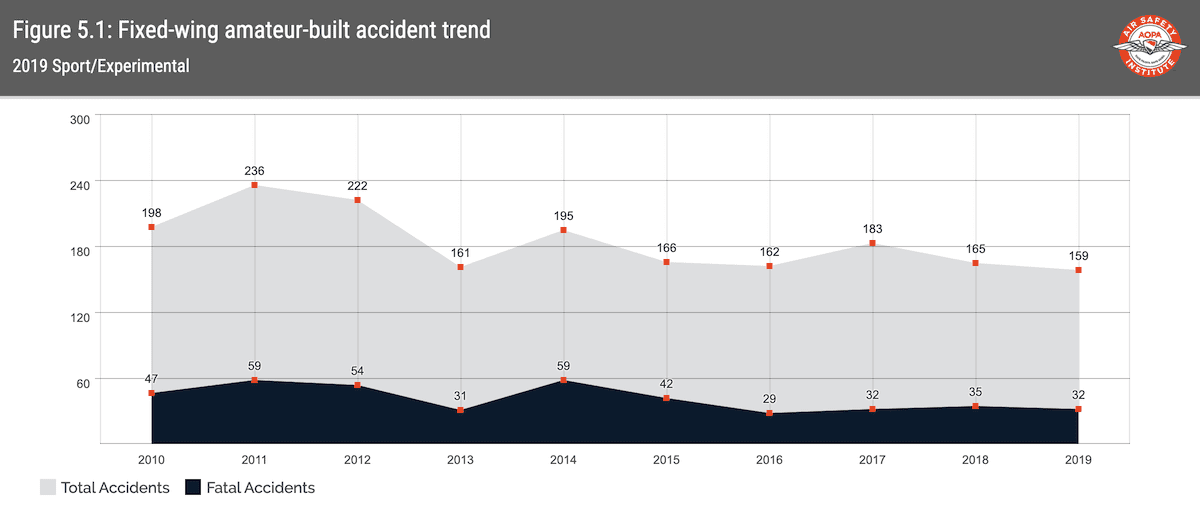
There were 159 sport/experimental accidents, 32 of which were fatal.
Commercial Fixed-Wing Accidents
There were 57 commercial fixed-wing accidents, 10 of which were fatal. The overall accident rate decreased for total accidents (1.68) but increased for fatal accidents (0.30) from the previous year.
The majority of commercial fixed-wing accidents continued to be pilot-related. Part 137 surpassed Part 135 accidents by 13 total accidents and paralleled fatal accidents with five in each part.
Non-Commercial Helicopter
There were 81 non-commercial helicopter accidents, 14 of which were fatal. The majority of accidents remained pilot-related.
The fatal accident rate declined to 0.98, while the total accident rate decreased to 5.68 per 100,000 hours.
Accidents still awaiting a final cause, not yet assigned, made up the largest category (35), while rotorcraft aerodynamics (15) continues to lead known accident categories.
Commercial Helicopter
There were 43 commercial helicopter accidents, of which nine were fatal.
The vast majority (60%) were pilot-related, followed by other/unknown (27%), and mechanical (11%).
The fatal accident rate increased for its third straight year to 0.57, while the total accident rate (2.74) rose sharply from the previous year.
Part 133 had four accidents (two were fatal), Part 135 had 14 accidents (six were fatal), and Part 137 had 25 accidents, of which one was fatal.
Want to Know More?
The Nall Report’s digital platform provides near real-time accident data. It is updated on a rolling 30-day cycle, allowing for the most current snapshot of general aviation safety performance, according to AOPA officials.
You can view the entire report, complete with charts, at AOPA.org.