

The number of general aviation accidents dropped in 2020, according to the 32nd edition of the Joseph T. Nall Report from the Aircraft Owners and Pilots Association Air Safety Institute (ASI).
The report shows a decrease in total accidents from 1,167 in 2019 to 1,051 in 2020. The 10-year average is 1,223 accidents each year.
Overall accident rates decreased from 4.87 per 100,000 flight hours to 4.69, according to the report. The fatal accident rate decreased from 0.89 in 2019 to 0.83 in 2020.
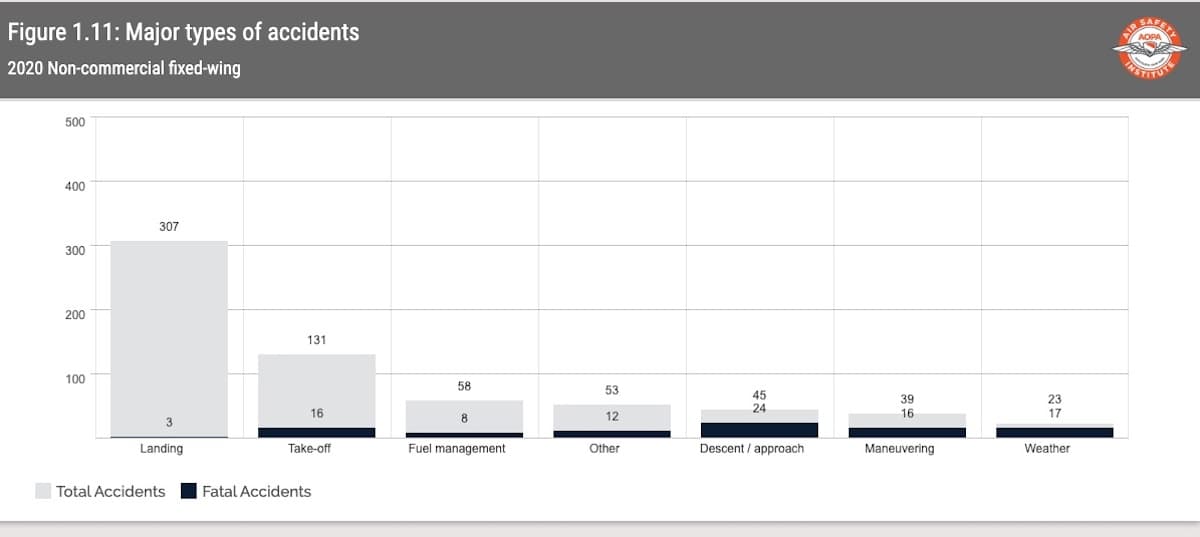
Weather-related accidents remain highly lethal, but overall weather accidents sharply decreased in 2020, according to the report.
Maneuvering accidents also saw a substantial decrease in fatal accidents reaching a 10-year low.
“An area where we see some discouragement is the commercial fixed-wing total accident rate, which rose following two years of decline,” said Robert Geske, AOPA Air Safety Institute manager of aviation safety analysis. “We are also disappointed to see the number of fatal fuel-related accidents, which has remained steady at an average of eight per year for several years.”
“Furthermore, landing accidents continue to remain the leading type of accidents, but thankfully they account for the lowest number of fatal accidents,” he added.
Descent and approach accidents rose in both overall and fatal accidents, with stall/spin accidents accounting for the largest number of fatal accidents, according to the report.
While the report crunches all the numbers related to general aviation accidents, it doesn’t point to why accidents decreased. One potential reason could be that there was less flying in 2020 due to the pandemic.
AOPA officials note that the report’s digital platform provides near real-time accident data that are updated on a rolling 30-day cycle, accelerating the analysis process, and allowing for the most current snapshot of general aviation safety performance.
The report provides detailed analysis of trends and rates for non-commercial and commercial fixed-wing operations, non-commercial and commercial helicopter operations, and sport/experimental operations.
View the 32nd Joseph T. Nall Report here.