

In response to our call for innovations, Jerry Olson wrote to tell us about the engine dehydration system he developed, which he says removes virtually all the moisture from inside aircraft engines.
“Removing this moisture should prevent many of the corrosion induced failures that many GA aircraft engines experience, saving those aircraft owners from overhauling their engines prematurely,” he says.
“I developed this dehydration system due to a corrosion-induced cam failure in the Lycoming IO-360 engine in my Cardinal RG,” he continues. “After graphing and analyzing the data from my oil analysis, it was apparent this failure was likely due to the high humidity levels where I live in Houston, Texas. After overhauling my engine due to this cam failure, I decided I needed a system to keep my engine dry.
 “Initially I tried to find a system to purchase. After not finding anything that I thought could effectively handle the high humidity levels in Houston, I decided to build a system that would.
“The end result is a very capable system. So much so, that numerous other aircraft owners have asked me to build systems for them. This has led to building nearly 50 systems in the last year. And, due to the systems uniqueness, I was awarded a complimentary booth in AirVenture’s Innovations Center this year.”
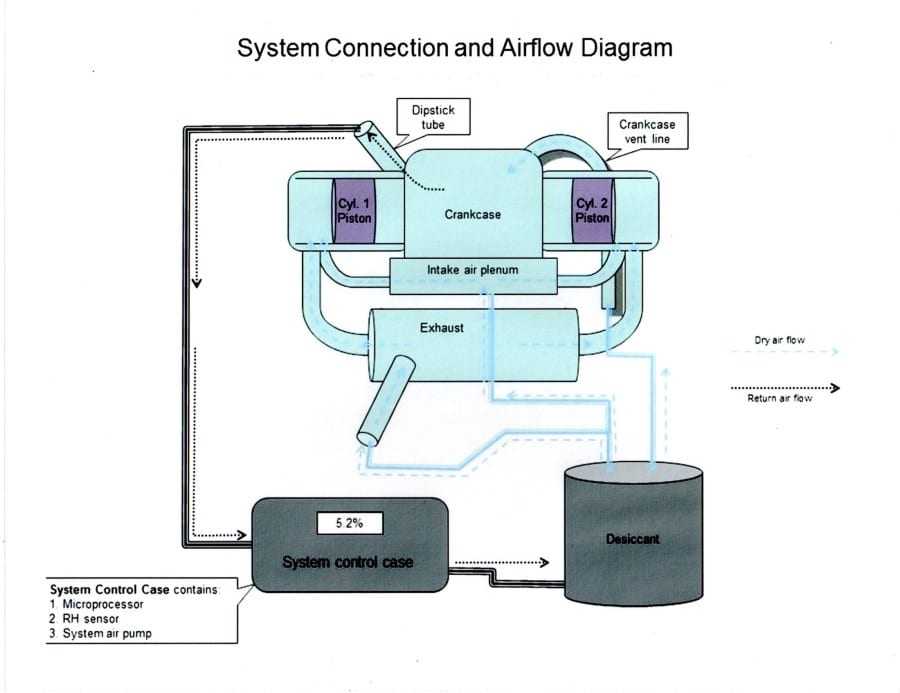 Here are some of the systems’ features and capabilities:
- Microprocessor controlled and fully automatic;
- Measures and digitally displays the relative humidity from inside the engine;
- Recirculates the engine air in a closed loop that progressively dries the air;
- Reduces and maintains the relative humidity inside the engine to below 10% on a continuous basis;
- Prevents outside humidity from re-entering the engine;
- Dynamically adjusts to relative humidity changes inside the engine and to changes in the weather;
- Actively removes virtually all moisture from inside the entire engine;
- Dries air inside the intake, the exhaust, the combustion chambers and the crankcase;
- Removes residual moisture from the oil, minimizing acid formation;
- Small, portable, and energy efficient;
- Can be used on aircraft tied-down outside, when powered by a small battery and solar panel.
You can see the system in action at EngineDryingSystem.com
Very nice work there, Jerry. Dad would be impressed, and I certainly am.
Joseph,
A kit with plans probably wouldn’t work out too well. Getting the system to work correctly can be frustrating. It took about 18 months for me to work out the bugs in the build process.
There is an ordering page on the website listed at the end of the article above where you can order a system. It includes a 12 month money back guarantee if you’re not satisfied with the system.
A patent application has been filed on the system.
Jerry this something I need as we live on the gulf coast, is it possible for you to sell a kit and plans. You should patent it .
There’s a fallacy in believing flying dries out our engines. After developing the engine dehydration system I was surprised to see how much moisture was left in my engine after flying. This moisture is the residue from blow-by of the combustion process. I’ve measured the dew points of the moisture left inside engines at 130 F. There’s a video demonstrating this on my website.
Weekly flying definitely helps, but it’s more due to re-lubricating the engine internals, than by eliminating the moisture.
Nice for those that can’t just fly their airplanes at least once a week to burn out all the moisture.
If he says it works, believe him. I used to own that Cardinal with him as a partner, and he is very picky. Good luck Jerry, hope all is well with you.