

Mark Robinson, the Chief Instructor Pilot of Revolution Aviation, was a particularly happy man Aug. 12 because his business was celebrating one year of operation — and oh, what a year it has been.
Robinson is the founder of Revolution Aviation, located at John Wayne Airport (SNA) in Santa Ana, California, approximately 20 nautical miles south of Los Angeles International Airport (LAX). The flight school teaches people how to fly airplanes, helicopters, and Remotely Piloted Aircraft (RPA). Robinson believes it is the only flight school in the nation teaching people how to fly RPAs.
Robinson is one of those individuals who is passionate about aviation. If it gets off the ground, chances are he has some stick time in it.
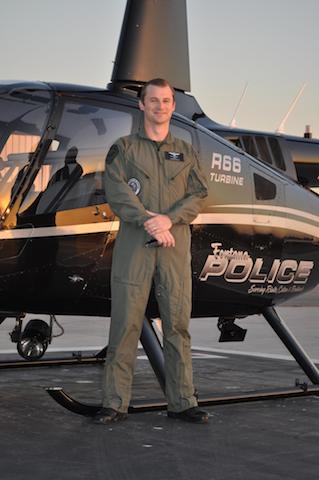 “I took my first flight in a helicopter on Feb. 2, 2007, in London. At the time I was a currency broker living in London,” he said. “That day I took a demo ride I decided I wanted to do that as a career. Prior to that I had been in helicopters for company events, but it was the initial ride that got me thinking, and I was at a point in my life when I wanted to do something challenging.”
General aviation can be cost prohibitive in England, so Robinson came to the United States to do his training. Today he has more than 6,000 hours and holds an ATP in helicopters, along with CFI and CFII tickets. He also holds certificates for Airplane Single Engine Land and Lighter Than Air.
“I worked for Goodyear for a year flying the blimp,” he noted. “It was fun but it was slow, and not dynamic enough for me. When the blimp is used for an event, you circle that event about 55 times, then you come back and land.”
He decided that it might be fun — and challenging — to start a flight school of his own. His goal was to create a place where like-minded people — those passionate about aviation — could learn and share the aviation experience.
“Our website says it all,” he said. “Our domain name is Eat Sleep Fly. That is also our business motto. I want to educate people that you don’t need 20/20 vision, that aviation can relate to everything. I want to bring in the general public. Flying is something that it doesn’t matter if you do it little by little or have a lot of money to do it in fell swoop. Anyone can do this.”
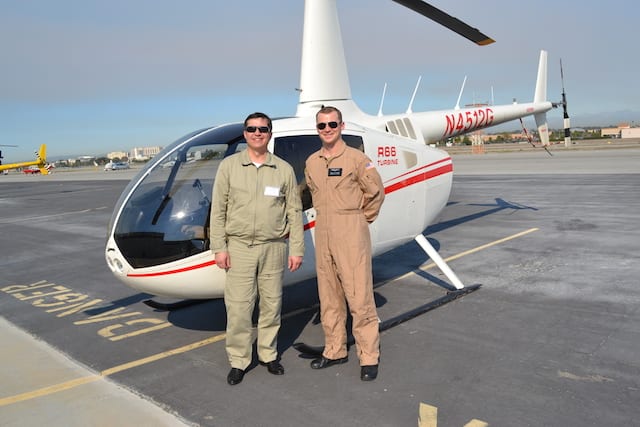 The flight school opened Aug. 12, 2013, with one helicopter and Robinson as the sole employee. A silent partner helped with funding.
“I was working out of a shared hangar,” he said. Today Revolution Aviation has its own space at the airport, as well as an office and classroom off-airport. The aviation fleet has increased and diversified.
“We now have four helicopters and a Liberty XL2 on leaseback that we use for IFR training,” he said. “The drone is an Aztec Ascending Technologies design called the Hummingbird. It is made in Germany and costs about $6,000.”
A handful of instructors keep the machines and the students in the air. At this point, most of the school’s clients are helicopter students who want to be professional pilots.
“We have approximately 40 students at this time. The youngest is 14 years old and I just soloed a 16 year old,” he said. “We are lucky enough to be in an affluent area where there are wealthy parents who want their kids to fly.”
Most of the training is done in Robinson R22 and R44 aircraft. “We are looking to purchase an R66 to expand the business,” he noted. “We are also looking for leaseback aircraft.”
The school is certificated under FAR Part 61. An application for Part 141 is in the pipeline at the local FSDO. Getting approved for Part 141 makes it possible for the school to work with students who pay for their training with funding from the Veterans Administration, and can help attract international students who come to the United States on student visas.
“Our business is about 80% helicopters, 15% airplane, and 5% drone right now,” said Robinson, adding that as far as he knows, Revolution Aviation is the only school in the United States that teaches how to fly RPA.
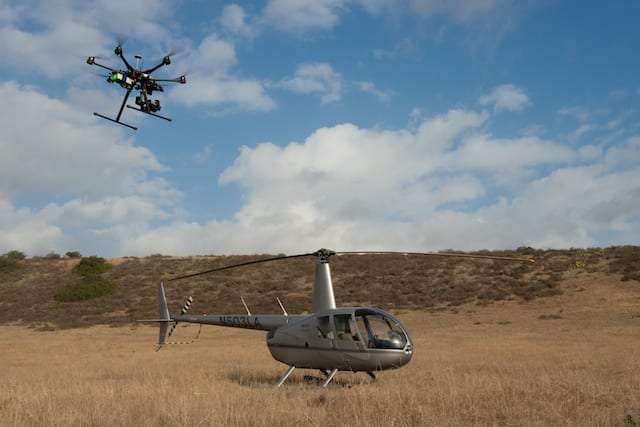 At this time, no FAA certification is required to fly a RPA, however the agency is feverishly working to draft those rules.
Robinson acknowledges it is a bit of a gray area now, so they must tread carefully with the RPA clients which, for the most part, are people who have purchased a low-cost RPA and want to fly it for fun.
“It is very much like buying a new television or DVD player and having someone teach you how to use it and what all the buttons do,” he said. “On the other end of the spectrum are people who spend upwards of $5,000, or their company has purchased one and the company wants to make sure they don’t break it.”
Very often the businesses that use the RPAs are contractors for the military.
According to Robinson, it behooves RPA pilots to have a good understanding of aerodynamics and airspace before launching.
“We stress safety rather than treating it like a computer game,” he said. “Our basic course contains information on the maintenance and systems of the RPA and we get into the social aspects of the aircraft, airspace rules and integrating the RPA into that airspace. Then there is hands-on flight. For the customer, this is a full-day course. There is a lot of safety training. Before each flight the pilot must check the batteries, as well as the engines. Some RPAs have four motors, some have eight and the pilot needs to know what happens when one of the engines quit. The eight-engine model, for example, can stay in the air, the four engine model will be coming down.”
“The social aspect is huge deal,” Robinson continued. “You have to be respectful of where you are flying it. You don’t fly them over crowded beaches or apartment complexes. We recommend they be flown only at parks more than five miles from an airport and under 400 feet AGL.”
To graduate, a pilot must demonstrate mastery of the aircraft.
“They have to be able to take it off GPS mode in free mode and they have to fly it down to the landing pad at their feet,” he explained. “They have to demonstrate that they have good enough aircraft control.”
Like most successful businesses these days, Robinson uses social media to help attract new students. He encourages customers to leave reviews on Google, Yelp, Twitter and other similar virtual billboards.
“I am on every social media platform there is to show people that our business is alive and the blood is pumping,” he said. “We ask for feedback from our customers after tours and lessons. By each of these posts we are creating history.”
“There is a lot of trust involved in aviation,” he continued. “When you are a new business and you don’t have a history, that can be a challenge. You have to create that trust.”
900 hours per year….quite a time builder…