

There are some people who get as much joy out of restoring an aircraft as they do out of flying one. Steve Noyes, an A&P/IA and commercial pilot from Newbury, Massachusetts, is one of those people.
Since 1985 he has operated Noyes Enterprises, which includes Birddogs by Noyes, a business dedicated to the restoration and modifications of Cessna L-19 Birddogs, the militarized versions of the C-305. One of the common uses of Birddogs is as a glider tower, so perhaps it’s understandable that a job maintaining tow aircraft led Noyes to the restoration of a 1942 Schweizer training glider, known as a TG-2.
The project came in to his life by happenstance, as so many vintage restoration projects often do, says Noyes. He says it was one of those instances when opportunity and desire coincided.
 “The year was 2008,” he recalls. “I was maintaining a fleet of banner tow Birddogs from East Moriches Aerial Advertising down on Long Island. The owner, Ron Delalio, who is a buddy of mine, needed some major maintenance done on one of the tow dogs. He off-handedly offered the glider as a barter deal. I always wanted to try gliding, so I did some research and found what better ship to learn how to glide in than this World War II TG-2 Training Glider, so I agreed to the barter deal.”
Schweizer gliders were first introduced to the world in 1938. The two-place designs were popular because they were relatively crashworthy and made it possible for a person to get instruction from an experienced glider pilot. In single-place designs, the glider pilots self-launched and stumbled their way through learning to fly.
When World War II began all aircraft — including gliders — were seized by Uncle Sam for the war effort and aircraft manufacturers went from producing civilian to military designs.
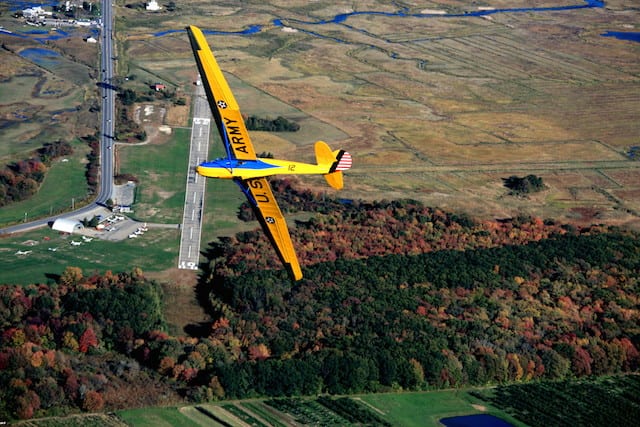 A check with the National Archival Research Administration revealed the Noyes glider was the 18th training glider ordered by Uncle Sam. It came out of the Schweizer factory in Elmira, New York, relatively early in the war.
“It was one of the first to be used,” Noyes says.
It is his understanding that when the United States entered the war in 1941, the military did not have any gliders in its aviation arsenal, but after seeing the extensive and effective use of gliders by the Germans, U.S. military officials established a gliding program.
“The glider spent most of its training life at Ontario, California, and at Twentynine Palms in California,” Noyes continues. “The training gliders were designed to train the glider pilots who were going to fly the larger WACO CG-4 gliders in the Normandy Invasion. Since this was going to take place under the cover of darkness, the TG-2s were one of the only gliders that were outfitted with navigation lights, as a lot of the training was also done under the cover of darkness. Of the many training gliders, there are only a handful that still exist. They reside in places like the Smithsonian, the USAF Museum, and the NAS Museum in Pensacola.”
The glider was stored on its trailer at Noyes’ place of business at Plum Island Aerodrome (2B2) until January 2010, when Noyes finally had the time to make it a priority.
The vintage glider is a natural fit at the aerodrome, he notes. The aerodrome, established in 1910, sits on 32 acres. It has two runways: Runway 10/28, which is asphalt and measures 2,105 x 50 feet, and 14/32, a turf strip measuring 2,300 x 100 feet.
“The property used to belong to my family,” Noyes says, adding that the airport still has a certain level of openness, as there are no chain-ink fences to keep the public — or the wildlife — out. In fact, it was the unexpected appearance of wildlife that got the physical restoration of the glider off to a dramatic start.
 “When my buddy Bill Pfeiffer was trying to pry open one of the wing spoilers, I pulled on the cable at the same time and as the spoiler opened, a family of displaced Long Island squirrels ran out at us,” he says with a laugh.
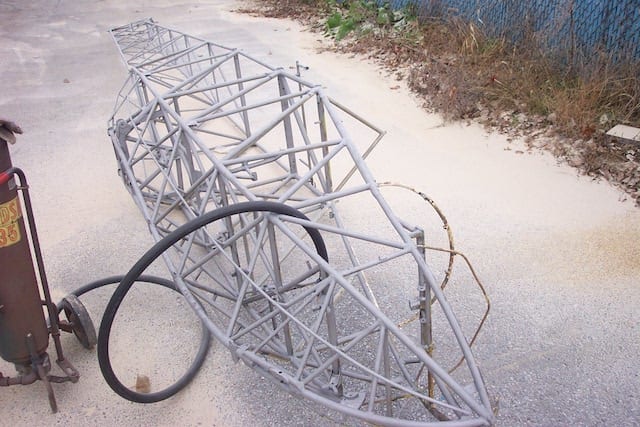
Once the critters were evicted, Noyes, Pfeiffer, and Noyes’ wife, Tina, got to work dismantling the airframe and determining what parts could be salvaged, what parts were missing, and what parts needed to be replaced.
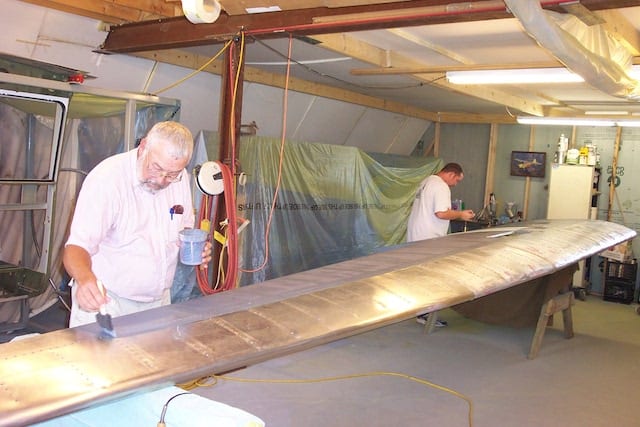
“There was the expected rusted tubing, which was cut out and replaced, and one wing needed the leading edge skins changed,” he recounts. “The ship was totally disassembled. If it wasn’t welded, it got removed, and even then it might have gotten removed.”
When an aircraft passes through many hands, it can make restoration more complicated, and that was the case here, according to Noyes.
 After the war, the glider was sold as military surplus. The Schweizer gliders could be purchased relatively cheaply, and were often flown until crashed, parted-out, modified, sold, flown and sold gain.
The restoration included unwrapping layers of modifications to get the glider back to its original military specifications.
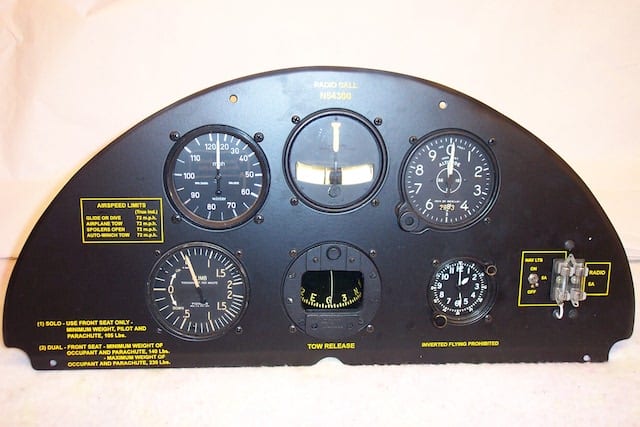
“Over the years, different people had removed or changed things,” he says. “For example, the original tail skid was missing, so I found a drawing and made a new one. Also, the front instrument panel was no longer standard, and the rear instrument panel was missing altogether. The electrical system, which consisted of a dry cell battery, had been removed, so I put it back. Les and Kyle Schweizer of K&L Soaring were quite helpful in providing me with photos of original drawings that I requested, right down to the drawing of the front and rear instrument panel. My buddy Dave O’Donnell helped make the form block which we made a new panel from.”
“The cabin canopy was also missing, so a new one had to be fabricated, along with the replacement glass panels,” he continues. “The control system had some fitment issues, so in making new control cables, I had to learn the Five Tuck Navy Splice for cable terminations for attachment points where new modern cable swage terminal would not fit.”
The glider is painted in Army Air Corps Blue over Training Yellow. The AAF air corps round insignias with the red dot “meatball” in the center grace the wings.
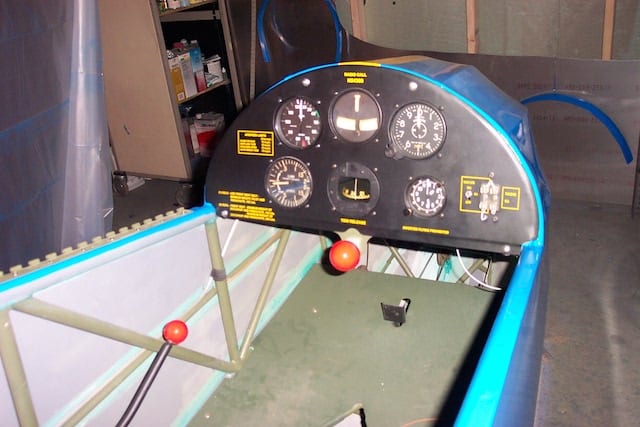 The glider returned to the air in August 2010 — “after four months of 12 hour days!” says Noyes.
A friend, Tom Mason, who holds a CFI-Glider certificate, provided instruction and in October 2010 Noyes soloed in the glider, adding to his more than 4,000 hours as a pilot.
The glider is launched by aero tow, and usually the towship is the SuperDog, a beefed-up Birddog created by Noyes.
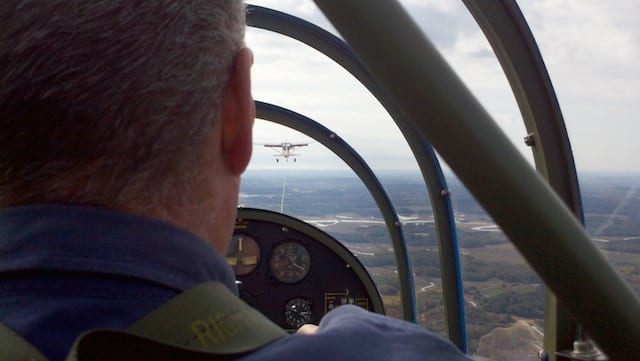 “A SuperDog is a Birddog that has had its old 1940s technology Continental O-470-11 or-15 firewall forward removed and replaced with a factory new Lycoming O-540 250-hp modern firewall forward using new lightweight accessories and a quiet, high thrust three-blade Hartzell constant speed propeller,” Noyes explains.
Normally, Noyes is the guy flying the towship for glider pilots, so piloting the glider is a new kind of a thrill for him, and it’s something that he’s happy to share with others.
“Most people are in awe when they see the glider,” he says. “They just can’t believe that this ship is actually from World War II and still flying.”
My dad was also a WWII glider instructor. He told me that when assigned to instruct in glider training, he had never even seen a glider, let alone fly one.
Awesome Job!!! My father was part of an elite group of selected during the early days of WWII to train in these gliders at Twentynine Palms, CA
Any man or woman that had the guts To get behind the stick of a glider to defend our country was HERO MATERIAL! JOE SMISEK WAS ONE OF THOSE incredible Souls and so was Frank Campbell!
My father, Frank R. Campbell was a WWII glider pilot and he would have been so proud to see what you have done to restore a glider.
I could not be more proud that my dad was one of 6,000 glider pilots that flew a glider in WWII.
Sincerely,
Rebecca Campbell Roeder
Frank R. Campbell’s daughter
FRANK was the nicest coolest guy I ever met. If you were to pick a best friend, father, or brother…he was your man…and I was the lucky man who knew him…and his family.
According to the airport supervisor at Millinocket Maine (MLT) Steve Noyes has relocated his Superdog modification business to MLT and the Glider is there as well. They plan to be flying it this summer.
A Dutch immigrant friend of mine and I restored a TG-2 back in the early 1960’s at the Barre-Montpelier, VT airport. I soloed for the first time in it at age 15. I know Tom Mason. He is in my QB hangar! I live in NH just north of Newburyport. Is the TG-2 still at Plum Island? I’d love to see it. Small world.
Many years ago I got several flights in one glider like this one.It is in my Club.How rare you mean?Can it be a experimental airplane, later? It is absolutely ORIGINAL.
Eduardo
Your glider has a sister ship here in Fairbanks AK. A group of us who fly CAP gliders are trying to acquire and restore it. I would like to keep in touch with you to take advantage of your lessons learned with the project.
A small nit-pick. The L-19 (later the O-1) wasn’t really a militarized version of the C305. The C305 was a civilianized version of the L-19. The military Bird Dog came first.
I was a test pilot for Lockheed and went with one of our flight test engineers to El Mirage for my first glider ride. 15,000 ft came surprisingly quick considering we were under an overcast. On downwind, we had to change runways 3 times. What a contrast!!!
Ross is one of the true good guys, transitioning many of us kids at Chino into Warbirds in the 70’s. I remember one T-28 flight in particular that helped get the aerobatic monkey off my back. Many hours of fun Blanik L-13 aerobatics followed at Hemet. Thanks for all the fun/interesting flights Ross.
Great story I fly a converted TG-8 that was based at Elmira , New York.
Oh what memories! I learned to fly in one identical to this. Soloed when I was 15 years old. Thanks for keeping the ol’ bird in shape!
Many years back, 1952 or 1953, an offer was made that my Dad took advantage of so we could have an inexpensive flying experience. It was a J-3 Cub, but it’s history being it was the first T-G 8 Glider converted to a J-3 F Cub. Dad bought it and we disassembled it and brought it home to get to work, stripped it down and went through the process of refurbishing it.
The aircraft is still flying on the Chez Republic after another refurbishing in military finish.
Interesting story. One of my uncles was a WWII glider pilot and became a GA recreational pilot after the war.