

It’s only a matter of time before the harmful algal bloom that has plagued Lake Erie begins to grow along the western basin and elsewhere this summer. This year, however, there will be a new tool employed to monitor the problem and spread the word to residents about toxic cyanobacteria.
Dr. Rafat Ansari, senior scientist at NASA Glenn Research Center in Cleveland, Ohio, has spearheaded a citizen science campaign along with general aviation pilot Terry Schubert, to involve public volunteers to monitor water quality along Lake Erie’s coastline and interior waterways. In this case, they are engaging private pilots to collaborate with researchers to collect scientific data.

“The goal is to help develop an early warning system to alert communities about algal blooms in their coastal neighborhoods,” says Ansari.
By seeking out general aviation pilots, academic researchers are exploring an innovative and low-cost approach to use citizen scientists to study and monitor harmful algal blooms and related water quality issues, NASA officials noted.
With GPS-enabled cameras mounted on the underside of a small aircraft’s wings, pilots fly along the coastline of Lake Erie while the camera continually snaps infrared and color images every five seconds from Cleveland, Ohio, to Monroe, Michigan.
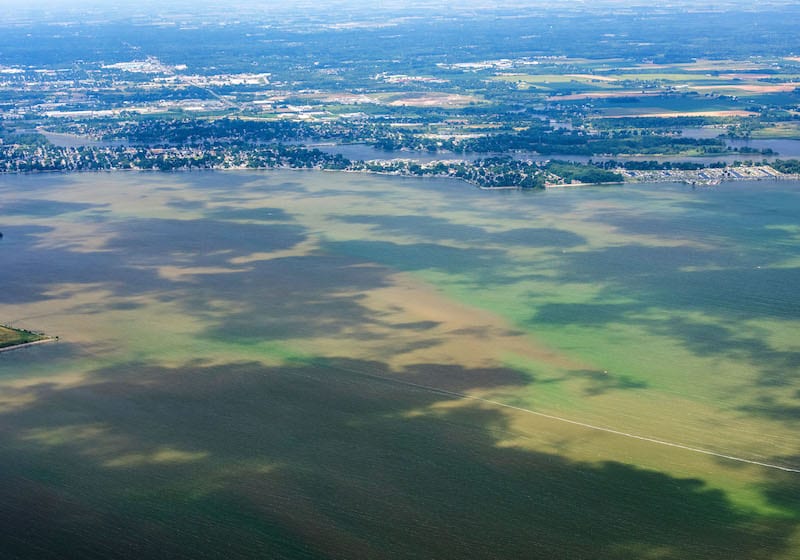
About 1,300 images are taken during every flight. These images will provide the data that could lead to predicting changes in water quality.
All data and images are uploaded to a website hosted by Cleveland State University that is available free of charge to the public, including students, teachers, researchers, water quality managers and policy makers.
“If you live in a particular community, you can click on a set of images taken from your neighborhood and see if an algal bloom is near your drinking, fishing, or recreational waters,” says Ansari.
While NASA is committed to helping other agencies and universities monitor the health of Lake Erie through satellite and scientific flights equipped with hyperspectral imagery, Ansari and his team believe there is a place for citizen scientists to make a contribution.
“It typically takes three to four days to get data from satellites,” says Ansari. “But data from small aircraft is available within a couple of hours. Additionally, small aircraft flying at lower altitudes can image algal blooms not always visible from satellites or high flying aircraft.”
And while university or government-funded scientists typically monitor water quality at the mouth of major river systems, they do not have enough resources to track water quality through every river and stream in a watershed. This makes volunteer citizen scientists vitally important in the effort to monitor and maintain water quality standards across the nation.
All private pilots in this project are volunteers and responsible for the safe operation of their own aircraft. While they also must purchase their own camera equipment and fuel, pilots are free to choose their own flight paths and plans.
Ansari and Schubert, both private pilots, have received interest from about 100 volunteer pilots across the country.
Each year, Ansari hopes to have pilots monitor harmful algal blooms in the Great Lakes, smaller inland lakes and coastal waters across the U.S. Their work will contribute to the body of knowledge scientists need to tackle this environmental problem.
I used to spend a lot of time on Lake Erie. It’s sad to see it returning to the 1970’s. The university’s web site is pretty broken. A lot of dead links when trying to pull up photos. I wasn’t able to get any after trying 10 or so different links.
Thank you for alerting me to the problem. I think it’s fixed now.