

The November/December 2016 issue of FAA Safety Briefing focuses on many of the questions the FAA commonly receives from the public, as well as how to interact more effectively with the agency.
Areas of discussion include aviation rulemaking, airman rules and regulations, and pilot resources.
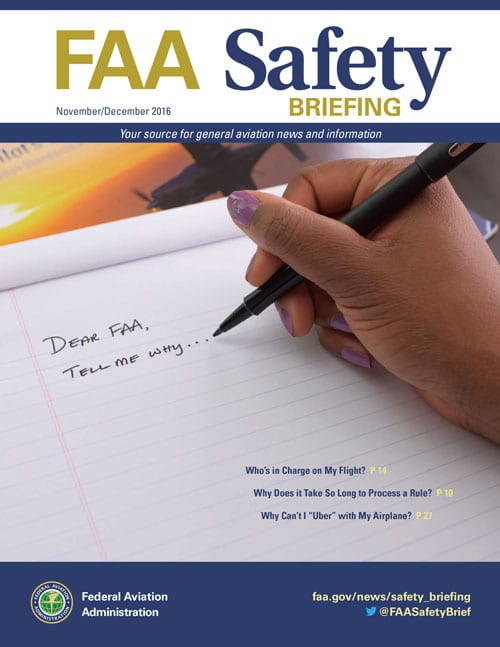
Feature articles include:
- Out for Comments – Why Does it Take So Long To Process a Rule? (p 10),
- Who’s In Charge? – Logging Pilot in Command Time (p 14),
- Breaking Bad – What to Do When You See Someone Doing Something Wrong (p 18)
In this issue’s Jumpseat department (p 1), Flight Standards Service’s Director John Duncan discusses some upcoming changes to Flight Standards that will provide a more function-based structure for the organization, while Aeromedical Advisory (p 5) explores questions about third-class medical changes.
In the Nuts. Bolts, and Electrons department (p 31), you’ll find answers to any questions you might have about Airworthiness Directives, while Angle of Attack (p 33) provides information on how to more easily navigate the wealth of information available to airmen on FAA.gov.
Why, when I get an online briefing for a 50nm flight in an airplane between two Florida airports, do I have to wade through notams for helicopter operations in Maine, and warnings about operations in Afghanistan?
You can change the way you abbreviate without changing the format! Abbreviations should look at least similar to the word being cut short. Example – maneuvering speed is Va – why not Vm (Give a hint)
They may answer that by the time that they act on the Congress mandated changes, including using valid drivers license, instead of requiring a Third Class
Medical. Lets see — Congress gave them a year but how much will you bet that it will take at least three years?
“bauds” – because of the vast amount of legacy equipment out there – a lot of it still hooked up with POTS running on copper wires.
And why waste bandwidth by transmitting more than you need to? Most weather programs there days will render the codes into plain English for you.
Old timers will tell you that by looking at the tabulated ASCII text in all its columns and rows you can “see” or “picture” a weather chart, fronts and trends. Certainly for winds aloft I can “see” optimal altitudes for my direction of flight. I’m not so good at the other stuff!
Not a joke.
When is the FAA going to do something about all the SSN’s mechanics put in log books that are out there all over the country? Any illegal can look in an aircraft log book and get all the SSN’s he will ever need.
Mechanics should be initialing their certificate number not their SSN’s. I’ve yet to see a SSN in a logbook
For a number of years the FAA thought it was a good idea to use a persons SSN as a license number. They later changed their minds and allowed mechanics to change their number but did nothing about the numbers already out there in log books. Is it going to take a law suit to get them to get off their fat butts?
Also CFI’S Just hope no bad guys get yours!!!!!
My sons certificate number was the same as his SSN until I had him change it. His SSN is in many log books. He got his number in the 1980’s I don’t know how long the FAA used the SSN’s. I assume some people are still using the SSN. My CAA number was never any problem.
Dear FAA,
Tell me why you still use morse code ?
Tell me why your weather information uses codes that were very useful when people measured bandwidth in bauds ?
Yours Truely
A joke
The weather information codes are used internationally. They re used where English is not the primary language and facilitate rapid and efficient communication between speakers of different tongues.