

During this week’s SUN ‘n FUN, Stallion 51 will celebrate its 30th anniversary.
The company, which provides flights and training in the iconic P-51 Mustang from its headquarters at Kissimmee Gateway Airport (KISM) near Orlando, is bringing some friends to the show to help it celebrate.
On Wednesday, a gaggle of Mustangs will land at SUN ’n FUN, then be ushered to the Warbird Ramp. According to Stallion 51 officials, 15 Mustangs will be flying into the show.
“We’ve reached out primarily to graduates of our program,” said Lee Lauderback, noting there are more than 180 graduates. “It’s a pretty intense program of learning to fly the Mustang safely.”

Stallion 51 held a variety of seminars Monday at its headquarters at KISM for those graduates. Then on Wednesday morning, the Mustangs will leave KISM and make their way to SUN ’n FUN.
The Mustang fleet will be arriving in flights of four so as not to overwhelm the Warbird Ramp. Arriving this way gives volunteers plenty of time to park the Mustangs and prepare for the next arrivals.
“Then it’s Mustang Day on Thursday,” Lauderback said. “We’ll have a big block of time to do single ship demos, hopefully some formation aerobatic demos and some bomber stuff. And, it looks like possibly a Heritage Flight featuring the P-51 with, I think, the F-16.”
“To cap it off, on Saturday, I’ll be opening the evening airshow with a Mustang demonstration,” he continued.
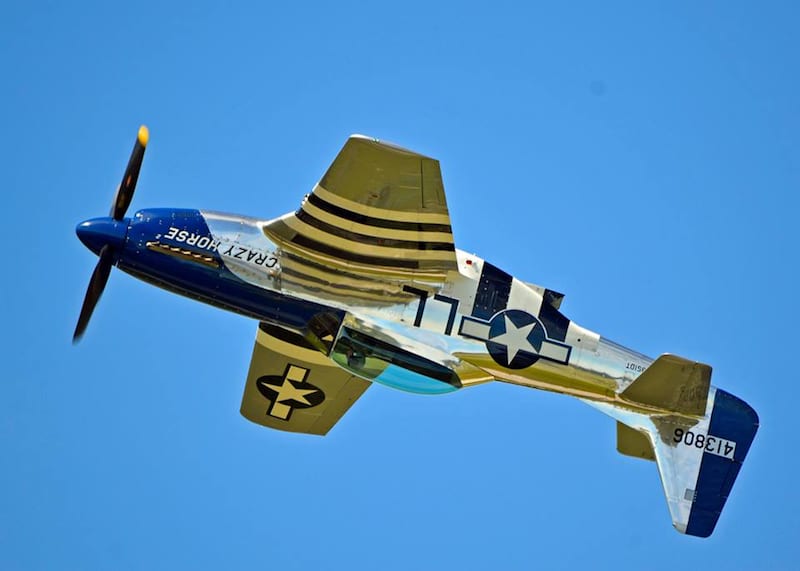
Stallion 51 began in 1987 after Lauderback retired as golf legend Arnold Palmer’s pilot. The initial mission was to fulfill a military contract for the Navy Test Pilot School. But what Lauderback noticed is that the test pilots would walk away from the F-18 and gather around the Mustang.
He then developed a curriculum to train today’s pilots in the P-51, as well as offer orientation flights.
Besides the more than 180 alumni of the training program, Stallion 51 has given orientation flights to thousands of people — too many to count. Those flights are among his favorites, Lauderback notes.
“I get to fly the Mustangs a lot, but to share it with other people who have never had a chance to fly the airplane is just really special,” he said, adding he has more than 9,000 hours in the P-51, making him the highest time pilot in the Mustang, right ahead of Bob Hoover, who logged more than 7,500 hours.
But Lauderback says he couldn’t do what he does without the incredible team at Stallion 51.
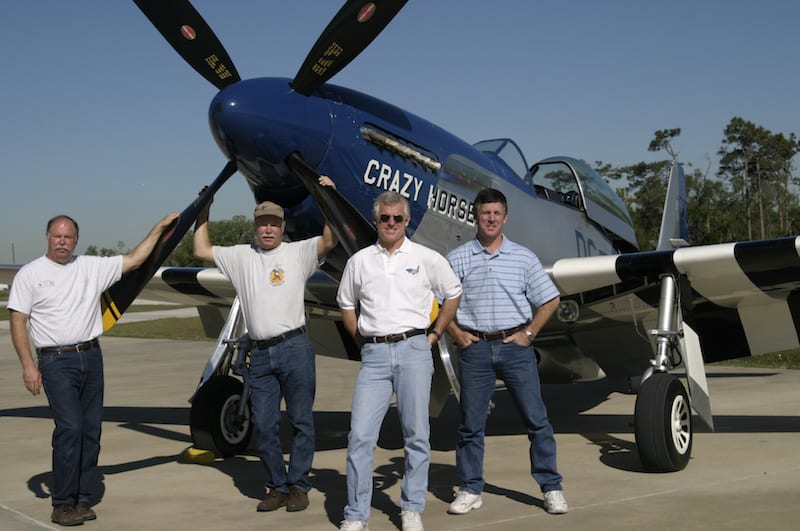
“We couldn’t do what we do, flying wise, without two of my brothers, Peter and Richard, the identical twins,” he said. “They are some of the top P-51 mechanics in the world. They keep us going. The standard joke is that I break them, they fix them. And, they build them, and then my little brother, John, sells them.”
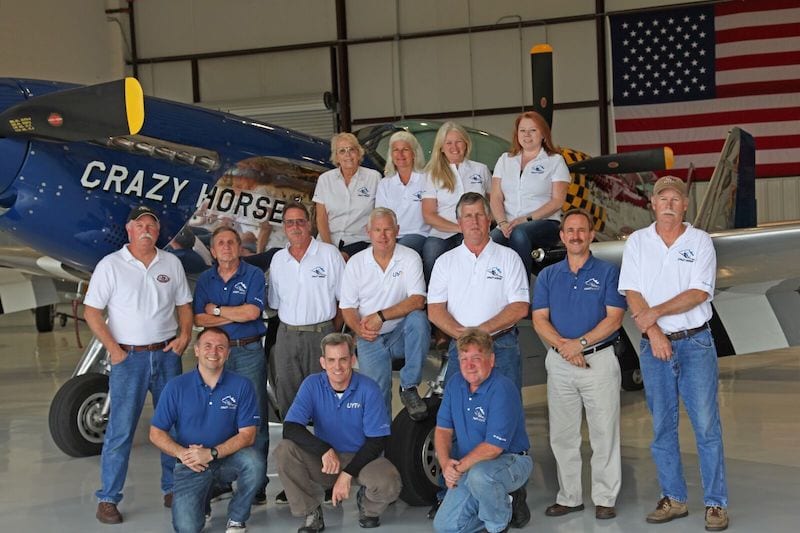
The company has 12 employees now, which Lauderback says is an “incredible team that make this operation really fun and safe and get the job done.”
He notes that his flying demonstrations are a tribute to the Mustangs “and the guys who actually flew it in combat — the reason we aren’t all speaking German or Japanese,” he said.
“Figuring this airplane was designed in the late 1930s, early 1940s, with slide rules and drafting tables in 120 days, it is just a terrific accomplishment,” he said. “To let people see just exactly what the airplane will do down low is sort of fun. Then you tie it up with an Air Force Heritage flight with the F-16 or the F-35, and the Mustang holds its own pretty well.”
“Let’s put it this way: We’re just having fun in the P-51,” he concluded.
Flying that legendary bird is enviable. No doubt one of the difficult things to learn and get used to is handling in ground operations given the cocked up angle at which it sits which is also true of two other warbird fighters among others, the Grumman F8F Bearcat and Vought F4U Corsair. Had to keep those big swinging prop blades off the ground which was partially solved with the gull shaped wings on the F4U. The F4U was initially rejected as unsafe by the Navy to bring aboard Ship in the South Pacific in WWII for the same reason, e.g. pilot’s forward field of view was too obstructed by the nose when slowed to approach speed. A Brit later solved that problem by demonstrating that by flying the F4U sideways in a steady heading sideslip during the approach the pilot could observe the Landing Signal Officer (Paddles) without obstruction right up until the LSO gave the cut signal whence the rudder pedals were brought to neutral, wings leveled and the throttle to idle awaiting impact with the deck and hopefully snagging of an arresting cable by the tailhook. It worked and the Navy took the Corsair back aboard ship from then on.