

WASHINGTON, D.C. — Initial research by a consortium of leading universities, through the Alliance for System Safety of UAS through Research Excellence (ASSURE), have begun to bring better understanding to the physical damage associated with small unmanned aircraft — or drones — colliding midair with commercial and GA aircraft.
The ASSURE research team set out to answer the question of what happens when — not if — there is a collision between a sUAS and an airplane.
“While the effects of bird impacts on airplanes are well documented, little is known about the effects of more rigid and higher mass sUAS on aircraft structures and propulsion systems,” said Mississippi State University’s Marty Rogers, the director of ASSURE. “The results of this work are critical to the safety of commercial air travel here in the United States and around the world.”
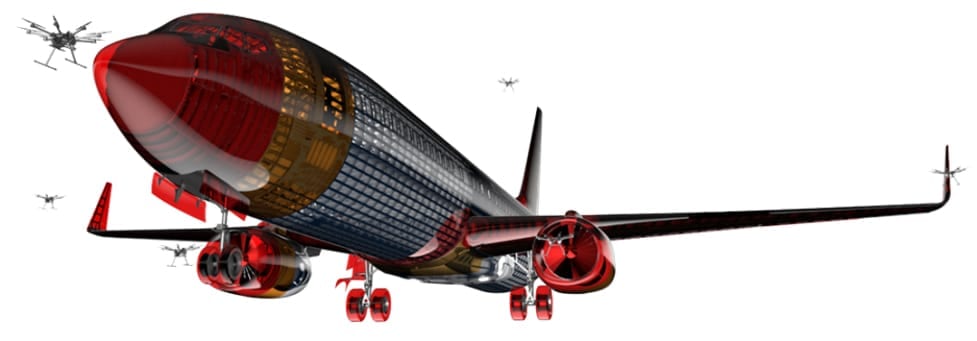
Researchers’ efforts began by first determining the most likely impact scenarios. This was done by reviewing operating environments for both sUAS and manned aircraft. The team then selected the commercial and business aircraft and sUAS based on these impact scenarios and their likely exposure to one another.
The commercial narrow-body air transport selected was characteristic of a Boeing B737 and an Airbus A320 aircraft, which represent 70% of the commercial aircraft fleet.
The business jet model represented a Learjet 30/40/50. Similarly, the team selected a small quadcopter and a light fixed-winged unmanned aircraft as representative of the most-likely threats to manned aircraft.
Researchers determined the areas of manned aircraft most likely to be impacted as being the leading edges of wings, vertical and horizontal stabilizers, and windscreens.
ASSURE researchers also performed engine impact simulations on the fan section of an existing business-jet-sized, turbofan-engine model that the FAA previously used for fan blade-out testing.
The FAA/ASSURE team conducted this research to better inform the scope of the next phase of research, as well as the critical variables essential to their continued research and engine ingest testing, according to officials.
“Computer simulations, supported by material and component level testing, were conducted to determine the effects of sUAS impacts on manned aircraft,” said Gerardo Olivares, Ph.D., Director, Crash Dynamics and Computational Mechanics Laboratories at Wichita State University. “Conducting this study through full-scale physical tests would not have been possible from a cost and time perspective due to the immense complexity of the task. On the other hand, simulation enabled us to study over 180 impact scenarios in a 12-month period. To ensure results accurately predict the actual physical behavior of collisions, we have spent a lot of time developing, verifying, and validating detailed models of manned and unmanned aircraft. Once the models are validated, we can use them in the future to investigate other impact scenarios.”
Researchers observed various levels of airframe and engine damage in all sUAS collision simulations. They confirmed that energy (projectile mass and velocity) and the stiffness of the sUAS are the primary drivers of impact damage.
This research showed that the severity of the collision is also dependent on the design features of the sUAS and the dynamics of the impact.
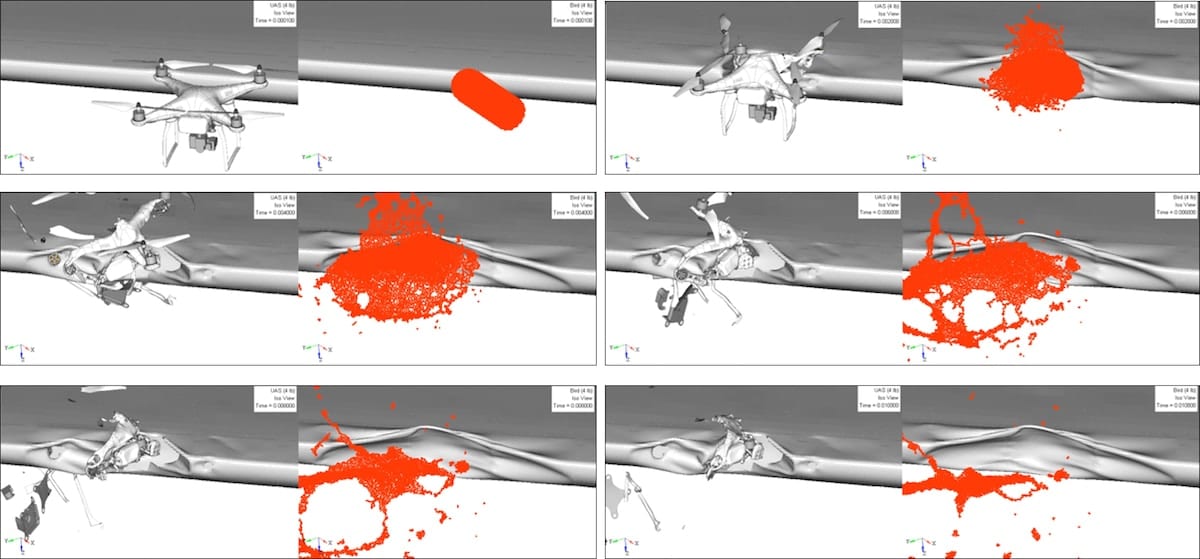
Commercial aircraft manufacturers design aircraft structural components to withstand bird strikes from birds up to eight pounds for the empennage and four pounds for windscreen.
ASSURE simulations show sUAS collisions inflict more physical damage than that of an equivalent size and speed bird-strike.
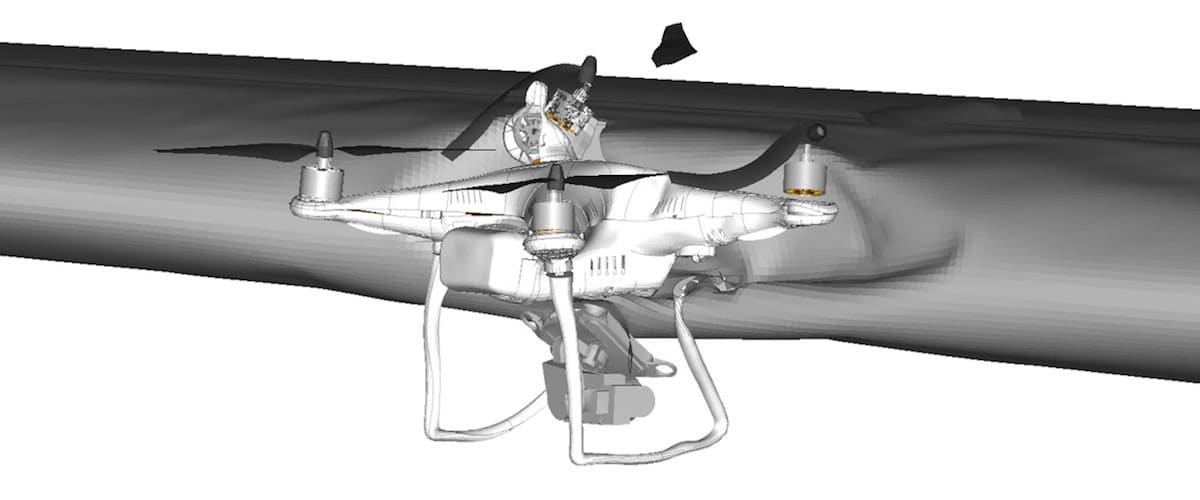
sUAS components are much stiffer than birds, which are mostly composed of water. Therefore, bird-strike certification regulations are not appropriate for unmanned aircraft. Additionally, regulators do not require and manufacturers do not design commercial and business aircraft to withstand collisions from other aircraft.
The ASSURE research team also conducted both physical testing and simulation on sUAS lithium batteries. Typical high-speed impacts caused the complete destruction of the battery, therefore, in these cases, there was not an increased risk of fire due to a shorted battery.
However, during some of the low-speed impacts, associated with landing and takeoff, the battery was not completely destroyed. In some of these simulations, the battery remained lodged in the airframe and there was potential for increased risk of battery fire.
The findings show the importance of properly researching and regulating the use of sUAS in a crowed national airspace system, officials say.
While design features can decrease the severity of a drone impact, sUAS pilots and the public must be aware of and abide by regulations for safe sUAS operations. It is critical that everything be done to keep these collisions from occurring through the safe separation of all aircraft, both manned and unmanned, the researchers note.
The FAA will depend on the sUAS community to help develop the technology for proper detect-and-avoid so that these aircraft do not meet in flight.
This is the first in a series of research projects conducted to understand and quantify the potential severity of airborne collisions. Future studies will research the severity of collisions with general aviation aircraft, rotorcraft, and high-bypass turbofan engines representative of those found in airline fleets today.
Because of the scope and magnitude of this research, and the impact it will have on industry and national airspace safety, the follow-on studies will be broken into multiple phases beginning this year and running through FY21.
The complete report is available at ASSUREuas.org/projects/deliverables/sUASAirborneCollisionReport.php
Sorry I have to ask – or tell you – that I missed the entire plot of your story
because I could not identify the letters, UAS!
I am a private pilot and a remote pilot. I think this is being blown out of proportions after reading comments here. Regulations are already in place to prevent conflict between drones and aircraft. 500′ min for aircraft or 1000′ min over populated areas. Drones are limited to 400′ AGL. DJI drones have an altitude limit of 120 meters built-in and won’t go higher unless purposefully overridden. Drone operators are required to give notice to airports of any operations within 5 miles. Whenever there is a conflict between drones and aircraft, someone is violating existing laws or regulations. Most of my drone flights are under 200′ and never within 5 miles of airports…. there are apps for that. As with anything, including firearms ownership, there are rogues out there, but they are very few in numbers. Technology is being developed to detect and disable drones flying where they are prohibited, which is the right way to address the problem, not more regulation, which obviously doesn’t eliminate the risk, since adequate regulations are currently in place within the US.
Your reasoning is based on false assumptions. I fly a seaplane and I have friends that fly helicopters. We often fly below 500 feet over water or over sparsely populated or uninhabited land. This is perfectly legal, and subjects us to unmitigated collision hazards from drones who are following the (inadequate) rules.
That is assuming the drone operators follow the rules, or even know about them. Jim Hefner, you are a responsible drone operator but you’re in the minority. The majority of drone operators don’t even know the rules and therefore could not follow them if they wanted to. Then there are those who don’t care a whit about the rules. Airliners have reported seeing drones ABOVE them when flying in Class B airspace.
If I break the rules the FAA can track me via my aircraft registration number and I can lose my license. The hobbyist drone operators are basically impossible to track or find, and have no license to lose even if someone manages to find them.
People including children of any age are picking these missiles up at Toys R Us, Best Buy or Costco and running off to fly them with no training, no regulation and no understanding of the life and death consequences of their actions. It is the wild wild west out there, and lives are at stake. Shame on our government for enabling this unsafe situation.
Marc, your points are well taken. Seaplanes and helicopters will have more exposure to problems when flying below 400′ within areas where drones are within range. If you are concerned about it, you should consider flying at or above 400′ or fly offshore beyond the range of drones.
Considering the incredibly high number of flights every year in this country (commercial and GA of all types) and the hundreds of thousands of drones that are out there in the hands of reckless and uniformed people that you describe, with only a handful of reported sighting incidents and no crashes, I believe the risk is very low. Most of the drones you are referring to sold at Toys R Us and Costco don’t have enough range to be a threat to aircraft, including helicopters and seaplanes. They are also small enough that they wouldn’t take down a plane if they did hit one.
Lack of education is definitely a problem. Something that I liked that DJI did in a recent update to their GO App, which controls the drone, was to make each operator take a knowledge test of the rules and regs before they could activate their drone via the app. In order to get through that test, you had to know the rules or I assume you learned them by guessing until you got the answers right. Either way is good to get more people to be familiar with the rules, which is a real problem.
I don’t see the risks as being near as high as your wild wild west comment suggests. I agree the risks are non zero, but I believe they are very low. The risks of bird strikes are much much higher.
I think you are wrong. I fly medivac helicopters and most of my flying is below 1000′. I have encountered drones and actually had to turn to avoid them, twice. I guess it is much easier than you think to “override” the altitude hold and fly above 400′. Also, I see drones all the time taking pictures around scene calls that I land at. below 400′ yes but in the way never the less. Sure there is no airport around and yes they are “legally” allowed to be there but where does the safety of my helicopter, crew, and patient become more important than someone’s pictures. They are still a danger to manned aircraft and should be banned period.
Yep, no midairs have ever happened when both aircraft involved were equipped with radios. ADS-B is infallible. I can just see a commercial airliner deviating from an assigned heading or altitude to avoid an ADS-B contact representing a drone. (That’s assuming the ADS-B system can accommodate MILLIONS of drones and they can be displayed as drones, not aircraft.)
Oh, and of course more rules and laws will fix it all, that always works.
The FAA (government) is completely irresponsible in two big ways. 1. allowing ANYONE in the air near ANY airport without a radio and 2. allowing drones to fly at all without TCAS or ADS-B on board to allow pilots a chance to see and avoid them. Even better would be to force the drone makers to be grounded until they can put tech on them that makes them automatically avoid any flying object they get near.
One of the most potentially, perilous experiences an advanced pilot can experience is leaving an IFR environment enroute to a VFR environment at an airport for obvious reasons. A drone is always being piloted by a partially blind operator because of a lack of an IFR briefing and being out of that system”s control. There should be NO compromise to the safety of the pilot operating on an IFR approach and abiding by those system controls.