

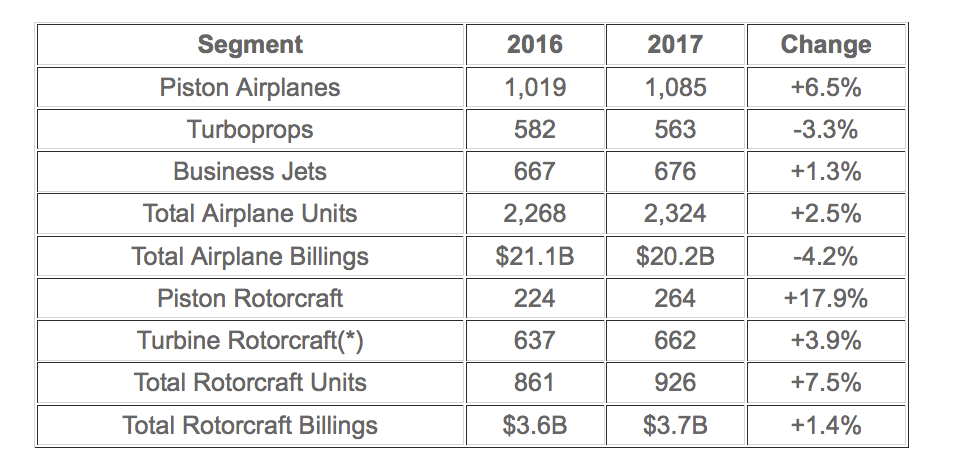
Airplane shipments increased globally 2.5% in 2017, but billings were actually down 4.2%, according to the latest figures from the General Aviation Manufacturers Association (GAMA).
The 2017 year-end aircraft shipment and billings numbers show that 2,324 airplanes were delivered in 2017, up from 2,268 in 2016.
However, billings dropped from $21.1 billion in 2016 to $20.2 billion in 2017, the report shows.
Worldwide rotorcraft shipments rose 7.5%, from 861 in 2016 to 926 in 2017. Rotorcraft billings increased by 1.4%, from $3.6 billion in 2016 to $3.7 billion in 2017.
GAMA officials noted that the rotorcraft segment stabilized after several years of declining deliveries. Piston rotorcraft experienced the largest increase of all segments at 264 deliveries compared to 224 in 2016, a 17.9% increase. Preliminary turbine rotorcraft data also indicates an increase of 3.9%, to 662 aircraft delivered.
Business jet airplane deliveries grew slightly, by 1.3%, rising from 667 to 676. Driving this growth are the several new aircraft models that entered into service in 2017, GAMA officials noted.
Turboprop deliveries slowed to 563 airplanes, compared to 582 deliveries in 2016, a 3.3% decline, while piston airplane shipments strengthened by 6.5%, to 1,085.
“The 2017 year-end results were encouraging, especially with the delivery growth we saw in the business jet, piston airplane and rotorcraft segments,” said GAMA President and CEO Pete Bunce. “Looking ahead, we’re optimistic given some very positive economic indicators, stabilization in the used business aircraft market, new manufacturing techniques spurred by additive manufacturing, and innovative aerospace technologies driving urban air mobility platforms, electric and hybrid propulsion, unmanned aerial vehicles and commercial space.”
$20 billion divided by 2324 airplanes is $8.6 million each (average).
How can it be that much?