

Flight schools need to adapt to the culture of younger generations to fill the ever-increasing demand for pilots, speakers at a recently flight school conference said.
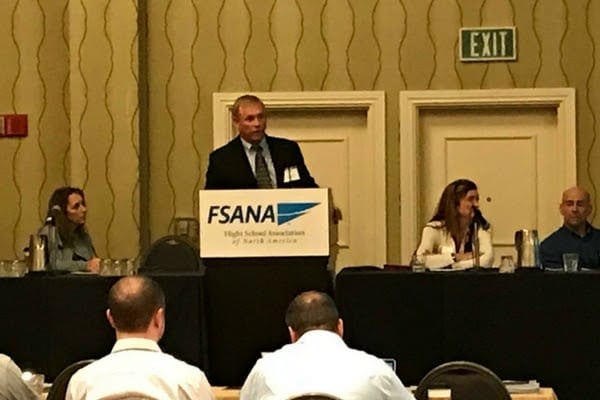
At the Flight School Association of North America (FSANA) Operator’s Conference, speakers noted two conflicting statistics facing the industry: The number of pilots needed by the aviation industry in the next few years is incredibly high, yet the number of students that actually complete flight training is incredibly low.
“Over the next two decades, 87 new pilots will need to be trained and ready to fly a commercial airliner every day in order to meet our insatiable demand to travel by air,” said Jon Ostrower in CNN Money.
At the same time, a survey by the Aircraft Owners and Pilots Association found that 80% of students who begin flight training never complete it.
“Young people will overcome a lot of obstacles to complete their flight training,” said Mark Leeper of Flight Schedule Pro. “They find ways to finance their education, they don’t have a problem with the rigorous course materials and regulatory requirements and check rides, they often willingly overcome many challenges because aviation is something that people get very passionate about.”
It’s no surprise that their biggest concern is often money. They knew the cost of the program before they started, but what they are uneasy about is whether they will complete the program on time with the amount of money they have budgeted.
The amount of time and training required for a flight student to master a skill can vary based on his ability to perform certain tasks to the satisfaction of an instructor or examiner. At $200-270 an hour, (which pays for the plane, instructor and fuel) a delay can really add up. Adding to the uncertainty and complexity is the fact that most flight students have multiple instructors who may interpret the course materials differently.
“Young people have also grown up with everything online,” he continued. “They do their banking, schoolwork, shopping, entertainment, and even their workouts online. My son prides himself on earning most of a bachelor’s degree without ever buying a paper book. So when a flight school doesn’t give them transparency into their training program, they get really frustrated.”
Many business owners fail to grasp how large this cultural shift is, and what it means to them. Consider that colleges are having trouble getting students to football games if the bandwidth in the stadium isn’t good enough. Students would rather stay home where they can use their phones and tablets while they watch the game.
You can work with or fight against this cultural change, Leeper said. Flight schools should want their customers and students to be connected and to have complete and transparent information about what they’ve completed, what to study next, and how far they’ve come.
Flight schools can leverage this cultural shift by using standard course materials delivered online, with online scheduling and visual progress indicators. Schools can use programs like Flight Schedule Pro that manage these tasks online so that students, instructors, flight school managers and other stakeholders like parents (who may be paying the bills) and advisors can access records securely while maintaining student privacy.
Other speakers included Bruce McCall of Triad Aviation Academy, Chris Erlanson of Nashville Flight Training, and Lisa Campbell of Air-Mods Flight Training Center. All three developed programs for young people (ages 12 and up) following FSANA’s AeroCamp model, designed to provide much-needed visibility to young people, who have few opportunities to engage with aviation.
“I proposed the idea after being inspired by a presentation Bruce gave at a FSANA conference. All of our instructors were against it at first, so I almost discarded the idea,” ” said Erlanson.
But after a few phone calls and some strong support from the airport community, he decided to give it a shot, and held a successful AeroCamp, which had great results and garnered national publicity when a local news story was seen and retweeted by celebrity Kelly Clarkson.
Every one of those skeptical flight instructors were excited to host the next AeroCamp, he said.

“Building a long-term pipeline for prospects is a brilliant marketing strategy,” said aviation marketing consultant Paula Williams of ABCI. “And it’s great for the industry because it’s really inspiring to get kids involved in such an exciting program.”
“It is an exciting time to be in the aviation and aerospace industry,” concluded Robert Rockmaker, FSANA CEO and president. “There are many energetic young people looking to find a pathway toward their dreams and goals. FSANA is helping to make their futures bright as we create programs for our flight school members and our nation’s youth.”
Still Training Like It’s 1942
Several years ago I drove out to the local airport through some seriously bad weather. Let’s call it a blizzard. I was really keen. Three of us showed up to endure the IFR instructor reading from a book for two hours about approach procedures. During the whole session he offered no paper-based activities to apply or test our understanding. No simulator training. ‘Save questions for the end…’.
Recently someone I know well drove out to a ground school course twice a week for a year and had different instructors read from PowerPoint slides. Again, no paper-based activities to apply or test her understanding. No simulator training. And one instructor did include training on how to use an E6B whiz wheel.
I’ve spoken with some World War 2 pilots over the years and outlined how training still seems to be done at the places I know about. They smiled and said it all sounded rather familiar. Especially the part about the E6B.
It’s been widely reported that there’s a terrible attrition rate after people get started with their primary training. Why?
Before pilot candidates begin they’re told about the significant financial cost (serious intake of breath!). They’re told how many hours they have to sit in a ground school classroom. And how many hours they have to fly with an instructor. So they have the basic information.
What they’re not told is that they will be trained the same way it was done in 1942. And even then it was bad pedagogy. They’re not told they will experience the YOYO method (You’re On Your Own).
Here’s how that works. The well-intentioned flight instructor presents a lot of information in a two – hour session. She reads from PowerPoint slides and the learner is expected to take notes. The learner can ask questions along the way, but not too many because that slows things down. The instructor has to ‘cover the material’ allotted for that time session.
The instructor doesn’t get any verbal or kinesthetic responses from the group or individual; nothing to confirm that what’s just been presented is understood. No paper-based activities to apply or test mastery of weather systems. No maneuvering of a small model aircraft on a simulated airport diagram to master taxi procedures. No training to the mastery level on how to receive and respond verbally to a taxi clearance. Oh, my.
Then the learner goes away and figures out what she was told. She teaches herself…on her own. And if she’s really resourceful and keen she will find one of the many online presentations about how to operate an E6B whiz wheel.
No wonder they drop out.
A system produces what it’s designed to produce. An apple tree produces apples. If you want grapes you have to change the design. If you want more people to complete your program change the design.
Direct Instruction is a different design. It’s been around for over 40 years. How’s it work?
Present a small concept unambiguously.
The learner responds in a way that can be seen or heard.
Correct the response, if necessary.
Apply the concept to determine the level of mastery.
Repeat.
I’ve used this system with 19 -25 year olds. But the 45 – 65 year old learners were way more fun. In an hour and a half we master 36 airport-related concepts, including the phonetic alphabet.
No one has to go away and figure it out…on their own.
Now, the fiddly bit. Direct Instruction uses a field – tested script which requires the teacher to say and do only what’s in the script.
Uh, oh, some instructors don’t want to be constrained by having to say and do only what’s been field tested and proven to be effective. They believe (wrongly) that being ‘in the moment’ produces better outcomes. Basically they make it up as they go along. What they get is different every time.
It’s a good thing apple trees don’t do it that way.
There’s lots more to know about Direct Instruction. Contact me ([email protected]) when you want to move past 1942.
Excellent, well written response that makes one think about the future of aviation. Thank you
Not sure I agree with the ATC points you make, but the rest of your letter is spot on and wholeheartedly agreed with.
FAA, like every single Govt agency I’ve dealt with, is bloated with those that have no interest in making anything better, more logical or more streamlined. There are good people there, but they are outnumbered by exponential factors.
General Aviation’s fundamental problem is the FAA’s over-regulation, which adds cost and bureaucracy and ensures the continued use of technology, which our grandparents may recognize but our kids won’t. Accordingly, don’t expect young folks to get excited about flying a (for them) un-affordable 2017 Cessna – which is more-or-less identical to a 1957 Cessna.
Under the FAA’s “leadership” light-aircraft GA in this country has gone from “thriving” to “on-life-support and dying”. Some of the worst junk flying around in today’s airplanes is “Certified” or “FAA-Approved” and the current regulatory structure simply assures that we will continue to have FAA bureaucrats writing more rules simply to ensure their own continued employment. At this time they are merely tinkering with ways to change the bureaucratic approval process for the next version of the half-million-dollar flying equivalent of the 56-Chevy. The mere existence of this flying equivalent is solid proof that the FAA’s ridiculous process has completely failed. Accordingly, the only way to fast-forward through 60 lost years of small-aircraft development is to get the FAA completely out of the regulatory business for light aircraft.
Light-aircraft Part-91 operations are obviously grossly over-regulated and yet there is absolutely no good reason why they could not be treated exactly the same way the Department of Transportation treats private cars and the Coast Guard treats private boats.
The National Traffic and Motor Vehicle Safety Act (originally enacted in 1966 and now recodified as 49 U.S.C. Chapter 301) gives the DOT’s National Highway Traffic Safety Administration (NHTSA) the authority to issue vehicle safety standards and to require manufacturers to recall vehicles that have safety-related defects or do not meet Federal safety standards.
In most states a (rich) 16-year-old kid can buy a street-legal 840-horsepower Dodge Challenger SRT Demon which is produced and sold that way without any lengthy and costly FAA-certification process. Are you really going to tell me that a hypothetical, non-FAA-approved 180-horsepower puddle jumper would be more dangerous to the public than this Demon?? Similarly, in many states 85-year-old great-grandpa Bob can legally drive his 500 horsepower, 50,000-pound mega-motorhome pulling a 20,000-pound toy-trailer one a regular driver’s license – and in some states he will even get to enjoy the same 80 mph speed limit on the Interstate as passenger cars – and without any kind of medical certificate!
There are plenty of small-aircraft experts out there who could be part of an ongoing effort to write a set of adequate standards that would apply to various classes of Part-91-only aircraft, which could then be manufactured, sold and flown without further involvement of the FAA or any other activity-killing bureaucracy.
The only realistic way to get the FAA out of the way is to dismantle the FAA – by parting out its responsibilities. Taking ATC away from the FAA would be a great start, but unfortunately that is apparently way too visionary for the organizations (AOPA, NBAA etc.) who proclaim to represent General Aviation. They are now arguing for the preservation of the FAA in its present form – ostensibly to save us a few user fees. But those user fees would be peanuts compared to the thousands of dollars we each are forced to spend every year to comply with nonsensical FAA rules.
Unfortunately, with their myopic views AOPA, NBAA, FSANA and others like them are part of the problem and not part of the solution.
Wow – you nailed it – and well said! So here’s how we’ll handle it when the time comes that we run out of pilots:
– Standards will be reduced (compromised).
– Marginally and unqualified pilot candidates will be selected for flight training. We will waste money trying to qualify these folks with additional flight time and resources.
– The government will generate special programs to fund, train and produce pilots (at tax payers expense)
– Our military aviator population will be depleted to the point of compromising our military readiness and creating yet another tax payer funded program to fix the military shortage. A never ending story that each generation of politicians has to learn on their own rather than study history.
– I’m sure you can add more…
–