

The venerable T-6 Texan first flew on Sept. 18, 1938, and the North American Trainer Association (NATA) is celebrating this important milestone at several airshows in 2018.
The major celebration will occur at EAA AirVenture in Oshkosh on July 24, 2018.
Major elements of this celebration include:

80 Texans to Oshkosh
NATA is actively recruiting T-6 owners and pilots to bring their Texans to Oshkosh to be a part of the 80th anniversary celebration. Each year at Oshkosh, there are about 50 Texans on the flight line. This year, NATA officials say they are striving to bring 80 of these historic aircraft to the big show. Pilots flying their Texans to Oshkosh are encouraged to register on the NATA website.
NATA Airshow at Oshkosh
EAA Warbirds of America is working with NATA to develop a 35-minute airshow showcase of the T-6 Texan and all NATA aircraft types as part of a NATA “Family Birthday Celebration.” This airshow will feature a 28-ship T-6 formation to create a large “80” over Oshkosh.
Accompanying this large formation will be additional T-6 groups, such as the Aeroshell Team, GEICO Skytypers, Canadian Harvard Aerobatic Team, a T-6 Heritage Flight with USAF participation, and large formations of T-28s, B-25s, and fighter aircraft led by a P-51.

Texans in Review
On July 24, 2018, EAA Warbirds of America will feature “Texans In Review” as part of its very popular Warbirds in Review program. Held twice daily during the week of AirVenture, the Tuesday Texans in Review event will feature historically accurate displays of a Canadian Harvard, a Navy SNJ-5C, a USAAF AT-6, and a modern USAF T-6 Texan II. Telling their stories about these Texans will be pilots who flew them in each military service throughout the years. This panel will be moderated by David Hartman (of Good Morning American fame and a friend to all Warbirds).
The North American Trainer Association is an independent, non-profit 501(c)(3) corporation dedicated to the preservation, restoration and safe operation and enjoyment of military aircraft manufactured by the North American Aviation company (NAA). NATA provides its 1,000 members with Type Club support and formation training. Membership is open to all pilots, owners and enthusiasts of these aircraft worldwide, and includes a majority of U.S. owners of these aircraft, and owners, pilots, enthusiasts and historians from 13 countries.
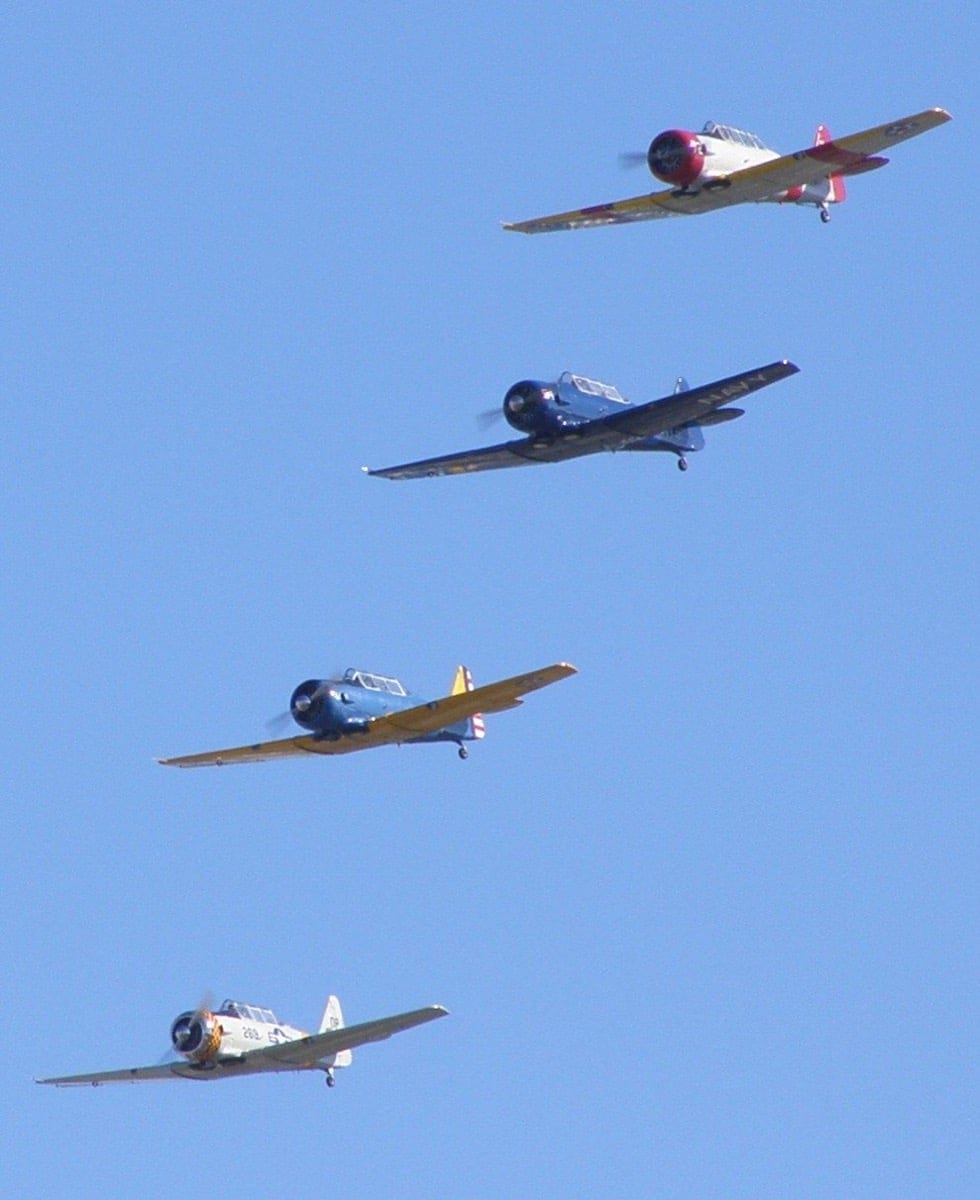
NATA aircraft types include all variants of the NAA P-51 Mustang, B-25 Mitchell, T-28 Trojan, T-6 Texan/SNJ/Harvard, NA-50, NA-64, L-17 Navion, F-86 Sabre, and T-2 Buckeye. In addition to our key mission of promoting safe formation flying, NATA provides educational scholarships each year through the Maintenance Scholarship program. The goal is to inspire the next generation of maintenance technicians to keep these historic aircraft flying, association officials note.
The North American T-6 Texan is a two-seat aircraft used as the advanced trainer for World War II pilots. Designed by North American Aviation, and first flown in 1938, the Texan quickly became the most popular trainer aircraft for the U.S. military in the 1940s and 1950s. More than 15,000 Texans were built between 1938 and 1947, and about 500 are still flying today.
Long ago a T-6 instr friend once said; ” If I had my druthers, I’d start em in a Bearcat, when good mov em into a Mustang, and when comfortable, then put em in a T-6!
My first encounter with the T-6, was in Kimpo AFB, Korea, I was assigned to a tactical squadron flying the T6, as forward air controllers.
When I was in South Africa in 1988-89 instructing Flight Test to a select class of SAAF pilots and Flight Test Engineers (all white during apartheid) there were at least 100 T-6s painted in a red and white trainer livery, all very clean and well maintained (received from Canada via Lend Lease Act during WWII) operating from this one airfield (can’t recall its name) being used as the primary ab initio trainer. The trainers were operating from a well manicured grass field complex of runways aligned in a 90 degree lattice configuration. I had the pleasure of flying the T-6 while demonstrating its spin characteristics for the purpose of teaching flight test techniques used in spin testing to both pilots and FTEs. One of its odd distinguishing characteristics, odd to me at least, was its heel of the right foot actuated starter button located on the floor adjacent to the rudder pedals. My biggest adjustment was getting use to timing the check forward on a two point landing touchdown to avoid the bounce. It was humbling at first especially on hard surface runways. Like all taildraggers it prefers to operate on grass.
Central Flying School, Dunnotter?