

Vehicles make more decisions for people than we might realize — and they have been for a while. Just nine years after the Wright brothers successfully flew the first plane in 1903, autopilot was invented. Cruise control came along in 1948.
But as both air and road travel witness the introduction of more automated features and shift toward highly autonomous systems, people will need more help learning how to use them.
That led to the formation of a team of researchers to develop algorithms that would allow a system to recognize when a human doesn’t know how to use it, and then adapt to that person’s skill level.
The researchers believe that these systems would not only train pilots faster, but also increase safety.
“We’re already asking humans to interact with intelligent machines and autonomous systems all the time, but we need to do it much better than we currently do,” said Neera Jain, an assistant professor of mechanical engineering at Purdue University.
The work, co-led by the University of New Mexico and Purdue in collaboration with the University of Colorado and the University of Texas at Austin, is part of a $5.5 million grant awarded by the National Science Foundation Cyber-Physical Systems program. The project is titled “Cognitive Autonomy for Human CPS: Turning Novices into Experts.”
The Purdue team will conduct experiments on how humans interact with complex machines, such as planes, drones, and autonomous cars.
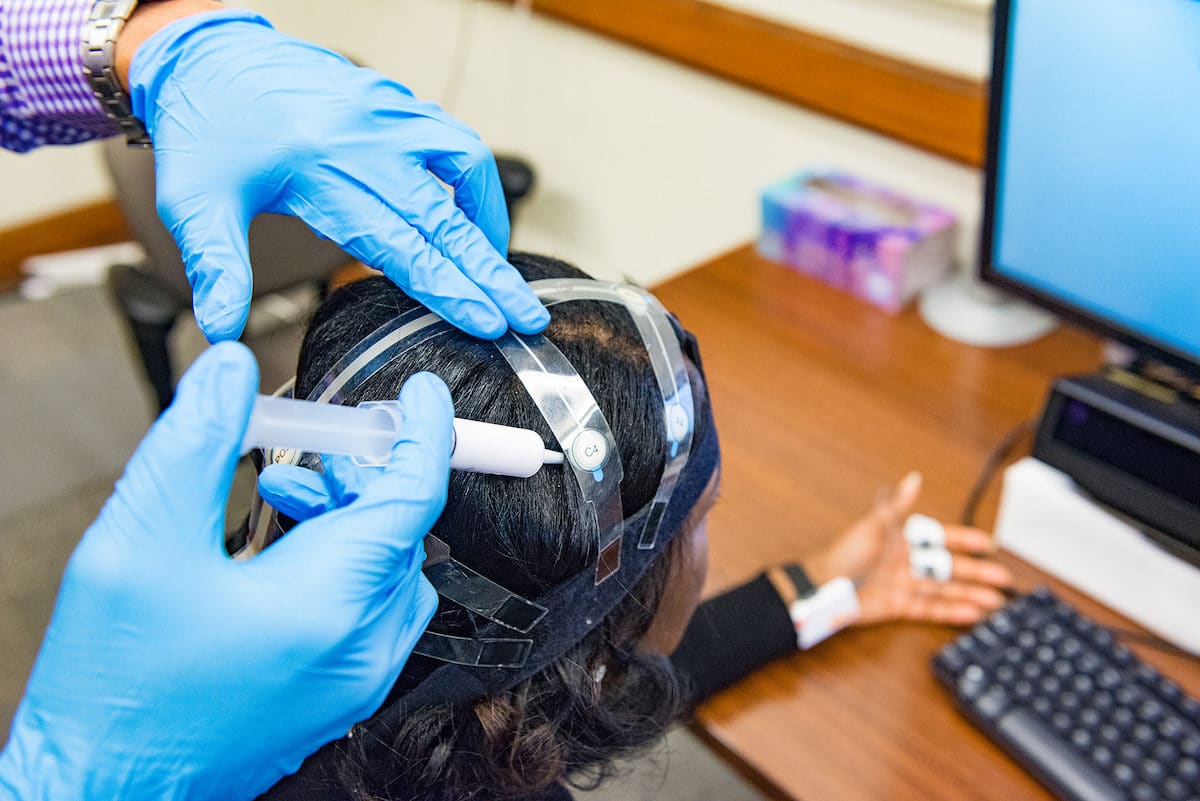
To study how much people trust these systems, the team will collect data on changes in heart rate, blood pressure, eye movement, and other metrics through psychophysiological sensors. Jain and Tahira Reid, a Purdue associate professor of mechanical engineering, developed models in 2018 that use these measurements to help a system estimate a human’s level of trust.
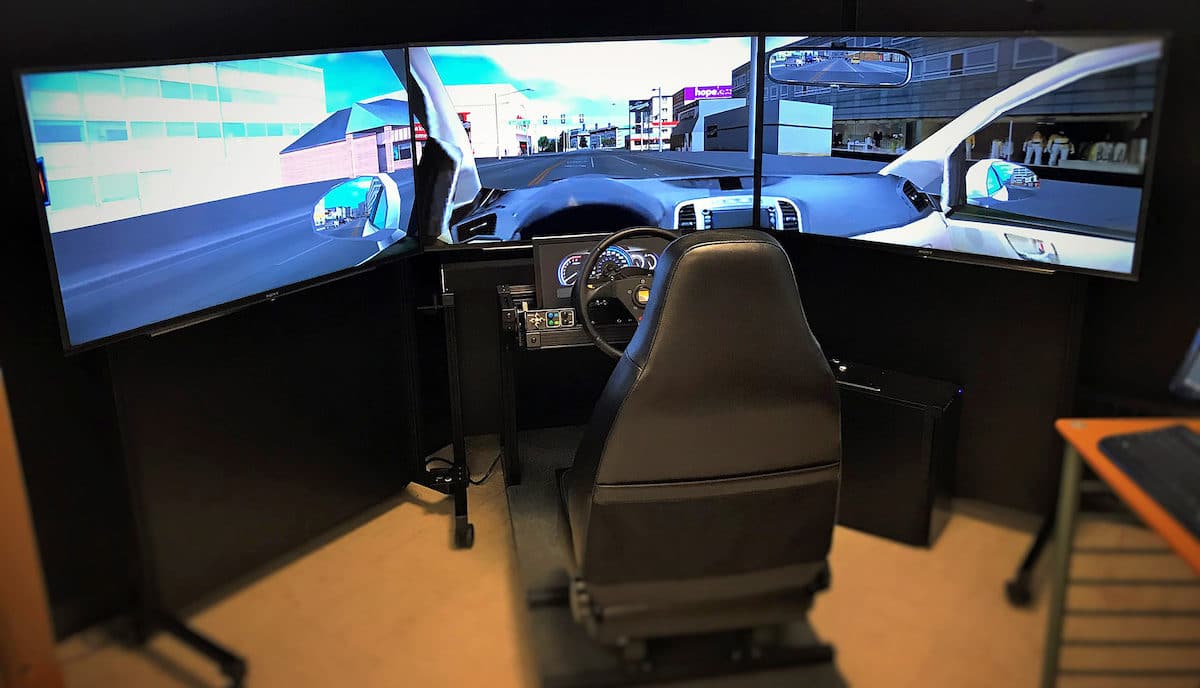
Performance will be studied as people interact with advanced driving simulations in the lab of Brandon Pitts, a Purdue assistant professor of industrial engineering, and virtual or augmented reality environments, such as a 20,000-square-foot unmanned aerial systems research and test facility at Purdue scheduled for completion this spring.
“Imagine an autopilot system that can identify your experience level and then gradually relinquish control as you improve. It could significantly reduce the amount of time it takes to train a pilot,” said Inseok Hwang, a professor of aeronautics and astronautics and principal investigator for Purdue on this project. Hwang’s lab will conduct research on human interactions with drones and other aircraft.
Imagine an autopilot system that can identify your experience level and then gradually relinquish control as you improve. It could significantly reduce the amount of time it takes to train a pilot.”
University of New Mexico researchers, led by Meeko Oishi, a professor of electrical and computer engineering and the project principal investigator, will use data from these experiments to come up with theories of how humans best learn while using these machines. The researchers will then develop algorithms and test them for translation into software that will enable machines to understand, predict, and adapt to human behavior.
The researchers hope the work will not only grow the field by developing machines that are responsive to human behavior, but also develop ways to prevent the ongoing pitfalls of how humans use autonomous systems.
“There are three things that the field wants to avoid fundamentally in human-machine interaction — misuse, disuse, and abuse of the technology. We’re designing new algorithms to make advances toward overcoming each of those barriers,” Jain said.
DON’T EVEN THINK ABOUT IT.
Seems like there’s a paradox here. They want to develop a truly intelligent automated aircraft piloting system to help train pilots. But if you had a truly intelligent automated aircraft piloting system, why would you need to train pilots??
Because a $5.5M NSF “grant” is available, you silly boy !!!
I started to google ‘Where does the National Science …’ and THIS popped out:
“Where does the National Science Foundation get its funding from?
Congress allocates money to fund the NSF from the federal budget. FYI, Social Sciences, the area drastically cut, does include neuroscience as part of the Behavioral and Cognitive Sciences subsection.”
The NSF ought to be researching ways to build airplanes cheaper instead of THIS nonsense !! Better still … their funding source ought to be cancelled.
I should have known! No wonder the NSF, FAA, HSA, TSA, EPA, etc., etc. are able to piss away Billions (maybe Trillions) of taxpayer’s dollars every year on useless nonsense!
But I guess that’s why Governments are formed in the first place.
Amazing!… Autopilots have been with us for over a century and not a single one has yet been invented which can fly an A/C at all well, let alone make anything resembling a decent landing; or even a safe one (Lord forbid) if there’s a crosswind! Put them all where they belong… in the junk truck!
Bullseye ?
Well Don, you don’t say what type of aircraft you fly with your ATP rating, but I have over 10,000 hours logged in the B-757/767, and I can tell you that the auto-land system in those and newer types are able to make prefect landings in up to a 10 knot crosswind. Those aircraft came into service at the beginning of the ’80’s so the autopilot system was developed in the ’70’s. And, yes, I have made more than one Cat IIIb auto-land approach at 300 RVR and zero ceiling that were not only “decent”, but pretty much perfect.
I do not agree with this idea of the plane training the pilot, but it is not correct to say that an autopilot cannot “make ….a decent landing”.
I disagree this is a good idea. The Boeing 737 MAX has a similar system, and look how great it is.
Having a machine make decisions about flight control that would remove me from the loop in a plane I am flying scares me. The recent experience of the 737 Max being flown into the ground by automated systems that were using faulty information is the worst case scenario. Having the aircraft systems take control close to the ground when I am landing off airport and intentional flying on the back side of the lift/drag curve would not leave enough time to turn the system of and recover before striking the ground. If systems like this become available, I will make sure they never get anywhere near a plane I open.
Yes, flight training is challenging, but learning that the machine will take over if you get sloppy is a very bad lesson. That mindset can lead you into situations that are deadly if the automated systems fail. Going through the arduous process of actually learning how to balance all the forces affecting your flight may take more time, and may be frustrating at times. The flip side is that investing that time in training produces pilots that are able to deal with the inevitable problem situations that can arise during flight, including problems with automated systems.
Interesting concept indeed. I wouldn’t mind a little “help” from time to time, but I do want to be able to turn it “off” and let me fly.
If this can be worked out, it will be very disruptive to flight training. It will get a lot cheaper BUT where are the airlines going to get multi-hour CFIs to fly their airplanes? If the number of high time CFIs is reduced, the airline’s pipeline of pilot candidates will also be reduced. So much for the 1,500 hours PIC rule . . .
“This is your captain speaking, I have two hours total time in this new Boeing 79997 semi-autonomous aircraft, but don’t worry, it will fly the airplane when I can’t. I’d like to thank every one of our 950 passengers today for flying Bohica Airlines. Have a nice day!”