

By SYD JONES
It was 75 years ago when the world breathed a sigh of relief as the most destructive event in human history finally came to a close. World War II ended against Nazi Germany in Europe May 8, 1945 (VE Day) and the war against Imperial Japan in the Pacific finished Sept. 2, 1945 (VJ Day).
Over the past several years, plans were made across the country to commemorate and thank the “Greatest Generation” on this milestone anniversary.
Two of the most ambitious events conceived were fly-overs of World War II era aircraft over Hawaii and Washington, D.C.
The planned VJ Day anniversary fly-over in Hawaii would be over Pearl Harbor and other military installations on Oahu where the surprise Japanese attack drew America into the war, as well as the battleship Missouri now docked in Pearl Harbor where the final surrender documents were signed in Tokyo Bay.
The fly-over scheduled for VE Day over the National Mall in Washington D.C. would highlight how America’s industry and workforce quickly transformed the country into an “Arsenal of Democracy,” producing the bulk of the weapons needed by America and its Allies in the effort against the Axis powers.
But 2020 unexpectedly became the Year of COVID-19. And that changed everything.
Even through the height of the pandemic angst during the spring months, the supporters of these two events did not give up. The D.C. event was not cancelled, but moved later in the year to Sept. 25. The Hawaii planners hoped that their late summer time frame would distance their event from the worst of the pandemic’s effects.
I was already scheduled to fly Larry Kelly’s B-25 “Panchito” in the D.C. fly-over when I got an unexpected series of phone calls early in July. Dave Prescott wanted his B-25 “Old Glory” to participate in the Hawaii event. The plane was in Florida at American Aero undergoing maintenance and would have to be flown across country to North Island in San Diego. There it would be loaded on the aircraft carrier Essex with other World War II aircraft being transported to Oahu for the event.

Andres Morales had been hired by Prescott to serve as its chief mechanic. The B-25 already had months of extensive maintenance carried out on it during its annual inspection, but was far from finished. The fuel tanks and props were still removed and modifications had begun to install a new avionics suite. He had been working long days assisted by American Aero staff as available but most of the responsibility was on his shoulders.
We were under a tight deadline to get the airplane there as it was supposed to be loaded aboard the aircraft carrier on Aug. 28, just two weeks away. After the repairs and avionics installation were achieved we would need to get in a couple of successful test flights before setting off to the west coast. It would be tight, but doable, with a bit of luck.
The old bomber was reluctant to come out of its beauty sleep. Lots of unexpected issues arose, which were frustrating and extremely time consuming. Our first test flight was almost a week behind schedule, and more items needed to be attended to.
Prescott kept in touch, relaying that the Navy was aware of our issues and might have a little wiggle room left in its schedule to allow us to make it aboard. The weather also looked like it could be a factor as an active hurricane season percolated in the Gulf.
Paul Reidy agreed to be my co-pilot for the cross-country trip and joined the group effort to help Andres get the bomber ready, but it seemed like the opportunity for departure was getting away from us.
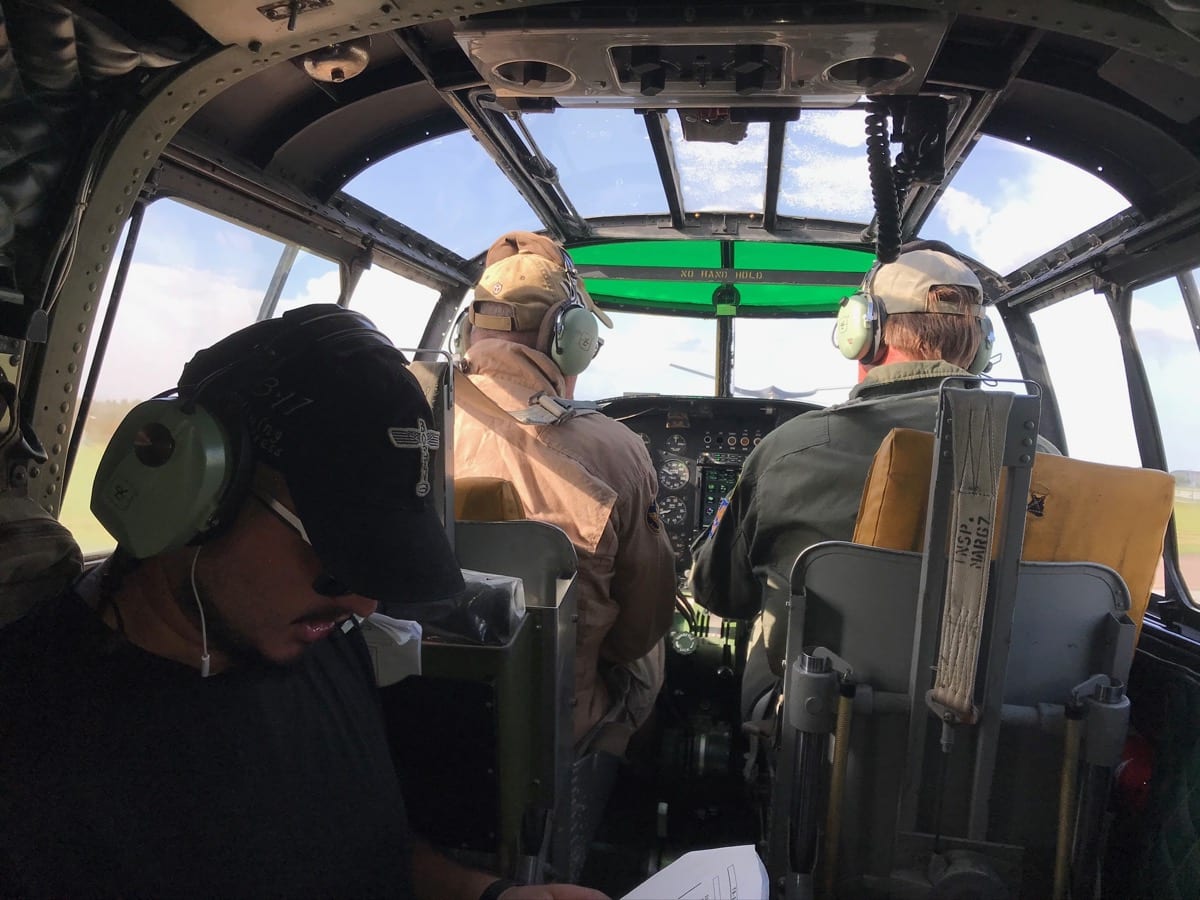
We were down to the last possible departure day when we managed to get in a successful test flight. Not wanting to waste time, Paul, Andres, and I flew from New Smyrna, Florida, to Kissimmee where my wife, KT, was waiting with our luggage. Even though it was late in the day, we quickly topped off the fuel tanks and departed westbound. We landed for the night in Mobile, Alabama, happy to have gotten a start on the trip.
The next morning presented low clouds in all directions, but we found a hole and climbed above them. Later we ran into the remains of a tropical storm across eastern Texas and had to pick our way through the rain. A quick refueling, oil check, and external examination in Waco and we were off again to El Paso.
Every stop we made became a local event as this unexpected visitor from World War II taxied up to the local FBO. Automatically KT dealt with the FBO office managers in getting the best fuel discount, Andres serviced the plane like a NASCAR pit stop, Paul inspected the airframe and helped Andres, and I calculated our next fuel stop.
My plan was to spend the night in Yuma, Arizona, which would allow me to call North Island the following morning with our arrival time and receive our Prior Permission Required (PPR) number to allow us to land on the base.
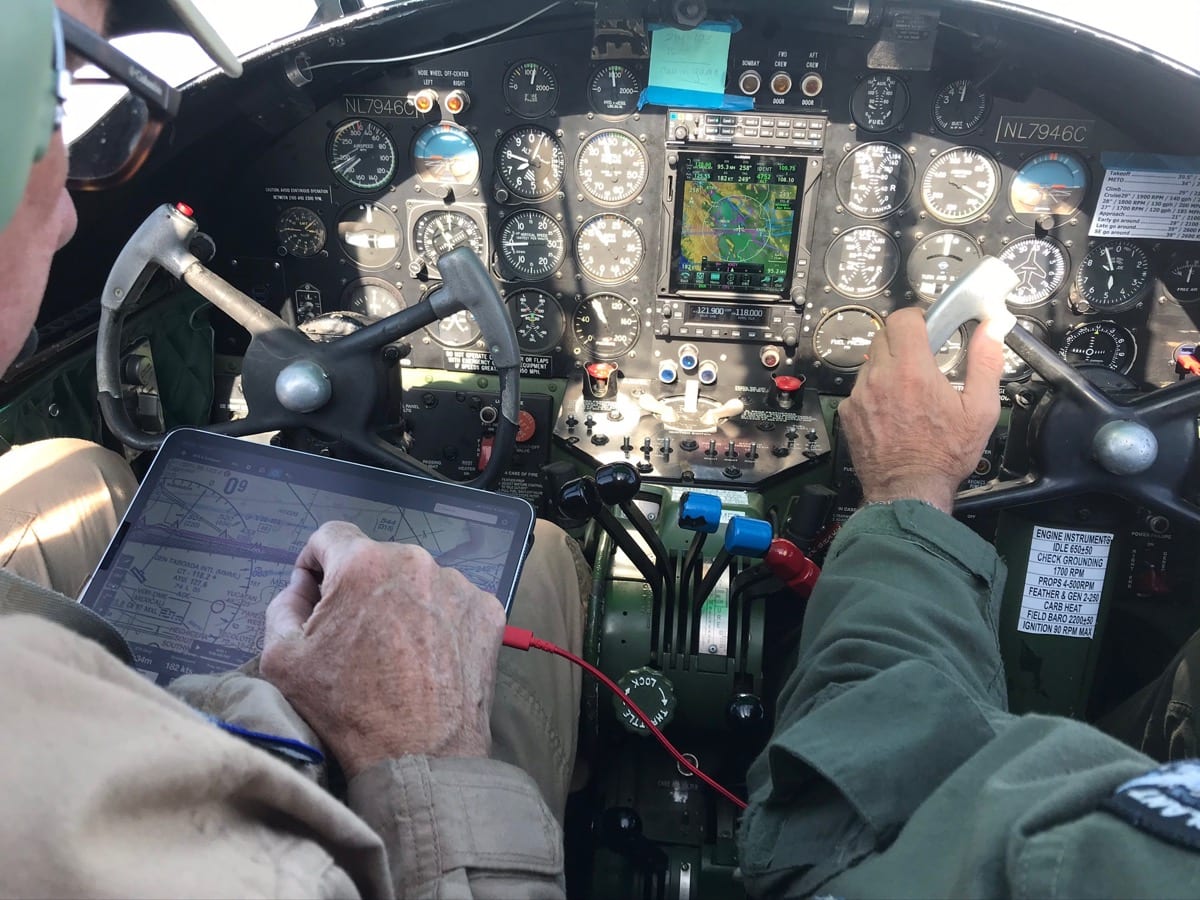
Flying a B-25 for hours is tiring due to the never ending low frequency, high volume noise level, but unlike single seaters, you can get out of your seat and stretch while someone else takes the controls, so the four of us shared the load.
Climbing over the mountains of the western states, we easterners were amazed at the vast dry landscapes below. I knew it was going to be hot when we began our late afternoon descent down to Yuma, but was still surprised to see the carburetor air inlet temperatures go into the red as we made our final approach. No go-arounds or takeoffs this afternoon!
Next morning, it was a much cooler 92° at 7:30 a.m. I contacted North Island by phone to report our inbound status. We then took off into a howling, tumbleweed blown devil’s breath wind of brown dust that we didn’t clear until 4,000 feet. We climbed over the last mountains separating us from our destination and were reviewing arrival options when we found out a marine layer had formed and had reduced visibility and ceilings to nil at North Island. I decided to land at Browns Field just north of the border and about 14 miles from North Island to allow the layer to burn off.
After landing, the locals all assured us the layer would burn off by noon (it didn’t). Then they said it would burn off by mid-afternoon (it didn’t). Finally they said it would fade just after sunset (it didn’t). I called the North Island tower several times during the day and was told they couldn’t see their own taxiways.
I noticed on ForeFlight that a small clearing from the north had actually made it down to nearby San Diego International. I talked to the North Island tower, who told me that if we came in from the north we might make it in. We started engines and were preparing to taxi when Browns Field tower notified us that North Island had called them — the field had once again dropped below minimums. It remained that way, even after dark.
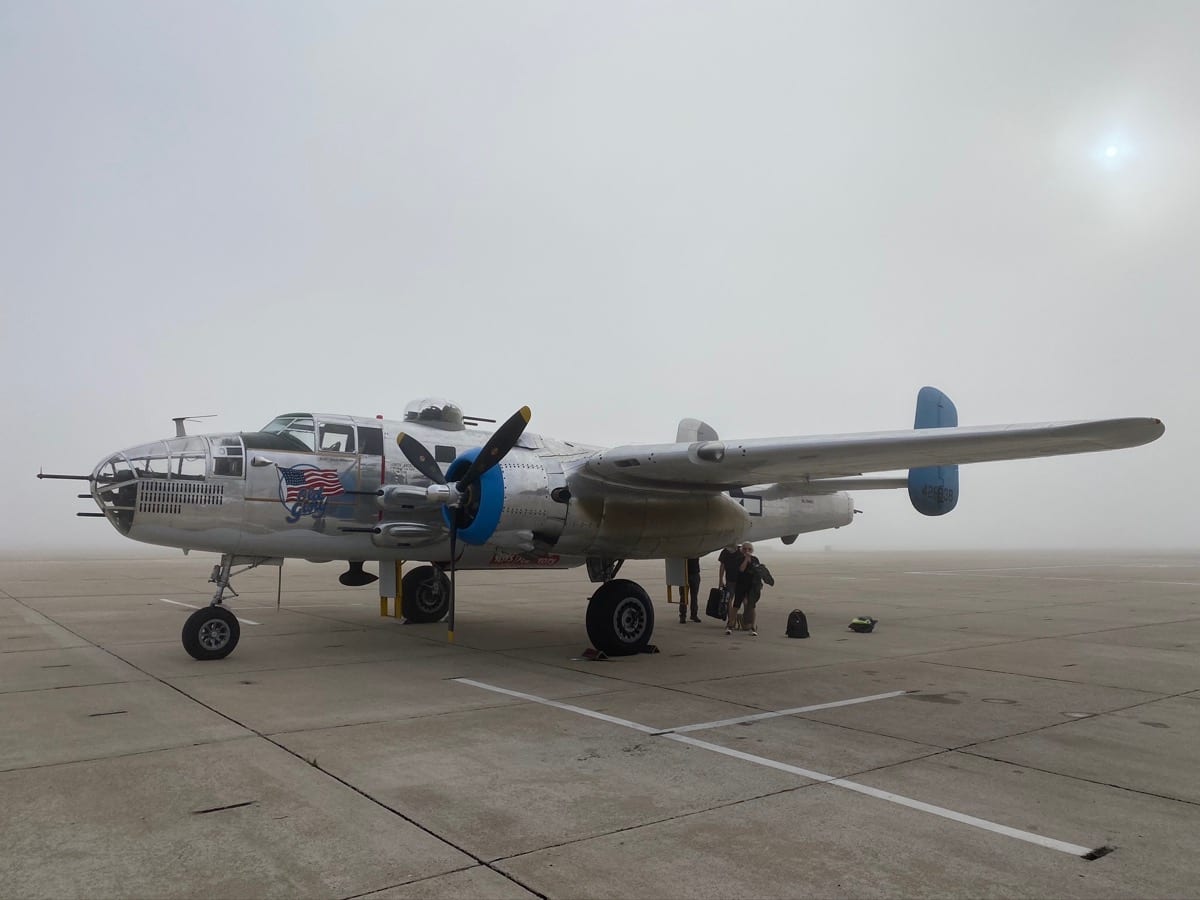
Next morning the marine layer seemed even thicker and covered Browns Field too. It was Aug. 2 and our last possible day to get to North Island. The carrier had time and again pushed back its departure to allow us aboard. Tomorrow it was leaving with or without us.
For the 50th time that day I examined ForeFlight, and noticed the same opening that occurred the previous day was there again. This time it looked like it might touch the northern edge of North Island. I called their tower again, and the controller said it looked clearer to the north. I asked her if she would let me in from the north on a “special” and she said yes.
We threw our luggage aboard the airplane, boarded, and called North Island tower one last time. Was it still clear from the north? “For now!”

We launched quickly and climbed through the maze of controlled airspace around us. Paul was manning the radios like a virtuoso and we were cleared through a quicker route than expected right over the top of San Diego International Airport at about 700 feet. A quick final and landing on One Eight— we made it! About a half hour after we landed, the marine layer closed over North Island again.
The B-25 was towed down the streets of the base from the airfield to the awaiting carrier. Within an hour it was being hoisted aboard, the last plane to be loaded.

Those of us involved with the Hawaii fly-over were given special waivers as “essential government employees” to circumvent Hawaii’s lock down response to COVID-19. We were all required to take a COVID test immediately after arriving and were supposed to self-quarantine until receiving the expedited results.
From that point on we had free access to the military bases on the island and were supposed to remain in a bubble of fellow participants. Hawaii had been in a constant state of flux for months dealing with the demands of the pandemic. Our group was “special” and this was hard to explain to the various authorities who were dealing with ever-changing rules and regulations set by the government.
Rob Pinksten and Taigh Raimey had already taken Old Glory up for a flight before I arrived, but the crew roster would change. Because the B-25 had seemed unlikely to make it to the ship on time, Rob had agreed to fly a TBM Avenger for the owner instead. Taigh had intended to fly his PV-2 Harpoon, but it was sidelined with engine problems before it could be put on the ship. Taigh had been integral to the loading and unloading of the planes from the carrier, but was without a ride. I needed a co-pilot, Taigh was qualified, and we had flown together before, so it was an easy decision.
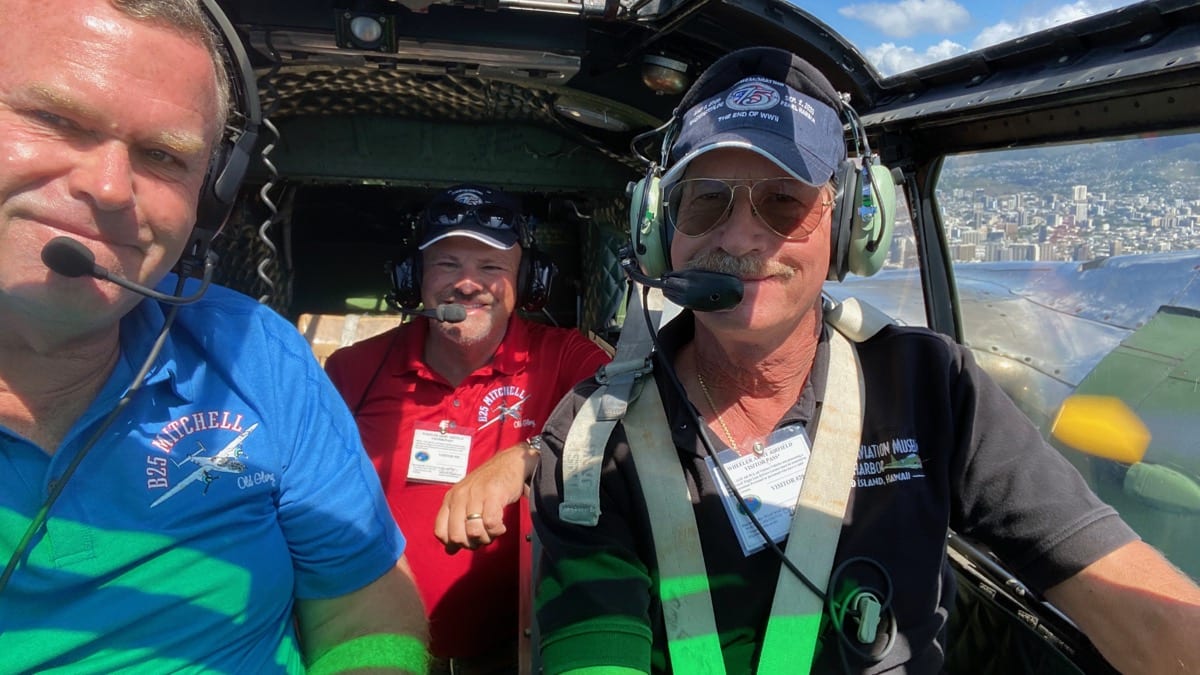
Once the World War II aircraft were unloaded from the carrier, they were transported to Hickam Field. Any post-shipping maintenance necessary prior to the flying activities was carried out in the base’s cavernous hangars. Hickam Field and Honolulu International Airport (PHNL) share runways, so once ready to fly, the aircraft taxied to PHNL and were initially staged from there.
Having lived and worked in Hawaii, I wondered how high the frustration level of the event planners was in putting this fly-over together. Combining layers of military regulations, local FSDO interpretations, and Hawaii’s irascible government with a frosting of Coronavirus panic would be a challenge few would willingly accept. Fortunately for us, Elissa Lines and Clint Churchill of the Pearl Harbor Aviation Museum, Bruce Mays, and a few others stepped boldly into the breech.
For two days Taigh and I flew sponsors and media around the island in the B-25. Our riders were thrilled and it gave us a chance to practice Honolulu’s unique departure and arrival procedures. My local knowledge came in handy in identifying where we were supposed to go.
At the end of the day, all the crews would meet on the fifth floor pool deck of our hotel for “debriefing” while maintaining our required bubble. We were the vast majority of the people staying in the multi-storied hotel, and were spread out over two floors. Someone from the adjacent high rise apartments called and complained that we were too close together, didn’t have masks on, or there we too many of us.
During our second night on the pool deck we learned that the local FSDO had declared that none of the experimental category airplanes would be allowed to fly in Honolulu’s Class B airspace. Since we were all staged under that airspace, the Wildcat, Bearcat, and T-28 could not fly. The event planners immediately began negotiating with the FSDO over this, but for a time it was a tense situation with a less that satisfactory result.
Instead of issuing a waiver for this special event, the FSDO declared that the experimental aircraft would only be allowed to depart and arrive at Honolulu over the ocean to the south of the airport, and they would not be able to fly over Pearl Harbor, Honolulu, or any populated areas.
The planners began immediately working on an amended fly-over route solely for them. We were also disappointed to learn that Hawaii had decided not to allow the World War II veterans scheduled to fly in from the mainland for the commemoration to come to the islands over COVID concerns.
On Aug. 27 we all flew to Wheeler Field where we would be operating from for the fly-overs. Wheeler, like Hickam, was a primary target during the Japanese attack, and many of the P-40s based there were destroyed. Wheeler is now an Army helicopter field, but its historic hangars still stand. Our daily briefings were held in a hangar that was heavily damaged during the attack.

On Aug. 29 we did our first parade flight. The three experimental airplanes would depart to the north and would fly down the east and west side of the island just off shore before retracing their route back to Wheeler for this and the other parade flights.
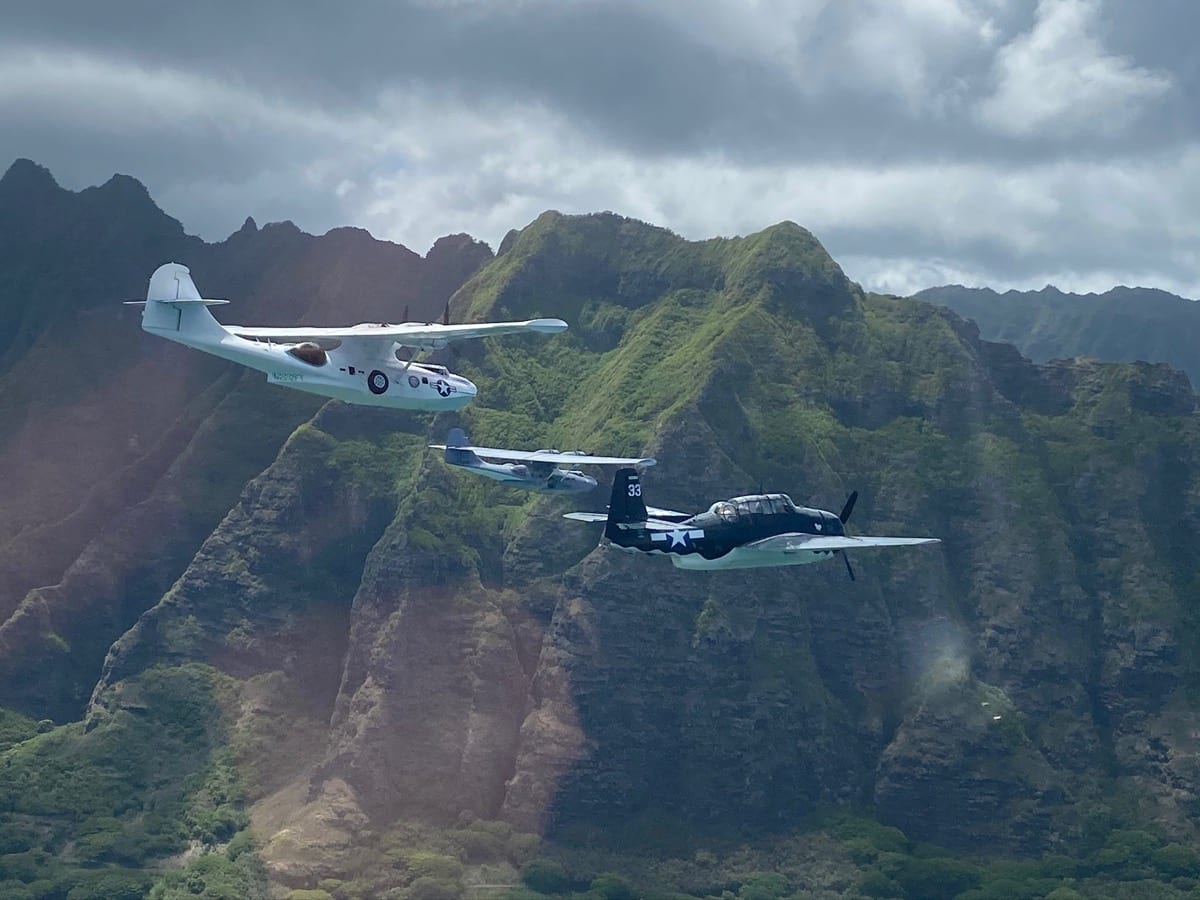
Old Glory lead the main parade, followed by a P-51, a TBM Avenger, two PBYs, a flight of T-6s, and a lone Stearman.
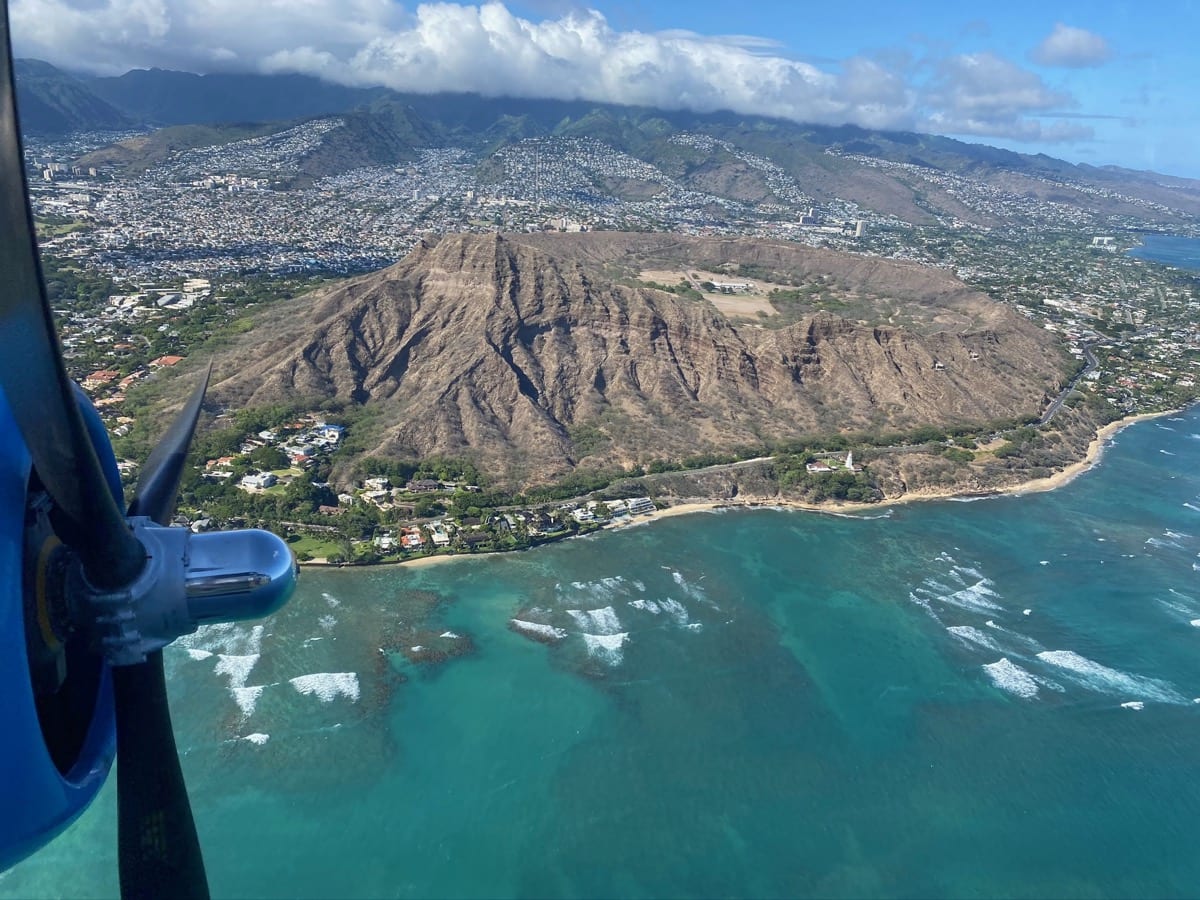
Our flight path took us over Pearl Harbor, just north of Hickam/Honolulu, the “Punchbowl” (National Memorial Cemetery of the Pacific) past Waikiki, past Diamond Head and Koko Head, past Bellows Field and Kaneohe (both attacked during the Japanese raid), over the Opana radar site (where the Japanese attack was first spotted) and Haleiwa Field (where Lts. Welsh and Taylor got airborne during the attack and shot down six Japanese aircraft), then finally back to Wheeler.
Due to the speed differential, the flight spread out pretty quickly. There were a few cars along the Wheeler base fencing defying the government lockdown to watch us take off and land.
The only incident of the event happened on return to Wheeler. The Bearcat had brake problems and taxied into a large fire extinguisher placed on the flight line and then into a T-6 that had just shut down. Fortunately no one was hurt.
The military originally would not allow marshallers on the flight line despite KT’s request, however they learned fast that taildraggers are not the helicopters they were used to. KT was asked to organize the marshaling and no further ramp issues occurred.
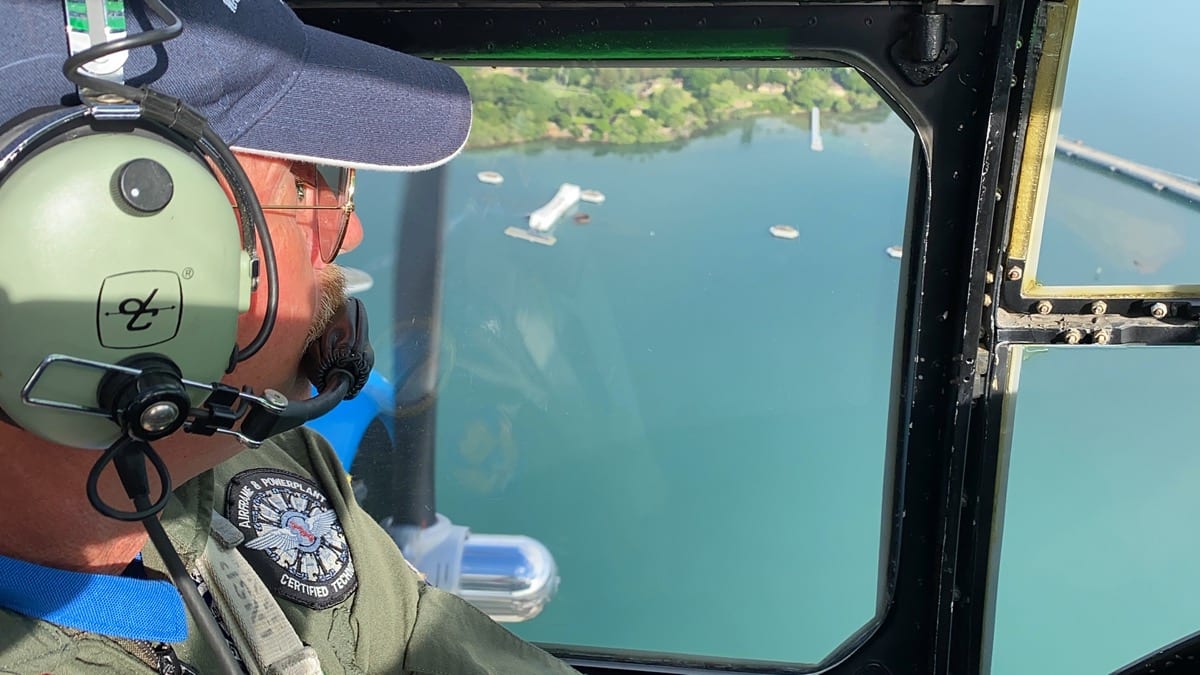
The following day we performed the next parade flight, which was also a practice for the big day. The main group was again led by “Old Glory,” and this time we departed to the north to Haleiwa Field, Dillingham Field, Keana Point (where the Japanese attacked Pearl Harbor and Ewa turned south), followed the western shoreline (the Japanese Pearl Harbor/ Ewa attack path) across the western shoreline just north of Barbers Point/Ewa and continued descending to 1,000 feet to fly over the southern and eastern shore of Ford Island past the U.S.S. Missouri and U.S.S. Arizona before returning to Wheeler.
That afternoon we did a formation flight with a PBY down to Kaneohe and returned. The next day more media flights for us and a fun formation flight again to Kaneohe with two PBYs, the TBM, and a P-51.
On VJ Day (Sept. 2) we made our final parade flight, a virtual carbon copy of the previous one. The P-51 had joined us for this final portion of the parade as I slipped the bomber left wing down near the Missouri and Arizona. We returned again to Wheeler.
My last flight in Old Glory was on the return flight to Honolulu. We joined the two PBYs as they flew down the eastern shore of Oahu, and watched one do a water landing and takeoff near Kaneohe. We then proceeded past Koko head and held over Diamond head while the PBYs were cleared to Pearl Harbor for a final splash n’ dash there. Finally we were released to join them over Pearl Harbor and circled Ford Island a number of times before recovering at Honolulu.
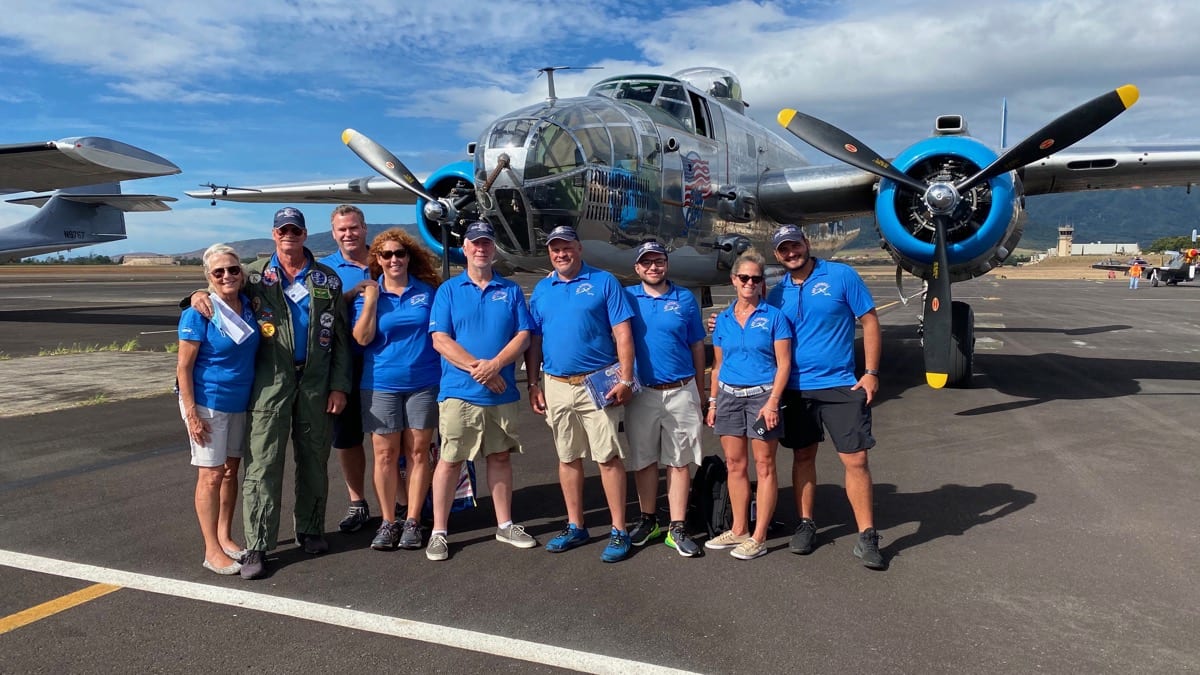
The next day the B -25 would be loaded again on the aircraft carrier for the return trip to the mainland. It had been a rare privilege to fly the B-25 over Oahu’s historic sites 75 years on.
During my time in Old Glory it had not missed a beat — all the work to get it ready for its long trip had really paid off. I enjoyed flying the nicely rigged airplane, but not more than getting to share the experience with KT, Paul, Andres, Taigh, David Prescott. and the Prescott Foundation Crew.
Read Part II of Syd’s story about the Washington, D.C., fly-over here.
Editor’s Note
Unfortunately, Old Glory crashed in Stockton, California, on Sept. 19 after a mechanical issue forced the crew to put the B-25 down in a field, where it hit a drainage ditch. The crash did extensive damage to the aircraft, including tearing the starboard engine completely off the wing. Look for an update on Old Glory in an upcoming issue of General Aviation News.
Fascinating story. Thanks.
As so many of us do, we watch aerial parades in the sky of special airplanes on special occasions as they fly serenely past to pay homage to these special occasions.
The story of Old Glory and its triumph over the many problems presented and solved before the final parade honoring those who served in the military and were present during the Pearl Harbor attack on December 7, 1941, is a story of extreme dedication and talents. That mechanical and operational problems that were solved before the flight could occur are minor miracles.
The objectives were all met with patience, skills, and a do-or-die philosophy. Kudos to the crews of Old Glory and all the other planes that were flown.
Ann Holtgren Pellegreno
Incredible effort for an incredible event. I would expect nothing less from Syd, KT, and the whole OLD GLORY operation.
That was a great story. Thanks for posting.