

Amanda, a student pilot from California, writes: In studying the various kinds of flaps, three of them — plain, split, and slotted — all have very clear descriptive names. Then there is Fowler. What is a Fowler?
Funny that your question about flaps came in when it did. Just yesterday, the flap on a high-wing plane put a heck of a bump on my head. Being a low-wing jockey, and wearing a cap to keep the sun out of my eyes, I guess I lost situational awareness of the possibility that there was something above my head that could injure me during preflight.
It wasn’t actually a Fowler flap, but a split flap that gave me a splitting headache.
Now, to answer your question: Fowler isn’t a what, but a who. They’re named after Harlan Davey Fowler, the guy who invented the most complicated flap in our arsenal.
But before we dig into Fowler’s very interesting story, real quick for my non-pilot readers: A flap is a bonus flight control (more correctly called a secondary flight control) that allows pilots to change the shape of their plane’s wings in flight.
Why would anyone want to do such a thing?
Well, there’s no such thing as the perfect wing. A wing that rocks in cruise flight isn’t always the best for takeoff or landing — especially when the runway real estate is on the short side. At the same time, an awesome short takeoff and landing wing may not be the best wing for getting anywhere fast.
Flaps essentially allow pilots to carry more than one wing with them, and choose the best one for the job at hand. Flaps are located on the trailing edge of the wing, and most, but not all, modern airplanes have some sort of flap.
For perspective on what the Fowler flap is, we’ll need to quickly sketch out the different types of flaps.
The plain flap is simply a hinged section of the trailing edge of each wing that can move downward like a horizontal door, changing the shape — and the characteristics — of the wing.
With a split flap, on the other hand, only the bottom surface of the wing moves down; the top is solid and stays unchanged when the flap deploys.

Slotted flaps are similar to the plain type, but allow air to slip through a slot between the wing and the flap when it’s deployed.
But the subject of today’s concern, Fowler flaps, are a different kettle of fish altogether: They slide out the back of the wing on tracks as they deploy, literally making the wing larger, rather than just changing its shape.

All four flap types (and there are other sub-species of flaps in the aeronautical universe) have their advantages and disadvantages. The main advantage of the Fowler is that it creates massive lift compared to the others, but on the down side, it’s more complicated to engineer and maintain, and the size of the flap and its associated hardware adds weight to the airplane.
Interestingly, this sophisticated marvel of aeronautical engineering appears very early in the history of aviation — a mere 18 years after the Wright’s first flight, and only five years after the first airplane flap of any kind — a time when most airplanes were still made of wood and fabric.
The Fowler flap, a standard on commercial jets today, was decades ahead of its time. What kind of person was Fowler that he could see that far into the future? Did an apple fall on his head and trigger innovative thought?
Not quite.
Born in 1895 to Dr. Charles Fowler, the first physician in Sacramento, and his wife Carrie, the young Harlan was bitten by the aviation bug early on. He built model airplanes, and by age 15 he was experimenting with Cody/Hardgrave-style man-carrying kites. In 1917, after the U.S. declared war on Germany in World War I, he joined the newly created United States Aviation Experimental Bureau, a department that newspapers of the time declared was on a mission to establish “an Airplane Corps second to none in the world.” Fowler quickly worked his way up to the second in command of engineering design at McCook Field in Dayton, Ohio — the Edwards Air Force base of its day — the very nerve center of early military aviation R&D.
But he didn’t stay there long. In addition to aviation, Fowler seems to have been bitten by a second bug: Entrepreneurship. He worked with a number of firms as a consultant in the 1920s, helping to develop the Pitcairn Mailwing, Aeromarine flying boats, and even the U.S.S. Shenandoah, the Navy’s first “Zeppelin.”
Then he had the bad timing to start his own company, Fowler Airplane Wings, Inc., right before the stock market crash of 1929.
Needless to say, that didn’t work out too well, but he spent the rest of his professional life as a successful independent engineer, working as a consultant for some of the biggest names in the biz: Convair, Douglas, and Martin, as well as the U.S. Air Force and U.S. Navy. He held more than 20 patents, won the Franklin Institute’s prestigious John Price Wetherill Medal, and wrote numerous scientific articles and several books. San Jose State University’s Special Collections & Archives is the home to his papers. All 27.5 linear feet of them!
In addition to the Fowler flap, he’s also the father of the modern cargo container used in air freight, and he developed vertical takeoff and landing aircraft in the 1960s.
But the flap! When, during this prestigious career, did he develop the flap? And who was he working for at the time?
It was a personal project. He did it on his own, using his own funds, receiving patent number 1,392,005 in 1921 for the concept, which at the time he called a Variable Area Wing.
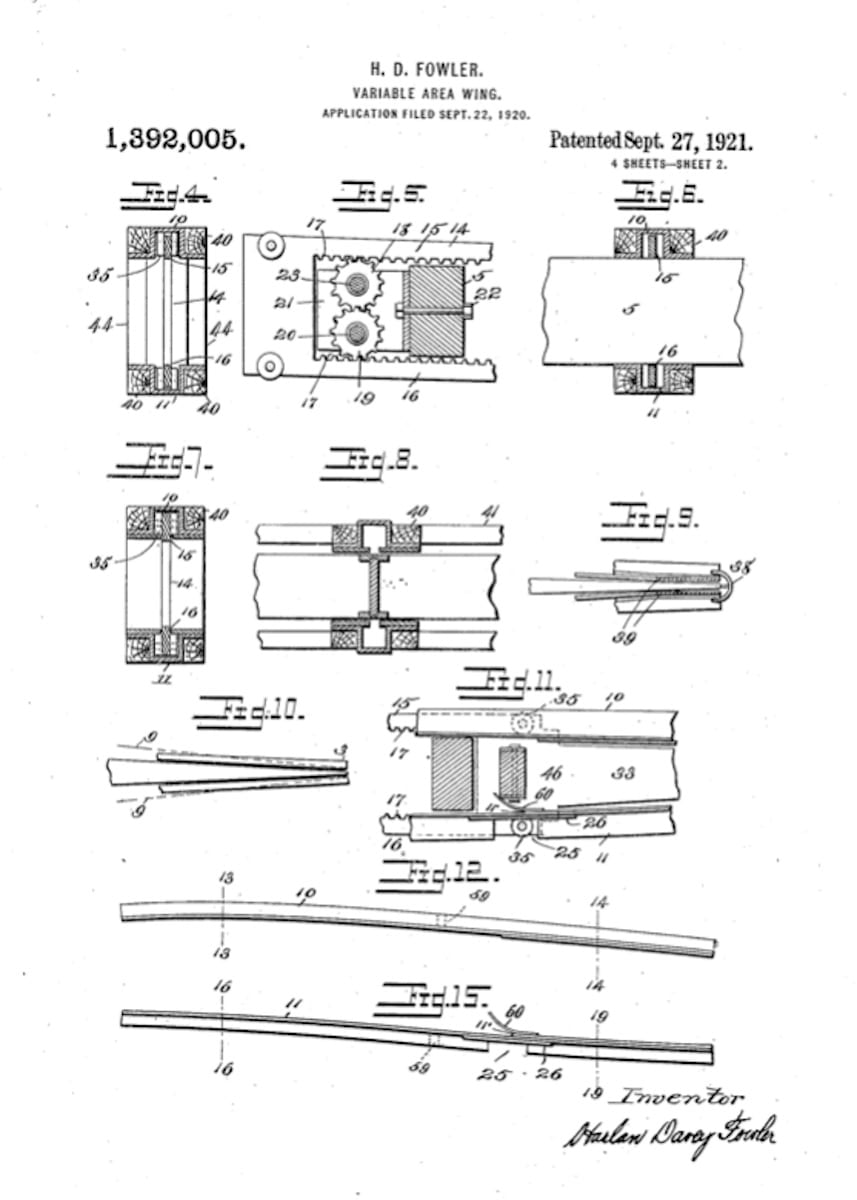
A patent is one thing. He still had to prove it worked. And then sell airplane manufacturers on the idea.
Fast forward to 1927: Working with mechanic Stanley Crowfoot, he built prototypes that were tested in the wind tunnels of the National Advisory Committee for Aeronautics, the forerunner to NASA, which at the time were managed by engineer Fred Weick, who would in later years go on to design the Ercoupe, Piper Pawnee, and the original Piper Cherokee.
Weick gave the Fowler flap his blessing, and collected data showing that the Fowler flap reduced landing speed, decreased both landing and takeoff distance, and improved climb.
The flap’s airplane debut was on the unsuccessful Martin 146 bomber prototype in 1935. It also appeared on production models of the Lockheed 14 Super Electra, a plane built to take on the Douglas DC-2 and Boeing 247 in the early airliner arms race — an arms race that both Lockheed and Boeing lost to Douglas’s split flap DC-3.
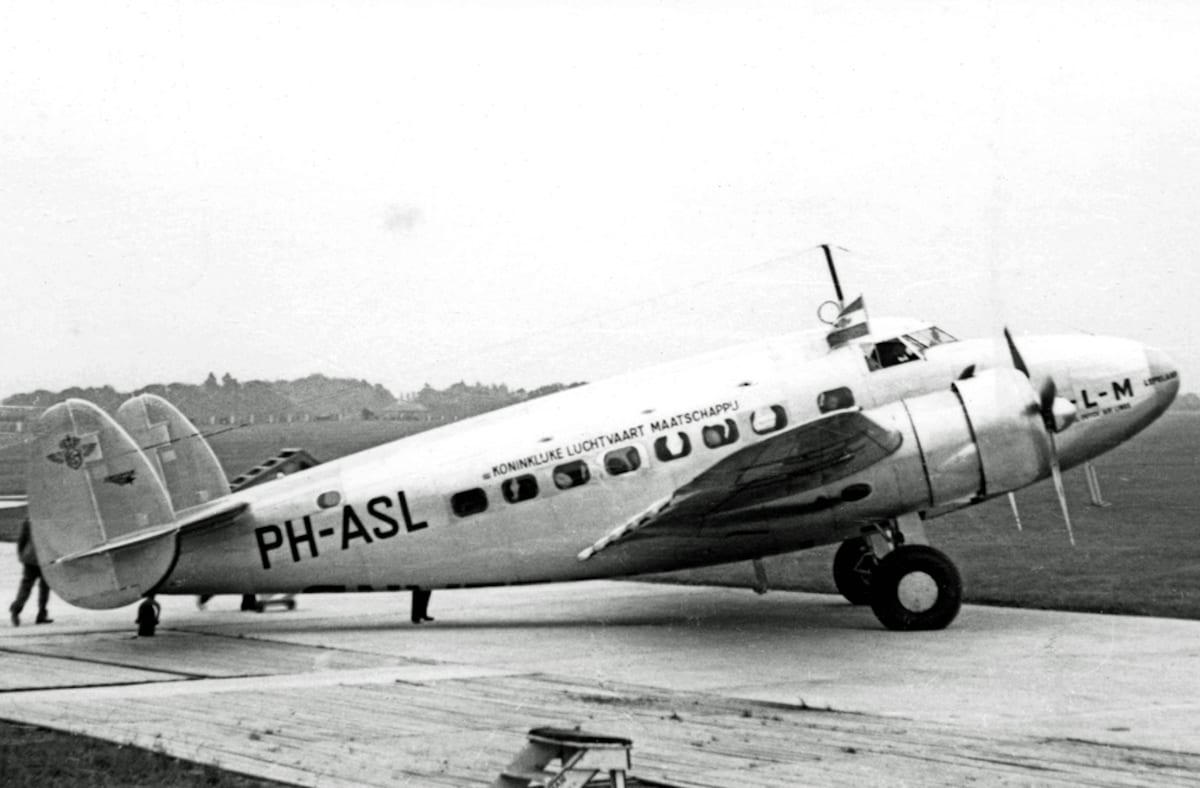
But despite that early loss, Fowler flaps would live on. They were used on the P-38 Lightning, Boeing B-17 and B-29, C-130 Hercules, and later took prominence in the jet world on the 727 and the 747.
In our universe, some Gulfstream have Fowler flaps, as does the Kappa KP-5 LSA, and some STOL modified Cessna light twins and Super Cubs.

I appreciate your article as it comes when I am lecturing today on this exact type flap to my AMT class on the various control surfaces and how they work. This gives a great explanation of the system and more importantly the history. You are providing more information then just the textbook info and it is appreciated.
Your article should start with a broad generalization and then go into the details of the various types. Flaps give the airplane wing more lift (and drag) at lower airspeeds. They prevent stalls at lower airspeeds (perhaps the most important feature). They allow (safe; anti stall ) increased angles of ascent and descent (perhaps the second most important feature).
Most SE Cessnas have moderate Fowler flaps.
I’m surprised the whole single engine Cessna line isn’t included in the list. I always thought they were Flower flaps since they run on a track that goes back and down. Did you forget?
The Cessna Cardinal also has Fowler flaps.
I just can’t picture that but next time l see a Cardinal l will have a close up look.