


Fatal accidents in amateur-built aircraft were up slightly over the last year, but still remain below the historic average.
For the federal fiscal year ending Sept. 30, 2022, the FAA reported there were 56 fatal accidents in experimental category aircraft over the preceding 12 months, including 39 in amateur-built aircraft.
That compares to 42 total accidents — 33 in amateur-built aircraft — during the 12-month period between October 2020 and September 2021.
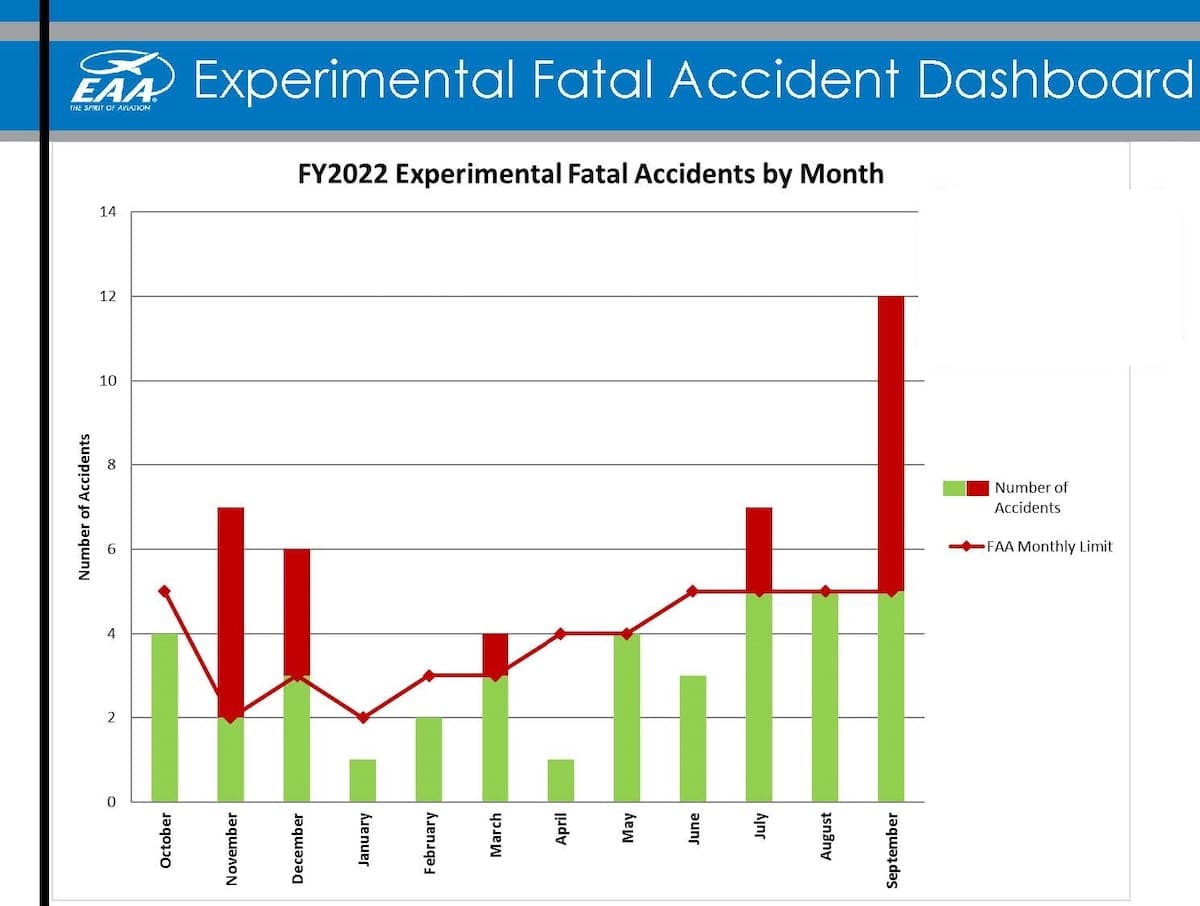
“The fatal accident totals, for both amateur-builts and experimental aircraft overall, remain 30% to 35% below where they were just a decade ago, including when looking at the three-year rolling average on which the FAA bases its annual not-to-exceed number,” said Sean Elliott, vice president of advocacy and safety for the Experimental Aircraft Association (EAA).
“While that’s good news, we never want to see an annual increase in the totals,” he continued. “That’s a reminder that we all must continue to work to make safety the top priority even with the small numbers we see each year.”
The higher accident totals in experimental category aircraft mirror an increase for all of general aviation over the same 12-month period, according to EAA officials. This also coincides with preliminary figures that show an increase in flight hours in 2021 and into 2022, they said.
“EAA has been deeply involved in FAA’s safety analysis teams for several years, and we consistently see that experimental aircraft accident causes are very similar to accident causes for all GA accidents,” Elliott said. “It shows that the accidents overwhelmingly do not occur because a pilot is flying an amateur-built or experimental aircraft, but because of factors relating to pilot decision-making or flight procedures. Those are areas where EAA safety programs and resources can make a difference.”

EAA has worked with the FAA and NTSB on efforts to reduce fatal accidents, such as distributing thousands of copies of the EAA Flight Test Manual to amateur-built aircraft owners and recommendations such as the increased use of an additional safety pilot during initial flight testing in amateur-built aircraft. Other safety initiatives, including regular safety webinars, have also put the spotlight on safety for experimental category aircraft, EAA officials said.
I guess you can just stay in bed. Life is a risk and you mitigate the risk with common sense and learned responses.
Dear Sirs,
Three miles a minute in a home built a/c is not unusual.
Many have approved equipment installed that is too time consuming to operate or interpret. (EDM GPS)
It distracts the pilot from the basic task of flying.
Look out!
The Gov’t book is a good idea, but… “You can lead a horse to water, but you can’t make it drink” so goes the expression. You have to actually read the book. Every hobby has its risks and risk-takers. Mine is amateur radio. Every year some Sam Ham kills himself by touching the high voltage wires in his amplifier or falls off a ladder or out of a tree to his death while stringing an antenna. Why? Enthusiasm for the hobby overcomes safety consciousness. I can appreciate the awe and wonder of rising above terrain in a machine you designed and constructed must be a thrill. But when the pilot leaves caution, by-the-book procedures and plain old common sense behind on the ground, he hastens his own funeral. Sad but true. No government manual will change basic human nature of disregarding risks and plowing full-speed ahead.