

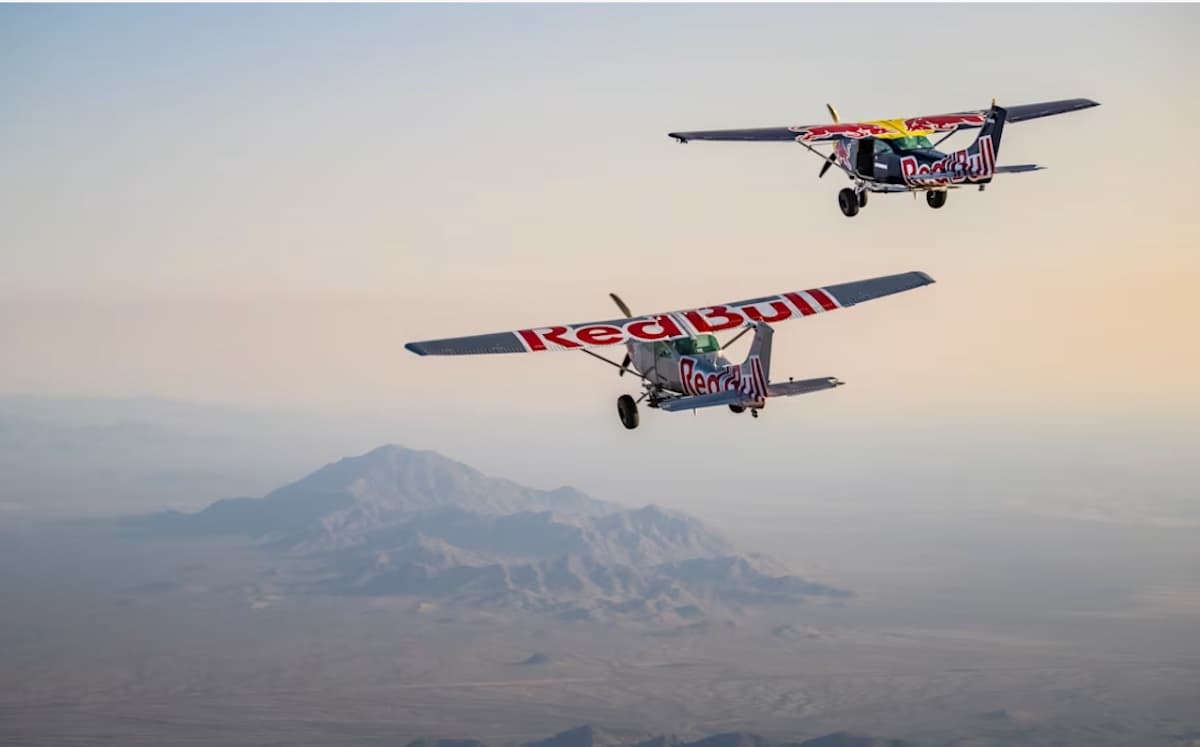
At a glance you’d be forgiven for thinking the report had to do with a crash of some new pilotless air taxi prototype.
The probable cause finding from the NTSB on the accident reads: “The unoccupied airplane’s exceedance of the critical angle of attack, which resulted in a stall, subsequent inverted spin, and impact with terrain.”
But seconds before the stall, a man was at the controls. A man who, once he got back to earth, would find himself not on terra firma, but in hot water.
Of course, I’m talking about the Red Bull Plane Swap debacle.
A Teaching Moment… and Then Another
In the weeks leading up to that Spring 2022 event, my CFI candidates were full of questions about the legality of it, which makes sense given that a significant portion of CFI training deals with regulations.
So I used the impending Plane Swap as a lens through which to teach about the waiver process that’s used for some air races and acrobatic competitions, as well as air shows and other exhibition events. The process by which you can ask — in advance — for permission to break the rules. A process that outlines your safety precautions and your reason for wanting to do so.
Plane Swap was a wonderful case study, or so I thought.
And to be perfectly honest, I was pretty stoked about the event itself. I subscribed to Hulu just to watch it. I even figured out how to project from my laptop through my “powerpoint” projector to a big screen and organized a watch party with all kinds of Super Bowl-esque food and adult beverages.
Of course, in using the event as a lens to teach the waiver process, it never once occurred to me that the organizers did NOT have an FAA waiver. I mean…live stream? Major sponsor? No waiver?
But as it turned out, in the following weeks, I was able to use the Plane Swap as a lens through which to teach something else altogether: The certificate revocation process.

The Failed Swap
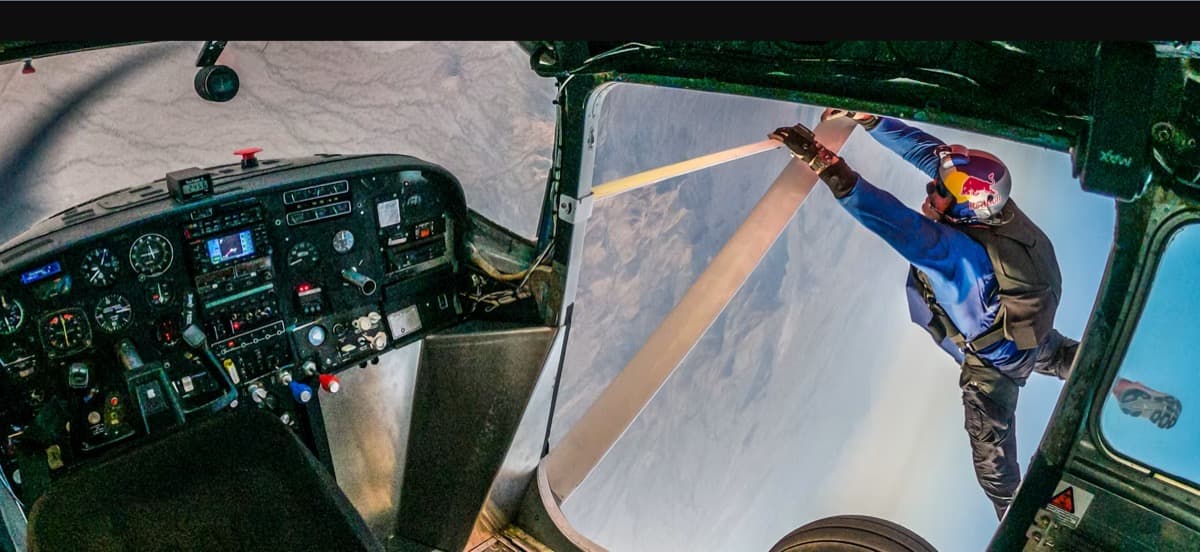
Almost everyone knows the basic facts: Skydiver pilots and cousins Luke Aikins and Andy Farrington intended to take a pair of highly modified Cessna 182s up over the Arizona desert, put them in 90° dives, and then each jump out of their planes and free fall to the other’s airplane, “swapping” pilots and planes in midair.
They had done dry runs of the concept with safety pilots, but the live stream on Hulu would be the first time the self-described “spectacle” would be attempted with just the two pilots, leaving the airplanes to their own devices for just under a minute.
Aikins successfully reached Farrington’s airplane, recovered, and landed.
However, Aikins’ own plane quickly went out of control after he jumped ship. I can still remember the collective gasp from the pilots at my watch party as the plane entered its death spin.
The Waiver
Now, at the time, the hype from Red Bull in the media said “the wild idea” for the Swap was a full decade in the making, and that the airbrake system for the two airplanes alone took over a year to develop.
So all of that said, when do you think the FAA was brought into the picture?
Are you sitting down?
Aikins, the lead for the project, did not petition the FAA for an exemption until a mere 55 days before the event. To its credit, the FAA fast-tracked the request.
Agency officials asked for more information within a month, but apparently didn’t like what they heard. On April 22, 2022 — two days before the live stream — they denied the petition.
Granted, at that point the pilots are pretty much warming up their engines for takeoff. But still, knowing it was illegal, Aikins went forward with the event.
Trying to Fly a Loop(hole)?
Which leads one to ask: What on earth was he thinking?
My guess is that the demons of external pressures possessed his soul.
In the denial letter from the FAA, Robert C. Carty, the Deputy Executive Director, Flight Standards Service, wrote that Aikins — in his response to the FAA and in a subsequent conversation — “expressed that he has made media and sponsor commitments regarding this event.”
Carty didn’t say as much directly, but the tone of his letter was “not my problem.”
And I can’t blame the agency.
Still, why did Aikins wait so long to petition for a waiver?
I think a clue is to be found in his mandatory report to the NTSB.
Aikins writes that immediately before the accident, “I manually deployed a specially designed drag device, manually engaged the pitch/attitude hold and shut down the engine, transforming the airplane into a non-flyable free-falling object.”
He went on to say that he then “exited the free-falling object.”
To me, this tells us a lot about his long-term thinking about the stunt. He thought he’d figured out a way around the regulations. A loophole. Hey, it’s not really an airplane anymore, so the airplane rules don’t really apply…
But that being the case, wouldn’t the safer bet be just to do it and try to justify it after the fact? Rather than to ask for permission, be denied, and move forward anyway?
And why, having clearly “decided” in his mind that the airplane wasn’t an airplane for the purpose of the regulations, did he even ask for permission to break the airplane rules?
I recall reading somewhere at the time that the sponsors — at the last minute — basically said, “Hey, you got a waiver for this… Right?” and perhaps this is what led him to file the last-minute petition.
What’s odd about this though, and worth bearing in mind, is that his team did — quite properly — change the airworthiness certificate of the accident airplane to an “Experimental (special)” certificate. They’re not just a bunch of anarchists.
So why didn’t they work with the FAA for permission since the beginning of the project?
I don’t know.
If they had, would the FAA have granted them permission?
I think that is highly likely. If the team had found an advocate within the agency early on, built in whatever safeguards the agency wanted, and spent more time talking up the public benefit — which was framed as being inspirational to youth to promote STEM careers — I think that the event could have been done with the agency’s blessing. After all, the FAA has approved some pretty crazy stuff over the years.
But it takes time to get those approvals and it requires working with the agency.
But instead, Aikins fixated on the loophole, and only — at literally the last second in federal bureaucratic time — applied for “permission.”
The Fallout
Now, despite his apparent confidence in his loophole, Aikins clearly knew the major stumbling block was the fine print of 14 CFR § 91.105, which requires crew members to be belted in at their stations.
But the FAA — in denying his petition — said he also failed to address § 91.113’s see and avoid. This is where working with the agency earlier in the process would have had benefits.
As it was, the violation of those two rules, along with the catch-all careless and reckless of § 91.13 were the basis of the revocation of all of his certificates.
Even his drone license.
The Accident
Why did the airplane stall after Aikins bailed out?
In a telephone interview with NTSB Senior Aviation Accident Investigator Joshua D. Cawthra, Aikins stated he thought it might have been due to the ballast used to offset the weight of the safety pilot.
In trials leading up to the event, it was flown with a safety pilot in each airplane, reserving the empty plane version of the stunt for the live grand finale.
But sit down. Guess what was used for ballast?
Actually, don’t bother, you’ll never guess.
They used extra fuel. In the fuel tanks.
Now, I’m no aeronautical engineer, but it doesn’t take much imagination to think that perhaps the fuel might displace oddly in a 90° vertical dive, shifting the “station” of the ballast away from the desired location. I mean, how far back in the wing do the tanks go, compared to the front seat location?
Plus, in addition to being able to slosh around, fuel is a changing weight as it’s burned off. Why didn’t they just bolt some steel plates to the floor?
More interesting still is why didn’t the other plane also stall, go belly up, and snap into an inverted spin? My guess is that it was probably much closer to doing so than anyone has imagined.

Perhaps they used different fuel amounts to compensate for the different weights of absent safety pilots. And the two Plane Swap pilots appear to have different weights. Was the fuel load customized to each plane or the same for both?
And, as each airplane was flown by a different pilot, perhaps the elevator trim settings prior to arming the autopilots were just different enough that one plane stayed the course and the other, well, you know what happened.
Given the amount of alleged effort in developing the stunt, you think someone would have run a student pilot-level weight and balance calculation before the flight. Or was the entire project more fly-by-night than it was made to appear?
One thing that bothered me at the time, and still does to this day, was the accident airplane’s… sorry… the free-falling non-airplane’s full-frame parachute.
Now I might be all wet about this, and Aikins has an excellent parachuting pedigree, but the Plane Swap chute doesn’t look nearly big enough for the job to my eye.
I’m thinking of how crazy-large Cirrus chutes are, at around 65 feet in diameter for the G5 and up.
The deployed chute in the Swap videos doesn’t look nearly that large, although in fairness, Aikins claimed that the emergency chute for the airframe self-deployed at 1,000 feet AGL as designed, but did not inflate properly as the airplane was inverted, so it could be that it is larger than it appears.
Still, this made me (cynically) wonder if the installed chute was a genuine safety feature or if it was just an afterthought to make it all sound safer. Frankly, it looked more drag chute than recovery chute.
Analysis & Discussion
Of course the stall is one thing. The spin is another.
To enter a spin, an airplane’s rudder has to be out of coordination. A 182 has a rudder trim wheel in addition to the elevator trim wheel.
So how could a pilot as experienced as Aikins not have properly trimmed his airplane?
Did the external pressure of knowing he was about to broadcast a wanton disregard for federal regulations to both the world — and the FAA itself — affect his ability to focus? I mean, surely, he must have known the agency, including the folks who denied his petition, would be watching. The media hype never let up.
What were his options, realistically, at that late date — setting aside the obvious option that he should have brought the FAA into the picture earlier?
Really there were only a few options remaining.
He could have canceled the event, and no doubt had his pants sued off of him by his sponsors.
He could have done the event with safety pilots and played the “big, bad FAA” card.
He could have said, “well, we don’t think these are airplanes, but we checked with the FAA at the last minute just to be sure, and they just won’t play nice with us…”
And of course, his last option was damn the torpedoes (and the regs), full speed ahead — which is the option he selected.
The Takeaway
But is this more than just a colorful case study of external pressures?
Yeah, I think so.
We often view external pressures as a response to last minute changes, like the classic cases of pilots flying into evil weather to get somewhere as to not disappoint others.
But this is different. The key element of the external pressure could… should… have been mitigated a decade before. “Contact the Friendly Aviation Administration” should have been the top item on the “to-do” list for the project.
So, I think the takeaway here is that we need to recognize that external pressures aren’t simply a last minute, change-of-situation phenomena. Instead, the roots of external pressures run deep, and can be years old — something that’s harder to apply the “I’M SAFE” checklist to.

Wheels set into motion far into the past easily become normalized thoughts. So perhaps this is a case study for avoiding the roots of external pressure. Or for at least recognizing such roots can exist.
And Aikins? What was his takeaway?
In his report to the NTSB, he left the “Safety Recommendation” section blank.
The Numbers
Want to read more? Download the NTSB’s final report here or view the items on docket here.

This Red Bull stunt doesn’t make me think of the guy who jumped out of a plane with the intent of crashing it. He’s a just a greedy shyster who tried to cover everything up through a web of lies and diversions.
Nah, the Plane Swap really reminds me of Martha Lunkin’s stunt when she flew beneath Ohio’s busy, 239 foot tall, Jeremiah Morrow Bridge. Then she blamed her digital silence on her supposedly defective transponder and ADSB. If ANY US pilot should have known the rules, and the consequences, it would have been Martha Lunkin. Martha’s tenure as a retired FAA Inspector and Safety Manager, former Designated Examiner, and columnist for Flying Magazine gave her a solid understanding of the regs. Shortly after the news of her FAA sanctions broke I wrote a short letter to the editor which evidently plucked a few of her feathers. I was surprised that she read it, and even more surprised that she responded with more than a hint of bravado. While I admire her stick-to-it-ness – She closed her email with ‘…maybe I’ll do it again’ … I really hope she doesn’t. Martha’s an amazing person.
Back to the waste of a good vintage C182… I hope will these guys will also think twice about biting the FAA’s hide. When they say “NO”, what is it about “NO” they don’t get??? The FAA’s hide is loaded with barbs (what lots of pilots call “regulations”). I’m really disappointed that the Red Bull organization demonstrated such clueless, over-the-top hubris. I really hope Martha’s previous run the FAA’s regs it might suggest better strategies for keeping the testosterone fired up Red Bulls second set of pilot licenses and ratings. Ya know, like “just DON’T”. Demonstrate some maturity, prove your brain is operational, think of a better strategy than your obviously flawed plans (note PLURAL).
Even if this stunt would have come off perfectly, it wouldn’t have thrilled my sole.
…two of the dimmest ornaments on the Christmas Tree of Life.
When you have Murphy, Darwin and the FAA all telling you this is a dumb idea, it is probably time to take the hint.
They didn’t, and as expected, this quickly went from “Hold my beer and watch this!” to “Splat”.
And for my next trick, I’m going to strap two JATO bottles to a Vespa and jump the Grand Canyon . . .
The worst part is he ruined a perfectly good Cessna 182.
It was ruined as soon as they painted Red Bull on it.