

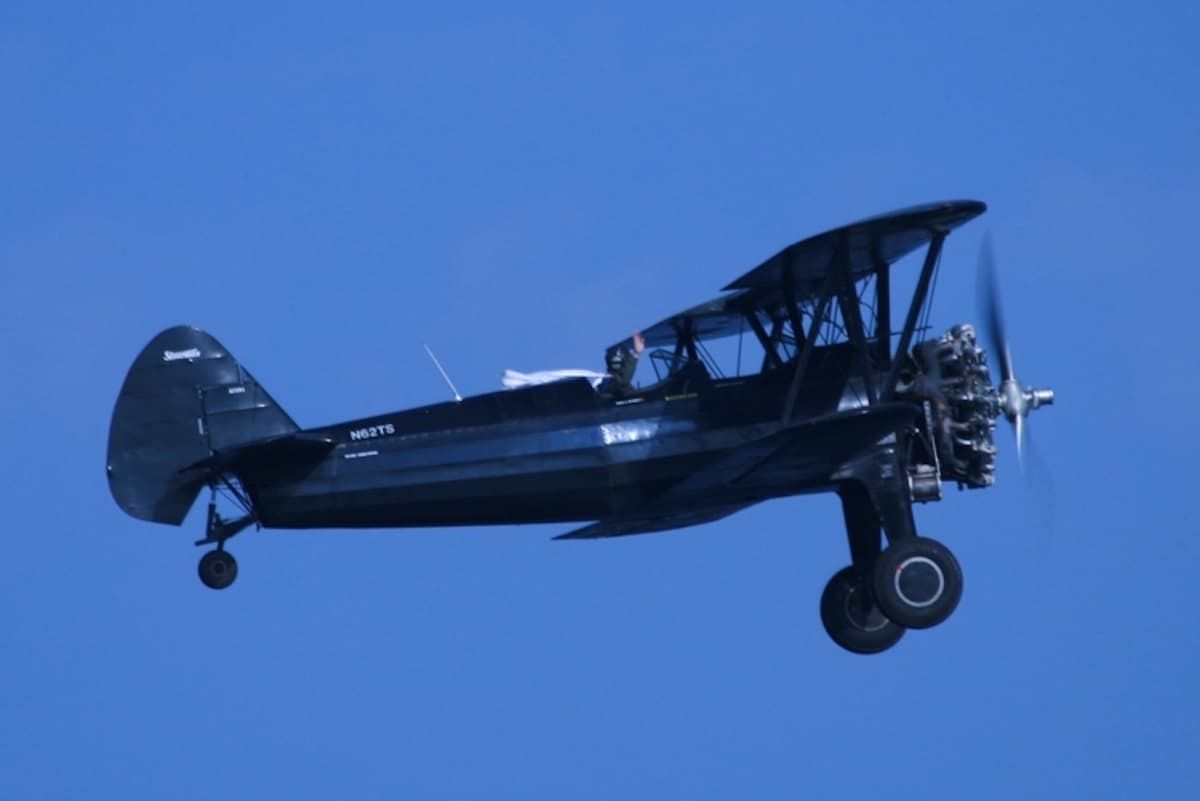
It must have been glorious back at the dawn of aviation. You wrapped your scarf around your neck, buttoned up your long leather flight jacket, strapped on your flying helmet, adjusted your goggles, slipped your flask of fortitude from your riding boot for a quick pre-flight nip, then stepped up to the long wood prop to give it a pull.
But, of course, those Wild West days of simple flying, wild men, and alcohol are long past.
Or so I had thought.
A boozy flight
Despite the lovely weather that day in early May of 2022, the pilot of the RV-7 overflew his home airport, Huntsville International Airport-Carl T. Jones Field (KHSV), after returning from a day flight to Dallas for a paintball event.
ADS-B track data then showed his airplane circling left, then right, for over half an hour east of Huntsville — with large deviations in altitude, heading, and groundspeed.
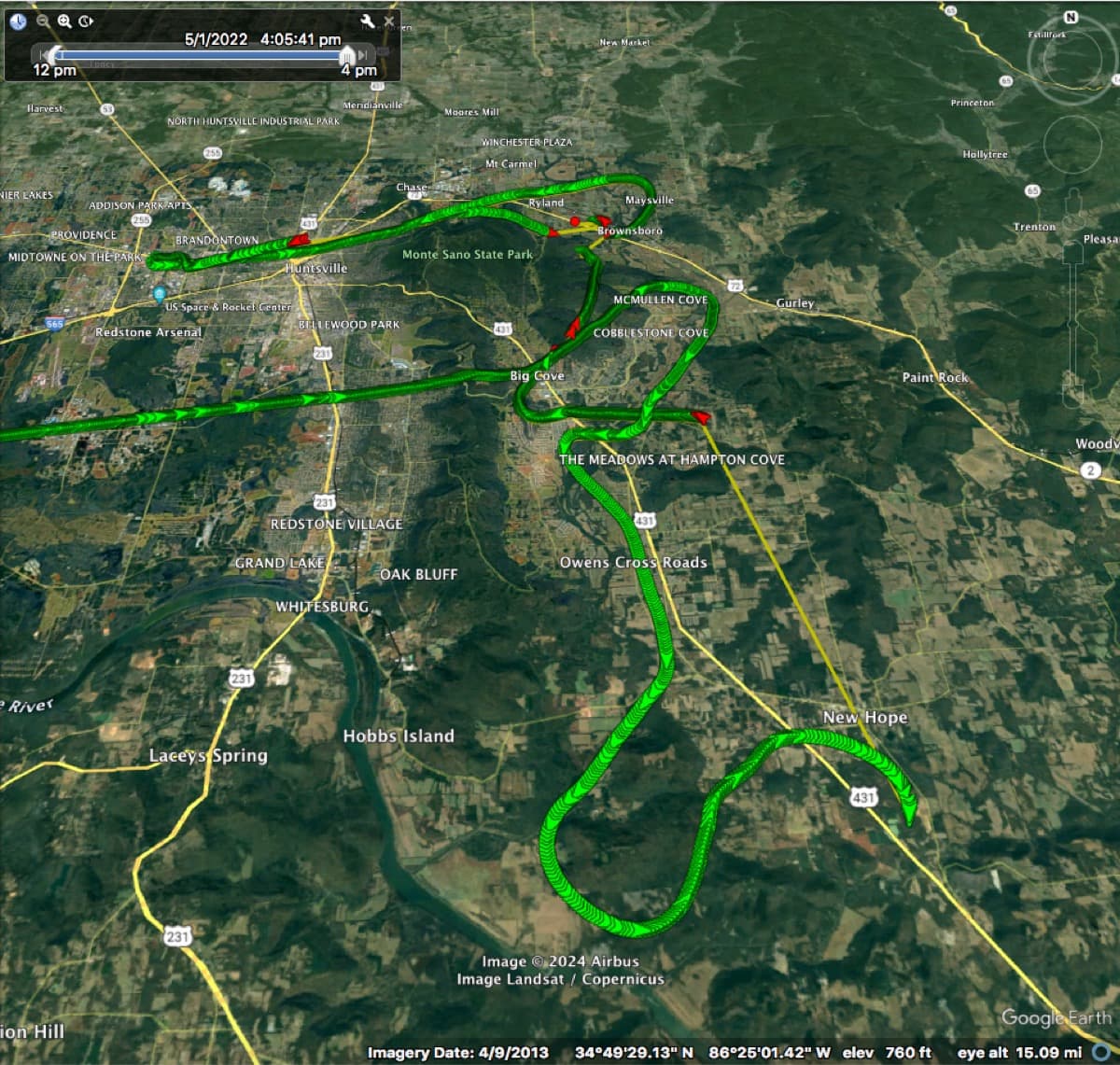
Finally, the track shows the airplane entering a low approach for a private airstrip called Moontown Airport (3M5) more than 16 miles away from the pilot’s destination.
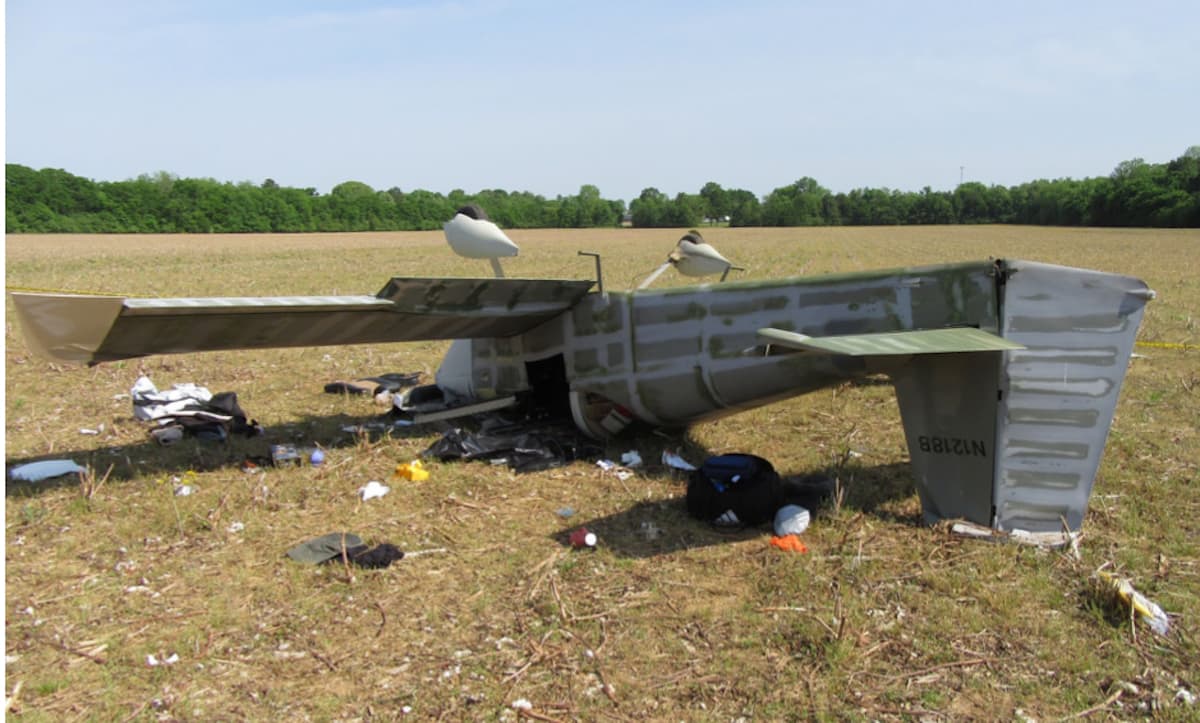
The landing is aborted on the first try. On the second try, 600 feet short of the threshold, the airplane plows into the ground, flipping upside down. The only passenger, a small dog, escapes the wreckage uninjured.
The pilot isn’t so lucky, sustaining serious injuries.
In the wreckage, first responders find a four pack of individual wine bottles. Two were open and empty, and a third was MIA. None of the bottles were damaged in the crash.
The reports don’t tell us if the wine was red or white.
The Pilot and his Inflight Beverages
The pilot was a 48-year-old male with a private pilot certificate, rated for single-engine land and helicopter. He held a second class medical, which was expired for second-class privileges, but was still valid for third-class privileges. His total flight time was reported as being 1,300 hours.
He was 5 feet, 10 inches tall and 160 pounds — about average height for a man in our country, but on the lean side.
And he was drunker than a skunk.
Toxicology testing of his blood and urine at the hospital following the crash placed his alcohol levels at 0.172%, nearly five times the FAA’s regulatory limit.
For those of you out of the loop, in addition to 14 CFR § 91.17’s decades-old “eight hours bottle-to-throttle” rule, an alcohol concentration limit of 0.04% for pilots was added on in 1985.
For comparison purposes, all 50 states have set the threshold for driving under the influence at 0.08%, with many states also having enhanced penalties for being more drunk than less drunk. The range for enhanced penalties varies from 10% on the low side up to 20% on the high side.
Alabama, where this crash took place, has no enhanced penalties for being more drunk than less drunk, but in states that care, they would have defined him as well and thoroughly drunk.
The NTSB’s final report on the accident dryly notes: “The pilot stated that he had not eaten on the day of the accident, had consumed one beer before the accident flight, and had consumed additional alcoholic beverages in the airplane during the flight.”
Seriously?
According to NTSB Air Safety Investigator Lynn Spencer’s report, in a conversation with the pilot, he told her that he had been through a divorce that “he didn’t want” about six months prior to the accident, which “may have had something to do” with the accident.
“He stated that he doesn’t drink that much; he drinks socially but ‘that divorce killed me. If I had been smarter, we would not be having this conversation.’”
That said, wreckage recovery personnel noted that his RV was equipped with a bottle opener, which was attached with a magnet behind the instrument panel. He also tested positive for cannabis.
Of interest, the bulk of his 2 hour, 48 minute flight was at 10,500 MSL, a pressure altitude where alcohol’s effects can be enhanced.
He was seriously injured in the crash, but survived.
His metaphoric drinking buddy, however, was not so lucky.
Two weeks later, in Cleburne, Texas, alcohol struck again.
Another Boozy Flight
I cringe when I read an NTSB report that starts with something like: “The student pilot was returning to his home airport after making three stops to pick up and drop off equipment and a passenger.”
So…there’s two violations of the regulations right there. Student pilot? Cargo?? Passenger???
Oh, but it gets worse, because you already know that this crash involves alcohol.
This time, investigators tell us that the American Aviation AA-1A was flying at low altitude about five miles from its home base of Cleburne Regional Airport (KCPT) in Texas, when it made a series of turning maneuvers — which appear to be a fly-by of the student’s house. Unfortunately, the airplane was flying near its stall speed and darn if it didn’t stall.
The NTSB report tells us that the airplane then “descended and impacted a field in a nose-low attitude and with minimal forward momentum.”

Six empty mini-sized 1.5 ounce alcohol bottles were found in the airplane’s glove box. The reports don’t tell us which flavor of spirits these were.
Personally, I prefer a Jack & Diet Coke in flight. But only when I’m a passenger in the back of a 737. Not when I’m the pilot.
Were the empties a coincidence? Bottles he was saving for some reason? Doubtful. His blood alcohol levels were similar to those of our previous hero.
So….illegal passenger, illegal transport of cargo, buzzing his house, and drinking on the job. What sort of student pilot was this? And what about the student’s instructor?
The Other Pilot
The student was a 41-year-old male and apparently a busy business owner. He held a third class medical.
In thinking about the impact of alcohol on body size, he was close to the national average in both height and weight for men, at 5-foot, 9-inches tall and 193 pounds.
But, of note, he had logged 111 flight hours.
Now, when I see that many flight hours with no certificate I think: Professional student. A quasi-aviator who has no intention of finishing the process.
And, in fact, the NTSB report states that the student had last flown with an instructor seven months before the crash, which means that any solo endorsements he might have had would have been long expired — not that the student was complying with his solo endorsement’s restrictions anyway, which strictly prohibit carrying of passengers or cargo.
His flight instructor told the NTSB investigators that the student’s cross-country training “was progressing well, but that the student was reluctant to take the private pilot written test,” and apparently the two “parted ways” many months before the crash.
The student pilot’s obituary described him as “always the life of the party.”
Analysis & Discussion
So two alcohol-involved crashes in two weeks? Both apparently not only from flying under the influence, but also engaging in the influence in-flight? And one of the pilots not even a fully certificated pilot at that?
It might be easy to look at the facts of the second case and just declare the pilot to be the poster boy for the anti-authority hazardous attitude. And perhaps he should share the poster with the paintball guy, too, who didn’t seem to have any compunctions about a beer on the ground chased by a few bottles of in-flight vino — a guy who included a bottle opener as part of his cockpit equipment list.
But there is a bigger problem here.
Because this isn’t just about self-induced bent metal or suicide by lifestyle choice.
These were two people — sharing our sky, with us — who were both so drunk that it’s doubtful that they would be able to successfully keep a pickup truck on a dirt road.
And one of those pilots was flying into a Class Charlie airport, the busiest in his state, an airport that served more than 1.4 million passengers last year with flights from American, Breeze, and Delta.
This kind of behavior — regardless of the root cause — puts other aviators, and our passengers, at risk.
The Takeaway
So what’s the takeaway?
If you think it’s OK for you to drink when you fly, that you can handle it, you are wrong. Get help. This isn’t the dawn of aviation anymore. There are a lot more people in the sky, and a lot more people on the ground, too, for that matter.
If you know someone who drinks before flying, or drinks in-flight, you need to intervene. This affects us all, both for our own safety and for the safety of our freedom to fly.
How many alcohol-related GA crashes do you think it would take before the government decides that the best solution is to limit flying to the professionals? Two more? Maybe only one more.
You cannot mind your own business.
The stakes are too high.
The Numbers
Want to read more?
Download the NTSB’s final report on the Huntsville accident here or view the items on docket here.
Download the NTSB’s final report on the Cleburne accident here or view the items on docket here.

What I would like to emphasize is that AOD (alcohol and other drugs) should be monitored not only on pilots but for all maintenance crew as well. It is equally dangerous for an intoxicated person to be working in the hangar or workshop especially on aero planes and engines. Furthermore I noticed that the Airforce in Defence do not exercise AOD testing on their employees. The Civil Aviation Safety Authority (CASA) has Part 99 that conducts random AOD testing.
Why don’t the aviation regulators standardize the system by making random testing of AOD on pilots and technicians mandatory throughout the world for both Civil and Military organizations?
The skies will be a safer place for all travelers.
Jeffrey Yap
23 May 2024
After experiencing the loss of a child who succumbed to years of alcoholism, I can without reservation or debate that alcohol consumption does not require any additional component to precipitate death. Alcohol does the job entirely on its own.
Bad decision making, the worse killer of people in the air and on the ground. It wasn’t the wine that killed that pilot it was bad decision making that killed him, it isn’t the gun that killed those people, it was bad decision making on the part of the person holding the gun, all this kind of destruction on humans is on purpose because of the lack of correction of bad decision making, what we need more than anything else is a school of hard knocks that will force people to learn not to make bad decisions, to take the time to understand what to do and what not to do. That way we all have a 50-50 chance of not making a bad decision, It still remains the worse killer of people ..Bad decisions override everything else.. A lot of people are just plain stupid and very dumb, and they are allowed to vote…God help us..
Next time William, tell us something we don’t know.
Of course .08 is a hypothetical number and tolerance at a given level varies widely, so cause and effect is generally subjective. Think of it as a field sobriety test. That’s actually a motor skills function test, not required for a driver’s license, and the officer has no medical certification to administrator nor interpret, rather he blames any level of non compliance on intoxication.
At least l that’s been my observation after being in and around the liquor business for 65 years and an employer in automotive repair, nightclubs, heavy trucking, and heavy construction for 50 years.
Your results may vary.
PS; I don’t drink, not defending drinking, just stating some facts that most people don’t actually think about.
The pilot with the bottle opener should have also installed a “breathalyzer” in the starter circuit as a known precautionary measure!
I mean, it makes perfect sense, right?
At least he is alive to contemplate this on his next aircraft build.
I totally stopped booze so I could commit aviation at any time.
Was a mechanic for 30 years with a regional airline……the culture of sobriety among flight crews…..lent a certain gravitas to the entire airline…an organic respect for them. The entire culture of an airline has zero tolerance for substance abuse…and I liked it..!!!
When I was a student pilot I thought the rule for alcohol consumption was 24 hours from bottle to throttle. Although it is only 8 hours I still follow the 24 hour paramater. I find it unimagible for a pilot to consume alcohol while flying. Those who do must have a death wish.
Agreed. This does impact ALL of us, whether we are flying or not. The loss of one’s personal control of ones-self is the worst crime ever. It can affect so many people, and for years after the bottle is empty. Sorry, I have no empathy or sympathy.