

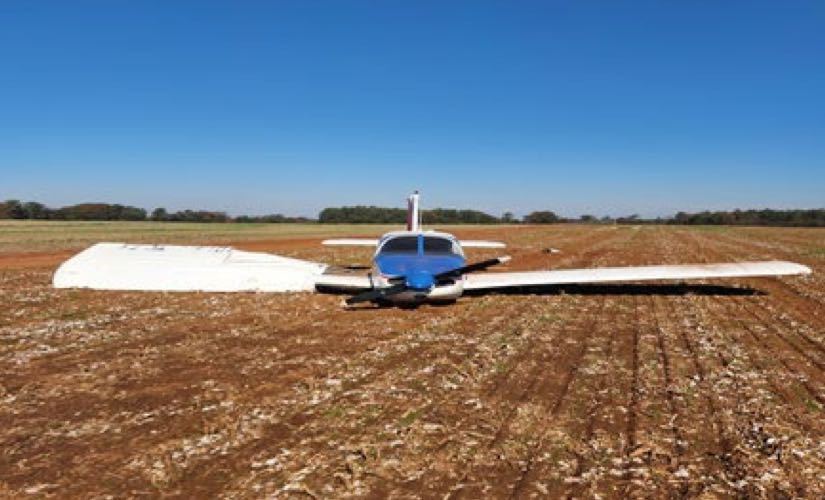
What Reportedly Happened:
On Nov. 2, 2022, at approximately 17:07 local time, the pilot departed from Milledgeville, Georgia, (KMLJ) with the intended destination of Decatur, Alabama (KDCU).
The flight was planned for 4,500 feet with a fuel load of approximately 48 gallons.
During the flight, the pilot noticed fuel consumption was higher than expected. As he approached Decatur, he observed fuel levels diminishing and estimated he had between 4 and 5 gallons left in the right tank while entering the landing pattern.
While turning from base to final for runway 18, the engine began to sputter. The pilot attempted to switch back to the left fuel tank and restart the engine but was unsuccessful. Consequently, he executed a forced landing in a field about 200 yards from the runway, resulting in a hard landing and substantial damage to the aircraft’s right wing.
An FAA Inspector later examined the aircraft and found no visible fuel in either tank.
Probable Cause:
The NTSB determined that the probable cause of the accident was the pilot’s inadequate in-flight fuel management, leading to fuel exhaustion and a subsequent loss of engine power.
Aircraft:
- 1963 Piper PA-28 Cherokee 235, N8667W
- Last Inspection: September 24, 2022 (Annual)
- Time Since Last Inspection: 10 hours
- Aircraft Total Time: 5856.6 hours (as of last inspection)
- Engine Manufacturer and Model/Series: Lycoming O-540-B4B5
- Rated Horsepower: 235 HP
- Aircraft Damage: Substantial (right wing damage)
Pilot:
- Age: 59
- Certificates: Private Pilot
- Ratings: Single-engine land
- Experience: 158 total hours (all aircraft), 61 hours in this make/model, 76 hours as Pilot in Command, with 22 hours in the last 90 days and 2 hours in the last 24 hours.
Injuries: None
Location:
- City, State: Tanner, Alabama
- Latitude/Longitude: 34.667231, -86.945621
Weather at Time of Accident:
- Conditions: Visual meteorological conditions, daytime
- Wind: 210° at 3 knots
- Temperature/Dew Point: 23°C / 8°C
- Visibility: 10 miles
- Clouds: Clear, no ceiling
To download the final report. Click here. This will trigger a PDF download to your device.
This November 2022 accident report is provided by the National Transportation Safety Board. Published as an educational tool, it is intended to help pilots learn from the misfortunes of others.

Didn’t take into considering SAF blended fuel. Has less energy density.
The POH lists the IO-540 fuel use at 20 gph at 65% power.
So 48 gallons would barely last 2+ hours, which is when it ran out of fuel,
[ the mains hold 50 gal.], and he didn’t fly the pattern close enough to be able to glide to the runway.
More Stupid Pilot Tricks. and a damaged aircraft.
Can’t be so high. The 300hp Cherokee Six burns approx 16gph at 75%. My searches indicate 12-14 gallons per hour for the 235hp Cherokee – same range as the C182.
Yes, The POH I just looked at lists 14 gph at 75% power.
I was looking at the wrong aircraft.!
Why was his pattern so far from the airport that he could not land f his engine quit?
Why was the plane out of annual?
It’s beyond me why anyone would depart without full tanks, not matter if they are going 50 miles to the next airport. In some cases I realize some planes can’t carry a full passenger load and full fuel tanks and in that case they need to leave someone at home. There is absolutely, in my opinion and perhaps I’m wrong, no excuse for running out of fuel, but it seems to continue to happen time after time. I never leave the ground in my Cessna 182 without full tanks, even if I’m remaining in the pattern to practice landings. It should be a habit and part of the pre-flight to make sure the tanks are topped off.
Why is it that so many accidents are caused by lack of fuel? When it is so critical to flight rather than setting a minimum altitude record, do they not top off every chance they get?
Based on comments from a few others (particularly low-timers): They look at their destination, figure the distance, look at the POH (which Marketing tells them that they have plenty of range) and they depart — no accounting for leaning, nor start up, warm-up, run-up, taxi, take-off, climb, WIND, enroute deviations in altitude or azimuth; but figure that they are Good-To-Go — cuz that’s what the Marketing department said so ….
Yes that would be inadequate fuel planning. But 48 gallons was more than adequate. He had made this trip previously noting he would have an hour’s reserve.
I made a comment last night, but it never showed up. ????
BTW, per the docket, he landed at 4 airports before approaching his destination….poor fuel planning.
And, knowing he was low on fuel, why not make a close in approach to ensure a glide to the runway ?
Are you sure about the number of landings? He mentioned two other airports but only for his route of flight.
Possible fuel gauge malfunction? The pilot estimated 4-5 gallons in the tank. Based on what? Gauge indication? Might not have been entirely his fault. He trusted his gauges and they lied to him?
Regards/J