

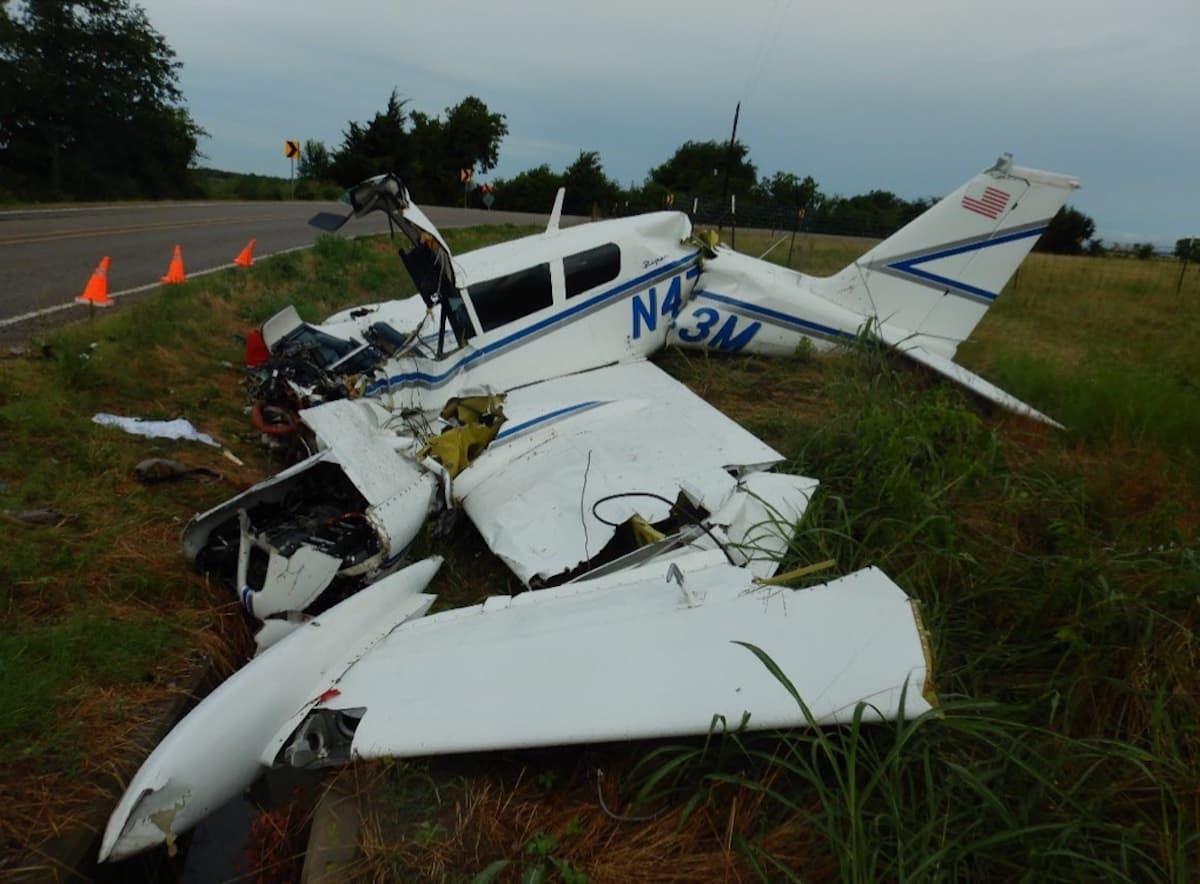
According to Automatic Dependent Surveillance-Broadcast (ADS-B) information, the Piper PA-30 departed Aero Country Airport (T31) in McKinney, Texas, at 0902 and proceeded toward Sherman Municipal Airport (KSWI) in Sherman, Texas, about 5,000 feet mean sea level (MSL).
At 0919:20, while the airplane was level on a northerly heading toward KSWI, onboard data indicated the right engine’s fuel flow fluctuated for about 15 seconds.
At 0919:55, the left engine’s fuel flow rapidly dropped to zero and the left engine cylinder head and exhaust gas temperatures decreased.
At 0921:55, about six miles southeast of KSWI, the airplane started an orbit to the right, then began a shallow descent on an easterly heading away from the airport.
About 0926, the left engine’s fuel flow rapidly increased, then dropped back to zero for the remainder of the flight. The airplane continued a shallow descent on easterly and northeasterly headings.
About 0931 and 13 miles east of KSWI, the airplane turned left and continued a shallow descent while on westerly and southwesterly headings.
About 0941, the last ADS-B data showed the airplane at 61 knots and less than 100 feet above ground level. The airplane was about 250 feet northeast of the accident site.
During the last four seconds of recorded data, the airplane turned left about 40°.
The airplane hit a field in Sherman on a southwest heading and came to rest upright about 50 feet beyond the initial impact crater. The pilot died in the crash.
Both propellers were buried in soft soil near the impact crater and had minimal indications of scoring or rotational energy. All propeller blades were near the low pitch stop (not feathered).
The forward fuselage was crushed consistent with a nose-down impact. The landing gear and flaps were in the retracted position. No anomalies were observed with the flight control system.
About nine gallons of fuel were recovered from the left main fuel cell and about 11 gallons from the left auxiliary fuel cell. About nine gallons were recovered from the right main fuel cell and about three gallons from the right auxiliary fuel cell. No fuel was recovered from either wing tip tank.
Both electric fuel pump switches were in the on position.
The fuel filler caps were not worn or damaged and the rubber sealing surfaces were not cracked.
The left fuel selector handle was found in the off position and the right fuel selector handle was found in the main tank position.
Fuel sampled from the left fuel selector contained a minimal flake of corrosion and did not illicit a reaction from water-finding paste. Fuel sampled from the right fuel selector contained multiple rust flakes and a bead of water and the fuel drained very slowly.
The right fuel selector was disassembled, which revealed rust and water that partially blocked the filter elements.
The right fuel selector was tested with low air pressure, which revealed partial blockage to the right auxiliary fuel tank port, and air could pass through that port when the handle was selected either to the off or main tank position.
The right fuel selector handle was difficult to move and produced a grinding sound when turned.
Both engines were examined, which revealed normal crankshaft rotation, with suction and compression obtained from all cylinders. The magnetos of both engines produced sparks at all posts when manually rotated. The left engine servo fuel screen was free of debris. The right engine servo fuel screen contained rust particles but was not blocked.
Probable Cause: The pilot’s failure to maintain control during a forced landing following a loss of engine power. Contributing was the pilot’s failure to feather the left propeller following the loss of engine power.
To download the final report. Click here. This will trigger a PDF download to your device.
This July 2023 accident report is provided by the National Transportation Safety Board. Published as an educational tool, it is intended to help pilots learn from the misfortunes of others.
He crashed right next to a road. He could’ve landed on that road. I fly a twin engine piper. Even if they’re coming down, you’ve still got a lot of time to find a place to put it down.
Pretty tough to make that determination based on the NTSB report. Other than the three photos showing power lines, trees, and a 90-degree bend in the road immediately adjacent to the wreckage, you have no way of knowing what other road conditions exist outside these photos’ field of view.
Looking at the ADS-B ground track, he flew over multiple ‘roads’ earlier that may or may not have been suitable emergency landing options…
Tragically, of course, we’ll never know exactly what he was trying to do; but given that the toxicology report identified a cocktail of substances that could have impaired his judgment…it’s not hard to imagine that his ADM and stick & rudder skills were affected.
From the report, it’s a little hard to tell why the engine anomalies. But it’s apparent that a relatively low time pilot lacked proficiency with emergency procedures in an airplane with a relatively complex fuel system. It’s an example of being perhaps legal, but not really proficient.
Sounds like training was needed for the pilot how to handle an engine failure including the need to feather the prop.
Sounds like it was lacking a maintaince program also , and fuel. Probably out of annual for years.
Not out of annual according to the NTSB report.