

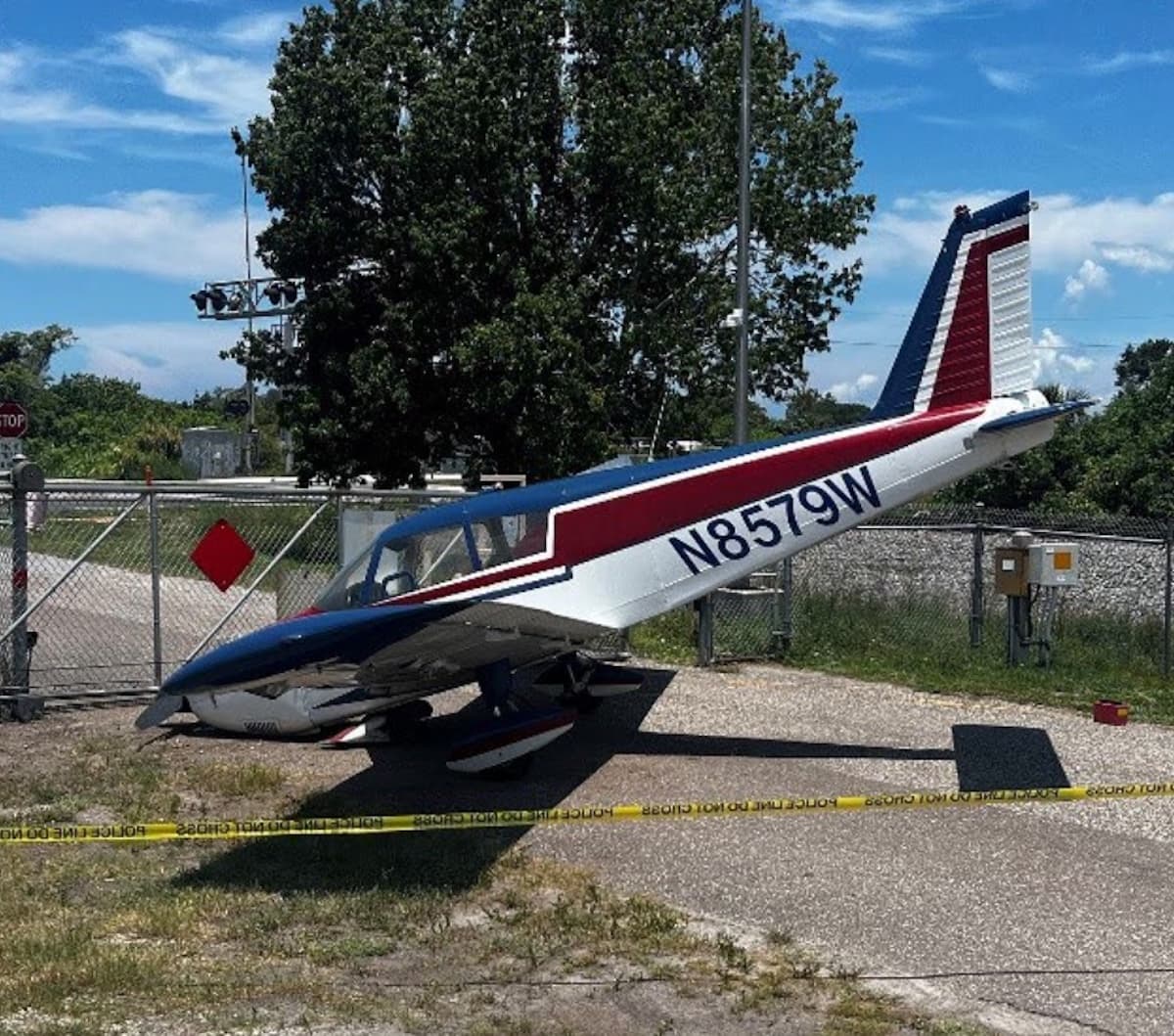
The pilot was attempting to takeoff from the airport in Clearwater, Florida, when the Piper PA-28-235’s engine lost total power about 100 to 200 feet above the runway.
He attempted to re-start the engine by switching the fuel selector from the right main tank to the left main tank, but the engine did not re-start.
He made a forced landing to a grassy area beyond the runway.
The airplane traveled down an embankment, struck a pole and a metal gate, which resulted in substantial damage to the left wing and several engine mounts.
Post-accident examination of the airplane revealed the right main fuel tank was intact and fuel was observed in the tank.
When the fuel was drained from the tank’s quick drain valve, as well as the fuel strainer located on the lower fuselage, a large amount of water was drained prior to any fuel being drained. Water was also drained from the carburetor bowl and the drain plug was corroded.
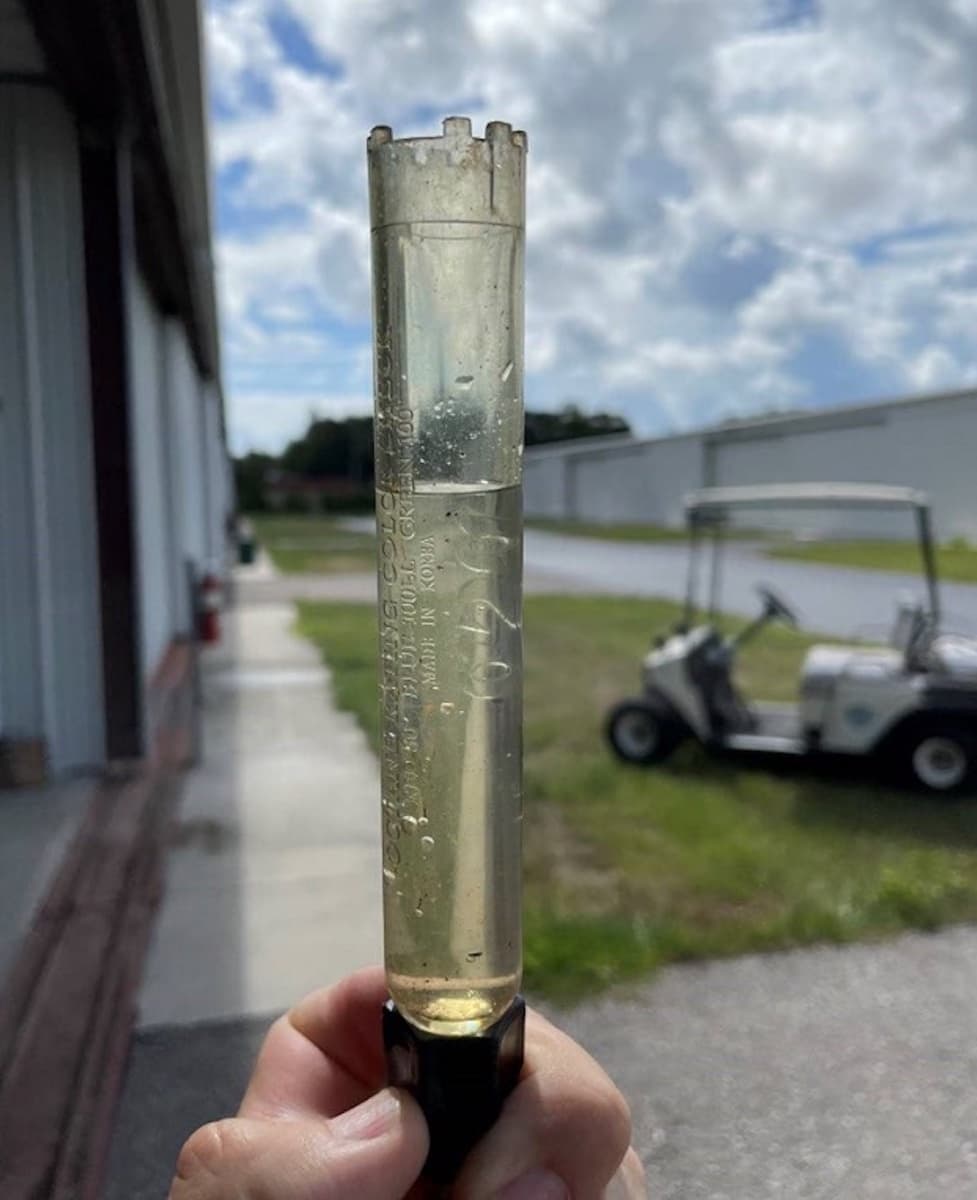
The pilot told investigators that he performed a preflight inspection “per the checklists” and had drained fuel from both the left and right main fuel tanks prior to the flight. However, he did not drain the fuselage fuel strainer as part of the preflight inspection, which is required per the checklist.
According to the airplane’s pilot operating handbook (POH), “This strainer should be drained regularly to avoid the accumulation of water or sediment.”
The loss of engine power on takeoff was most likely due to water contamination in the available fuel supply.
Probable Cause: The pilot’s improper preflight inspection which resulted in a loss of engine power due to fuel contamination (water).
To download the final report. Click here. This will trigger a PDF download to your device.
This July 2023 accident report is provided by the National Transportation Safety Board. Published as an educational tool, it is intended to help pilots learn from the misfortunes of others.
Just the thought that there are some pilots out there that have no idea how to differentiate Avgas from water kinda scares me, my instructor way back when 1992 made sure I knew what I was looking at, and it’s really not that hard…it may be an airplane but there is no rocket science involved to do that
For clarification, the sump drain on the Cherokee 235 is located on the belly of the fuselage under the rear seat. To check it, one must climb onto the wing and reach inside the plane and depress a spring loaded lever which will release fuel under the plane. If one wishes to trap the released fuel, one must have a pan under the wing. Most people, if they do indeed check it, as they should, look at the dispensed fuel on the ramp for water bubbles.
Really? You’re dumping fuel on the ramp?
Pretty sure he didn’t fly in with that amount of water. It had to be introduced at that location. And as mentioned, didn’t see a color contrast and thought it was good. Many pilots have issues because they aren’t mechanically minded.
Since a quick drain is located at the low point of a fuel tank, I can’t understand why the pilot didn’t detect water in the preflight fuel sample
On the PA-28s, at least up to the -181, I assume the -235 is the same, there’s the individual drains under each fuel tank, plus an additional one up near the firewall on the left side. The one near the firewall is the low point of the entire system. All three have to be checked.
The sump drain on the Cherokee 235 is located on the belly of the fuselage under the rear seat.
If the fuel sample is all water, like in the picture, and it is held up against a blue sky, it may appear to be clean uncontaminated fuel.
Only if your blind in one eye and can’t see out of the other eye.
Well it’s a concern I’ve seen others express. If there’s no line demarcating the different densities in fuel vs water, the pilot not looking carefully may then hold the sample so that a blue colored cowling (or the sky) is in the background and see enough blue color to conclude that the sample is all fuel when it’s all water.
My instructor always told me to hold the sample against the plane for a white background so you can clearly see bluish tint. Holding it up to the sky gives you a bluish background and you may misinterpret the color of fuel (or the lack of color in this case).