

It will sound callous, but there are some aviation accidents I read about where my first reaction is: Yeah, well, that served the pilot right.
But then there’s the other kind of accident. The kind that have me reaching for the Kleenex box even before I finish reading the report, much less having had time to think about it.
Today’s is such an accident.
It’s an emotional lightning rod that will zap you in the gut with the magnitude of the family tragedy for those aboard and those watching from the ground.
And while I certainly don’t want to add to the anguish of those survivors and witnesses, this accident raises a question that all new pilots should think about — and one that all flight instructors need to counsel their learners about.
So I’ve decided to take it on, and if anyone personally involved reads these words, please accept my deepest condolences, and understand my desire is only to use your tragedy as a tool to prevent similar ones happening to other families in the future.
A Spoiled Celebration
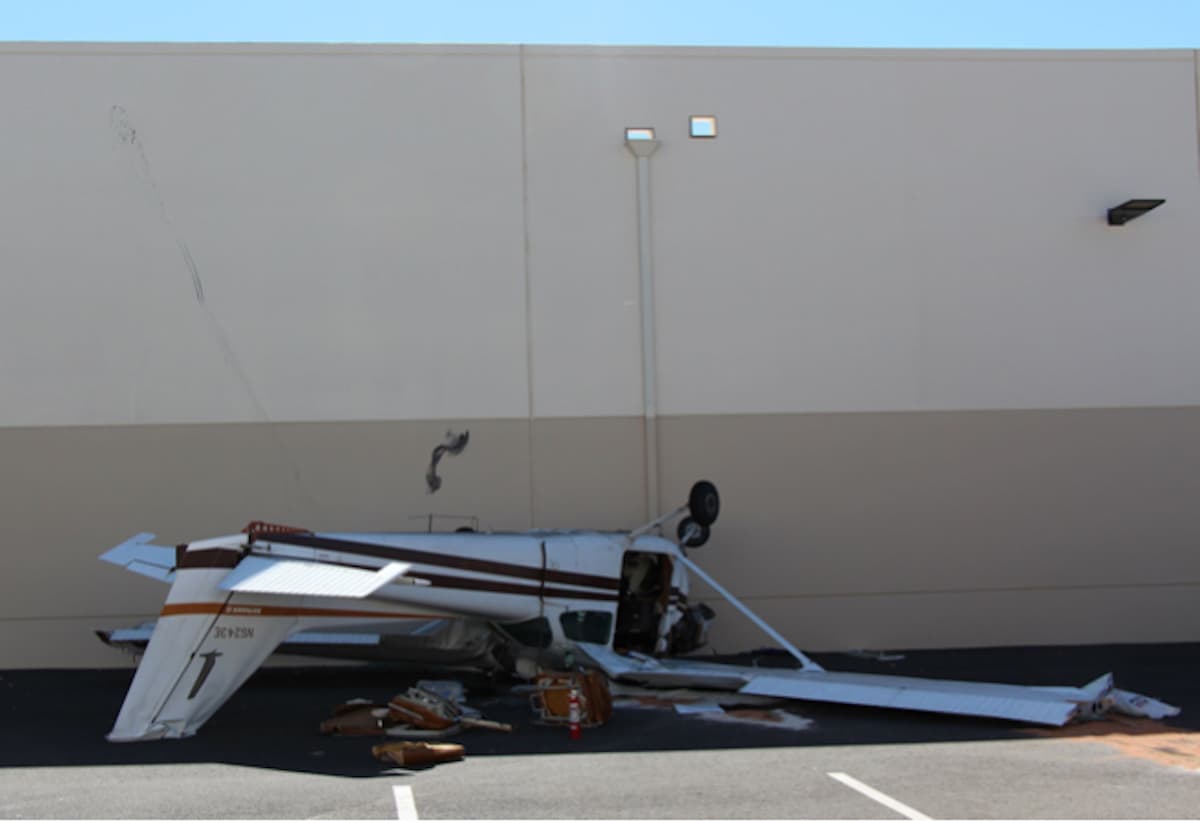
The crash itself is, sad to say, garden variety — at least statistically. A stall on an aborted landing attempt in a late 1970s model Cessna 172, exacerbated by a too-fast flap retraction that doomed the airplane as it clawed its way back into the sky. The pilot is killed and his three passengers are seriously injured.
Now the Kleenex part. The injured passengers are three of the pilot’s four young sons. The other son and the pilot’s wife were on the ground watching it all.
It was toward the end of a family fun day on the Fourth of July. Earlier, in the first of two sorties, the pilot took his wife and their youngest son on a local sight-seeing tour. The accident happened at the end of a second sortie, with the couple’s remaining three children getting their turn to see the world from aloft.
It was a celebration, you see. The family was marking an aviation milestone three years in the making. Dad had just gotten his private pilot certificate and he was marking the occasion by taking the whole family aloft on the same day, making them his first passengers.
The Accident Sequence
It’s a mystery why the pilot aborted the landing of the day’s second sortie. A witness reported the approach was “squirrely,” but the touchdown was around the thousand-footers, and looked fine from the flightline.
But on the flight deck, one of the children later reported that there was a loud “pop,” and the airplane began to shudder. The pilot “cussed,” then he makes the bad call that will cost him his life.
Already planted on the ground, he throttles up to abort the landing, taking off with “full barn door” flaps, according to one witness. The plane doesn’t want to climb. It drifts off centerline and heads toward buildings. The nose is high. Then, apparently, the pilot retracts his flaps — all at once. The plane stalls, rolls onto its back at about 60 feet AGL, and plunges to the ground between buildings.
The three children on board survive. But their father is killed in the crash.
The Pilot
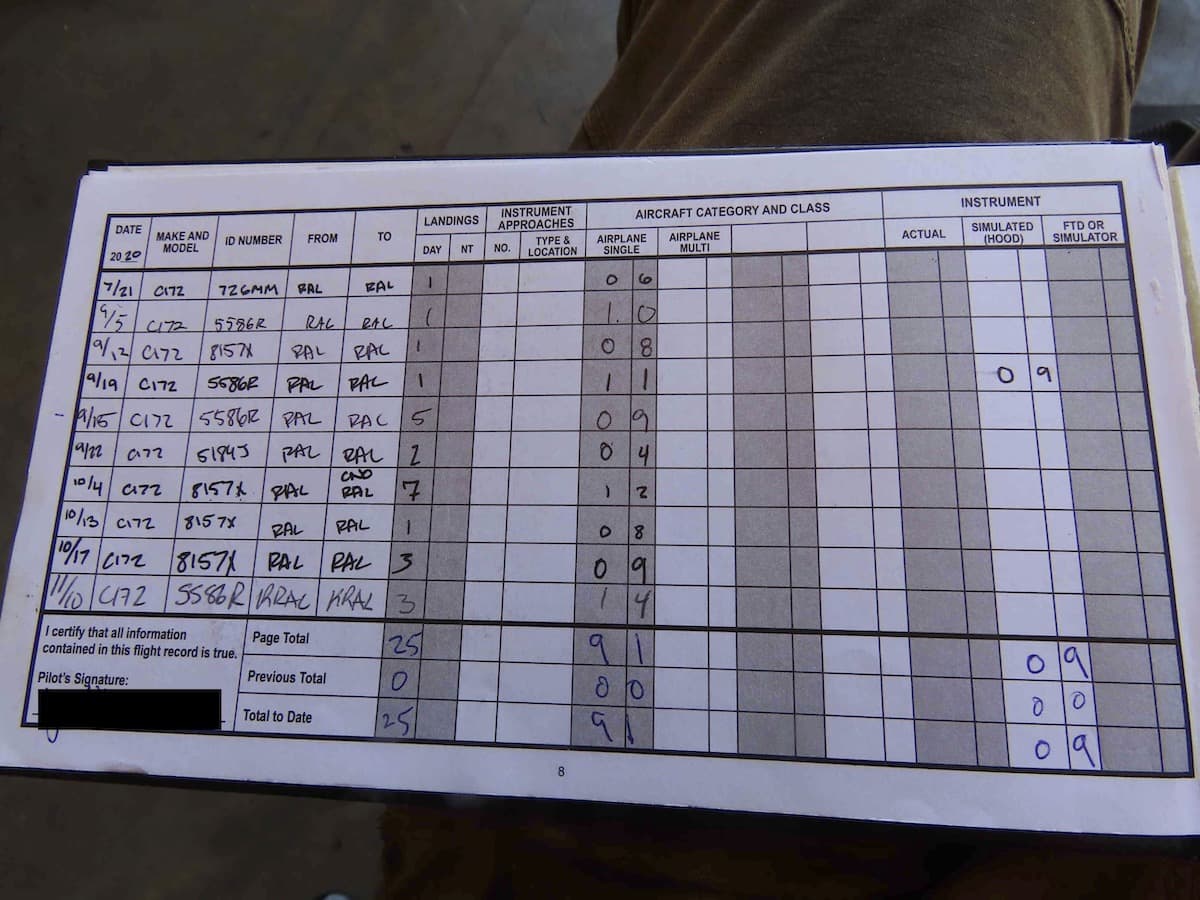
The pilot was a 39-year-old male, with a third class medical and a total flight time of 71.2 hours. All his time was in the same make and model as the accident airplane. He had received his private pilot certificate 15 days before the accident and the pair of sorties was his first flying since receiving his certificate.
Training Issues?
The NTSB, quite naturally, dug into the pilot’s training records.
His training took place at two different flight schools over a period of three years and was spread across seven different flight instructors.
I don’t find the number of instructors all that alarming, given the total length of his training time. Instructors have short shelf lives, at least the airline-bound ones, which are most of them nowadays. I occasionally have CFI candidates who have had nearly that many instructors over the course of a one-year accelerated program. And at least he had the benefit of different viewpoints.
One of the pilot’s CFIs reported that the pilot had issues holding the nose down during go-arounds, but the NTSB also talked to the issuing examiner, who reported no issues with any maneuvers — including go-arounds — on the check ride.
Analysis & Discussion
I don’t think the nature of the accident needs discussion. Nor the course of training.
Instead, what this tragedy got me thinking about is this: When is it appropriate for a newly minted pilot to take up their first passenger or passengers? And should such first flights ever be “full houses,” carrying the maximum number of people?
I dug out my dusty old first logbook. I have five, not because I have tens of thousands of hours, but because for many years I used the now-extinct Flywrite Systems logbooks that featured a full page to write notes about each flight, sort of a diary and logbook all in one. Looking at the first one, I wanted to see how soon after earning my private pilot ticket I took up my first passenger.
Unfortunately, I didn’t record my first passenger, or any passengers, in my early logbooks like I do now.
But I know for a fact that I took my father on a cross-country flight from Northern Colorado up into Wyoming to visit my aunt. And while there, I took her up over Cody, Wyoming, so she could see her hometown from the air. It was crazy turbulent, but my indestructible Aunt Bertha had a blast and was laughing and babbling the whole time.
By that point I had over 130 hours, had done my multi training (the order was different back then) and was time-building toward commercial and instrument tickets.
Did I take anyone else up before that? I honestly don’t recall. Maybe. Maybe not.
But that was just pure happenstance.
Because literally the day after I got my certificate, according to the faded pages of the 44-year-old logbook, I flew from Durango, Colorado, to Moab, Utah, to visit my high school crush, hoping to get her into the airplane, but that mission failed.
But had the young lady (and her mother) been less cautious, I — testerone-infused and 19 years old, and now a PILOT — wouldn’t have thought twice about taking a passenger up literally the day after I got my private pilot certificate.
Which then, as now, would have been fully legal and is nearly a pilot tradition. A right of passage.
But is it smart?
I confess, I am torn. But I did wince, then shook my head, when I read that this crash happened celebrating a new certificate.
I still recall what the examiner said to me when he handed me my private pilot certificate (they were cardstock back then — you got your actual certificate on the spot, not a temporary one). He said, “Congratulations, son. Here’s your license to learn.”
At the time, of course, I was thinking: What do you mean learn? I just passed the test! I don’t need to learn anything more… Oh, but there was so much more to learn, as I would discover as my hours built.
And because I was given a license to learn all those decades ago, I go on learning everyday.
The Takeaway
What can we learn from this accident?
I think the minimum takeaway is that, as a community, we need to talk about what level of real-world experience makes us worthy of carrying non-pilot passengers. This is one of those areas where — perhaps — what is legal is not necessarily what is smart.
Don’t get me wrong. I do NOT favor any regulation on this, for lots of reasons, including the fact that a number that’s right for one person is almost certainly a wrong number for another. But passenger-worthiness should perhaps fall into the kinds of things pilots set personal minimums for.
So, if you are a new student pilot closing in on your private pilot ticket, you owe it to your loved ones to make an honest assessment of what you think it takes to be passenger ready — in terms of real-world experience, not in terms of the regulations.
And I challenge you to think of it this way: If it were some other pilot, not you, how much experience would you want that pilot to have before you would entrust your loved ones to them? And why would you demand less of yourself?
If you are a rusty pilot, ask yourself if you really think three touch-and-gos does the trick? Or do you need a little more time with the stick?
If you are an instructor, I think you have a moral and professional obligation to at least broach the subject with your learners, and encourage them to reflect on the risks and benefits — just as they would with any other kind of aeronautical decision making.
Finally, all certificated pilots, I invite you to share your experiences with the new members of our club. How soon did you take your first passenger — or passengers — up? How did it go?
For my fellow “older” aviators, knowing what you know now with your licenses to learn, if you were transported back in time, would you make the same decision you made back then?
The Numbers
Want to read more? Download the NTSB’s final report here or view the items on docket here.

Thanks for this thoughful viewpoint. I, too, was excited to take my wife and young children flying after I got my certificate but I made them wait until I had 100 flight hours. It was just a number I set for myself.
As a newer old pilot, unfortunately I think the best context will be hammering home what my current instructor asks me all the time. Is currency the same as proficiency? I am an odd duck because I got my private nearly 20 years ago but between marriage and life, I was out of currency for nearly 15 years with barely 80 hours to my name. But I also was raised in aviation with my dad being a pilot. So I understood bernoullis principle at a younger age than I understood the rules of right away at a four way stop. I am now going back to get my commercial now that life is more established. I believe that like a lot of things it truly depends on the person. And like a lot of things not just in aviation, we must make poor decisions that teach us real life lessons in order to understand the magnitude of our choices. How many times does a person need to ground loop, how many times does a person need to get tossed taxiing behind a larger plane that just started their run up, how many times does a pilot need to pull tree leaves out of his landing gear because they forgot to factor in density altitude? We talk about the actual accidents but we need to also be aware that there are many times you hear pilots talking about getting caught in bad weather or doing something otherwise stupid and somehow making it out by “”keeping their cool” and dumb luck. I think the only real answer is that uncomfortable honesty is going to be the best key to helping in situations like this. That uncomfortable talk that a CFI says to his student,”Yes Bob, I know that you are at 65 hours of training and the feds say 40. But you are still struggling with this maneuver or you are you keep making substantial mistakes with your radio calls. It’s nothing to be ashamed of and you will get this but your safety is more important than an arbitrary minimum made up by the Feds.” Or even going to your student or a friend afterwords and saying. “Hey Tina, congratulations. I noticed that you have a tendency in your last go around that you really didn’t add any rudder and almost had a spin. That can be dangerous and I care about your safety. Can I talk you into doing some more power on stall practice and lessons before you take up any friends?” Those are the kind of awkward conversations that might need to start happening. Or last one because it is close to home with me. “Dad, it may be time to hang up the wings.”
My first flight after earing my private was 3 days later, taking my wife for a short ride. My second was a 3.3 hour cross country with her a week later. In retrospect, almost 35 years later, I would not change a thing.
I think “new pilot too soon” is a red herring. We always need to evaluate the risks and benefits of a flight in terms of our own proficiency and readiness, whether 50 hours or 5,000 hours, and whether alone or with every seat in the aircraft filled.
Bill, I’ve forwarded your post (and had it forwarded to me) many times.
I was pretty headstrong in 1971. 2 weeks after my checkride in a 150, I flew my wife and 2 daughters from Kentucky to Florida and back in a 172 (1 hour checkout) with less than 40 hours flying time in my logbook. I didn’t know what I didn’t know. I knew how to navigate VOR to VOR so the course was a real zig-zag – over 7 hours for a 5 hour trip when flying direct. Flight following? Nope. No such thing. The lessons were many and, thankfully, not calamitous but my wife didn’t fly with me again for several years. Smart girl.
The more I think about that trip, the less I want to think about it.
Later, as a CFI with all the ratings, I incorporated lessons learned by carefully coaching without all the “there I was” anecdotes. I’ve been very proud of my former students – good solid pilots, all.
Finished my instrument rating a few months ago and then completed my Cirrus Transition training from a C172S into an SR20…..I have around 40 hours in the SR20 and the rest of my time is in the 172S. Just took my wife and kids up for the first time a couple of weeks ago. They were only my second passengers in my entire aviation journey. I also took up my Grandfather about six months after I finished my private, but he is a pilot who had not flown in 25 or so years. I was in no rush to take up the most important people in my life and I am so thankful I waited so long. It was a wonderful flight and I feel so much more capable and knowledgeable than I would have as a newly minted private pilot. I know I still have so much more to learn and look forward to my continued journey in aviation.
I soloed at 17 in Jan 1973 after only 4.5 hrs dual in a C 150 and had never been up close to an airplane 2 months earlier. I did the 3 t&g’s and taxied back in really proud. After getting the pvt ticket later in the year I realized how unprepared I was during that solo should there have been even the slightest problem. Only a couple hours before the solo I was whacked in the side of the head for letting airspeed decay on a go around climb out. That action was the best learning tactic I have ever had.
My point is that primary students ( I be damned if I will comply with others terminology) may not have the depth of understanding of the actual physics involved and being a graydog, I’m questioning the modern CFI’s understanding of this.
Dust off the perception of the bold flyers of yesteryears. If they had then what we have now in terms of technology, I doubt they would spin through the cloud decks until they saw the ground then recover to land somewhere. It’s true that improper use of the rudder can shorten your life to seconds and basic flying skills should be learned in a J3 yet to dismiss the modern advances completely is not the answer. By the way letting a computer that controls a vehicle on roads that processes situations with a 360 view and never blinks is an amazing reality.
Over-reliance on advanced technology is a root cause of some of the accidents we read about daily on this news service and Juan Brown dissects. Back in the late 1950s when I was a kid, my first car was a 1953 Plymouth. Simple flathead six, three on the column. A full tuneup was six $.59 plugs plus filing the points, and maybe an oil change. Simple and reliable car.
We were a low-income single parent family, so I became a reasonably good mechanic to keep the machine running and inspected to get mom to the hospital where she was a nurse to keep food on the table. At that time, Pennsylvania law neither required insurance nor grooves on tires. Yes, bald tires were legal. I learned to drive in snow on bald tires and how to steer into the skid to get the front wheels rolling again, even though I was staring at a telephone pole dead ahead. It was a man-machine marriage, and we both knew everything about each-other.
I’ve read about early aviators of bi-plane barnstorming and crop dusting with just an altimeter and compass and a lot of brass on those wooden seats. It was another case of man-machine marriage, both understanding each-other and respecting their respective limitations.
Back to cars: today’s modern models include so many power-assisted microprocessor driven gee-gaws and doo-dads that drivers do little more than relax and enjoy the scenery. This removes the driver from any man/woman-machine marriage. Steer into a skid? You must be kidding! The ultimate idiocy is the extreme manifestation of this, the self-driving car. And lane changing guidance shown on a video display in the middle of the on-board computer (oh, dashboard). The idea man can substitute computer hardware/software for the human brain is nothing short of blasphemy.
So I opine here that the same negative characterization applies to the modern GA dashboard — the ‘glass panel’ — which will even wipe your nose and clean your eyeglasses for you. Yeah, GPS is an incredibly useful technological advance. But in the Olden Steam Gauge Days, pilots were much more aware (or should have been) of the functional mechanics and performance of their flying machine and just what lethal jeopardy sinking oil pressure readings means for the pilot’s lifespan. And how to handle the flaps, rudder, and throttle while scanning the landscape below for the least dangerous emergency landing area. Such landings are also frequently lethal with nose-overs and flames. Reading the tales of accidents published here and by Juan Brown, some of those pilot-owners are less than scrupulously vigilant about engine maintenance and fuel management. Big mistakes. RIP. Your 172 isn’t my ’53 Plymouth..
Older GA and commercial pilots I know stress the need to return to the earlier era of intimate rigorous stick-and-rudder training AND flying depending mainly on those human man-machine interface skills and a whole lot less on the glass panel display. But alas, that idea is destined for the Dustbin of History as new pilots are drawn in by the seductive siren song of advanced technology rather than personal proficiency. Eventually, insurance will become so prohibitively expensive that the GA hobby will diminish to the vanishing point. Alas. One man’s opinion.
Thanks/Regards/Jim
Watching show MAYDAY. Asian Airline required cockpit crew to only rely on instruments.
When on final they lost most of their instruments and had little to no understanding on how to fly the airplane. Crash killed all on board. I cannot quote the actual show but I never forgot that. Like many today really do not know how to drive their cars. Push pedals and steer which works until conditions require you to drive, then panic.
When snow comes, I take my Wife to vacant parking lot and throw the car all over it, hard braking etc. until she relaxes and can actually drive it.
Tragic for this family and the worst day of their lives.
Here in Argentina, you typically take your PPL check ride after flying at least – usually not much more than – 40 hours, including around 10 hours solo (cross-country usually occurs after you are certified). Once you become a pilot, you are required to log your first 25 PPL hours without carrying a passenger. You are legally permitted to fly with a certified & current pilot though. When I earned my PPL wings eons ago, I took that restriction as torture. Who wouldn’t be anxious to take family & friends up to see the town down below? However, it turned out to be a phase of growing self-awareness and growth. I was becoming more and more confident, especially if the air was rough and there was no other voice in the cockpit to calm me down. Over time I learned to appreciate the value of that restriction.
So many important considerations and lessons. Thank you for so delicately and honestly sharing the details with us. A tragedy that we can all learn and grown from. Thank you for sharing this in the hopes of mitigating the risks of more families suffering this pain. 💔
50 years ago my Seasoned Examiner & I parted ways with him making the exact same assessment of my piloting skills, after making a downwind landing, sock had barely drifted around, congratulations sir, you are now certified to learn. I was crushed. For one thing I still had to fly myself HOME !!! Certified never equates to qualified, that only comes with experience, too many variables. Little did I know, at the time, just how little I knew !!!!
“the NTSB also talked to the issuing examiner, who reported no issues with any maneuvers — including go-arounds — on the check ride.” That could be debatable. When was the go-around on the checkride done – short final at Vref or after the airplane made contact with the runway?
So sad and our hearts go out to the family…..Yet it keeps happening? Actually insurance companies control who flies (if you want insurance) ……………
71 hours over three years……2 flight schools and 7 instructors ……! is a red flag….
I could relate as we had a club that consisted of three Cessna 150’s and a 172. Most training was in the 150s…..When our student got his lCertificate, they would immediately want to up grade to the 172. It required a check out after the former student could solo it. The main point I remember about the check out is the pilot was required to fly the aircraft at gross weight, meaning two additional passengers in the back seat. The 172 is a different aircraft fully loaded as we all know. It was well worth it as many pilots with low time needed a few hours or more to fly it safely….
So sad and our hearts go out to the family…..Yet it keeps happening? Actually insurance companies control who flies (if you want insurance) ……………
71 hours over three years……2 flight schools and 7 instructors ……! is a red flag….
I could relate as we had a club that consisted of three Cessna 150’s and a 172. Most training was in the 150s…..When our student got his lCertificate, they would immediately want to up grade to the 172. It required a check out after the former student could solo it. The main point I remember about the check out is the pilot was required to fly the aircraft at gross weight, meaning two additional passengers in the back seat. The 172 is a different aircraft fully loaded as we all know. It was well worth it as many pilots with low time needed a few hours or more to fly it safely….
Sad story. Multiple bad decisions. Very tragic.
Thoroughly practicing go arounds, aborts, etc…with the instructor, briefing and debriefing are important, and not to shy away from maneuvers close to the ground, or on the ground. An intro only is not enough, just like stalls or unusual attitudes, they should be performed without passengers, when you obtain your certificate, to be/stay proficient. Even after you receive a certificate, it is always good to challenge yourself by flying with an instructor. You can learn something and even make a new friend. Think how thorough military, airline pilots and other professionals train. Why not hold yourself to a higher bar? Seek out the instructor who will not only challenge your knowledge and performance, but one who is interested in wanting/helping you to be the best you.
A sad situation certainly. It has been too many years/decades since my first flight after earning my PPL and a few decades since my last student pilot, so I don’t know what is taught nor how it is taught today, but I never read or hear about risk assessment prior to flight. In the last few years of my military flying and my civilian flying, I used the risk assessment tools that were required by the US Army Aviation. Regardless of the length of the flight or the number of passengers, if any. The assessment covered weather, flight route and fuel planning, pilot currency, health, rest, departing airfield, destination airfield, aircraft condition and airworthiness, etc. Numerical values were assigned to each area and in the end if the summation wasn’t above a certain value, the flight was ill advised, “Too Risky”. I’ve seen many flight aborted before they got off of the ground because of this process. And the assessment doesn’t really isn’t that time consuming, especially if one considers what is at stake. Could it be that a structured Risk Assessment prior to every flight should be a part of flight training and examination at all levels.
I believe the issue with most accidents, be it a 50 hour or 15,000 hour pilot, is the mechanics of flying that they didn’t comprehend.
I concur. For some reason after all those different viewpoints, Dad was dropping full flaps in a 172 to land on a 6,000 foot long runway. What a shame.
RIP