

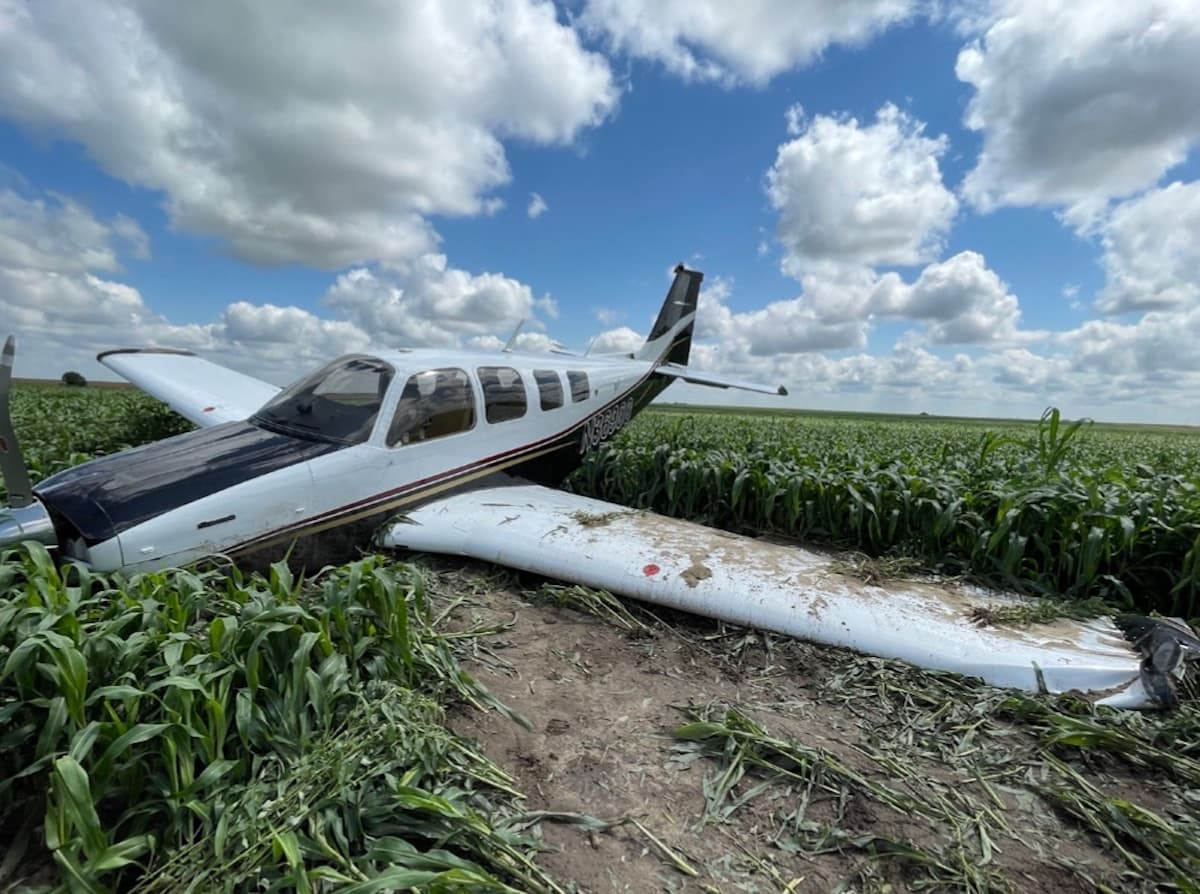
The Beech A36 departed from Northeast Wyoming Regional Airport (KGCC) in Gillette, Wyoming, and was en route to Dalhart Municipal Airport (KDHT), in Dalhart, Texas.
The pilot told investigators that while in cruise flight over a cloud layer near Oberlin, Kansas, the plane sustained a loss of engine power as if it were out of fuel.
He attempted to restore engine power by switching to the right fuel tank and activating the starter using the ignition key, however the attempts to restart the engine were unsuccessful.
As the airplane descended through the cloud layer, the pilot switched back to the left fuel tank and focused his attention on the airplane instruments to maintain airplane control.
The airplane descended through the clouds and the pilot regained visual ground reference about 1,500 feet above ground level.
He maneuvered the airplane for a forced landing to a road.
Upon touchdown the right main landing gear traveled onto the shoulder of the road and the plane exited the road and collided with an embankment. The airplane sustained substantial damage to the left wing and fuselage. The pilot was not injured, but the passenger sustained minor injuries in the crash.
According to the FAA inspector who responded to the accident, both fuel tanks had visible fuel and both fuel caps were attached and in place.
The pilot reported that the loss of engine power was due to a broken fuel pump shaft.
However, during the post-accident examination, the engine-driven fuel pump shaft and drive coupler were found to be intact. The fuel pump was operationally checked and no anomalies or malfunctions were noted with its operation.
The National Transportation Safety Board performed a post-accident examination of the airframe and engine. The examination revealed an obstruction in the left tank fuel vent. The one-way check valve in the fuel vent was observed stuck in the closed position, not allowing air through. When the fuel vent line was pressure tested the obstruction became dislodged.
Further examination of the check valve revealed debris inside consistent with insect debris.
No other mechanical anomalies were noted during the examination that would have precluded normal operation.
The airplane manufacturer’s emergency procedures checklist for an air start procedure after an inflight engine failure includes selecting the auxiliary fuel pump ON. The pilot did not engage the auxiliary fuel pump during his restart attempts.
Probable Cause: The blockage of the left fuel tank vent, which resulted in a total loss of engine power due to fuel starvation. Contributing to the accident of the pilot’s failure to use his checklist to address the loss of engine power.
To download the final report. Click here. This will trigger a PDF download to your device.
This July 2023 accident report is provided by the National Transportation Safety Board. Published as an educational tool, it is intended to help pilots learn from the misfortunes of others.
I see a problem with this. They were not on any flight plan, and were not using flight following. They were flying above a cloud deck. No radio call is mentioned nor changing of transponder to 7700. Dropping through a cloud with someone else being IFR getting a sudden call to turn, dive, climb….
Meanwhile this is what was said “We were losing altitude in clouds with no visability; I switched fuel selector back to left tank hoping for power, but felt nothing. My concentration �on became focused on instruments, trying to keep reasonable air speed and rate of descent above stall rate and not exceed yellow line airspeed. At one point my altimeter indicated very fast descent a�er we had lost airspeed and I manually pushed the nose down to maintain speed and not reach stall speed. I over corrected and was losing altitude at a high rate a�er I over corrected for low airspeed. So I began using considerable force on yoke to get the nose up and slow descent to a reasonable rate, at approximately 1500 feet AGL, we broke out under cloud cover and were able to maintain airspeed of approximately 80-90 MPH. ” [minor correction put in]
So we have two problems at the same point. This guy doesn’t have much altitude above a cloud deck before he gets into IMC and now needs to get trim in to maintain a proper descent rate now that he is in a glider in IFR conditions so that he can focus on getting engine restart. I think the NTSB people missed this little problem. You can’t follow an emergency check list and fly the plane in IMC if you don’t have an autopilot doing heading hold.
If I were to lose power and was not that far above the clouds, I would be putting in trim to set for best glide or something close to it. At that point with the engine windmilling, I wouldn’t be using the starter. I would, if I had a passenger, hand them the check list and ask them to read it from here (pointing to the engine restart) and give me the first item, and then next when I call for it.
You say that is easy to do sitting at your desk. But I’ve actually thought about this. And what do I do if…. This is why I always use flight following when X/C if I weren’t on an IFR plan.
Insect debris in the fuel line. Sheesh! The more stories I read on this news service the more I view GA operations as a crap shoot. Who would suspect insects in the fuel line? What do you need to do, a complete teardown inspection before taking off? When will GA aircraft have the reliability of today’s cars or even those from 60 years ago? Just pathetic.
Regards/J
Some aircraft, like my 1961 Cessna 175, has 3 tank vents. Each tank cap has a diaphragm vent, and there is an under wing vent for the left tank, which also connects to a crossover line to the right tank.
This is a carburated engine, so it gravity feed with about 1 psi fuel pressure….it has worked fine for 64 years now.!!!
2025 Cessna 172s have the same vent systems with a fuel injected engine.
‘ don’t try to fix what isn’t broken’.
So how does one check the vent??
You just look into the tube as far as you can. That doesn’t guarantee there’s no blockage somewhere deeper of course. On low wing models, getting under the wing to do that isn’t exactly easy, but you know the consequences.
I looked at some A36 preflight checklists online and none mentioned checking the fuel tank vents. Perhaps some owners of A36s can take a look at their factory provided checklists and comment here if their checklists require checking the fuel tank vents.
As for the Emergency Procedures (such as making sure the Aux fuel pump is on, all I can say is: Practice Practice Practice!
I am glad to read that the pilot and passenger survived the ordeal.
The “fuel vent – check” is the second item under #7. Left Landing Gear, and the first item under #9 Right Landing Gear.
The engine restart is 1. fuel selector valve – select other tank (check to feel detent), 2. auxiliary fuel pump – on, 3. mixture – full rich, then lean as required, 4. Magnetos – check left and right, then both. 5. alternate air t-handle – pull and release.
Not completing the restart list fully is a recurring theme in these reports.