

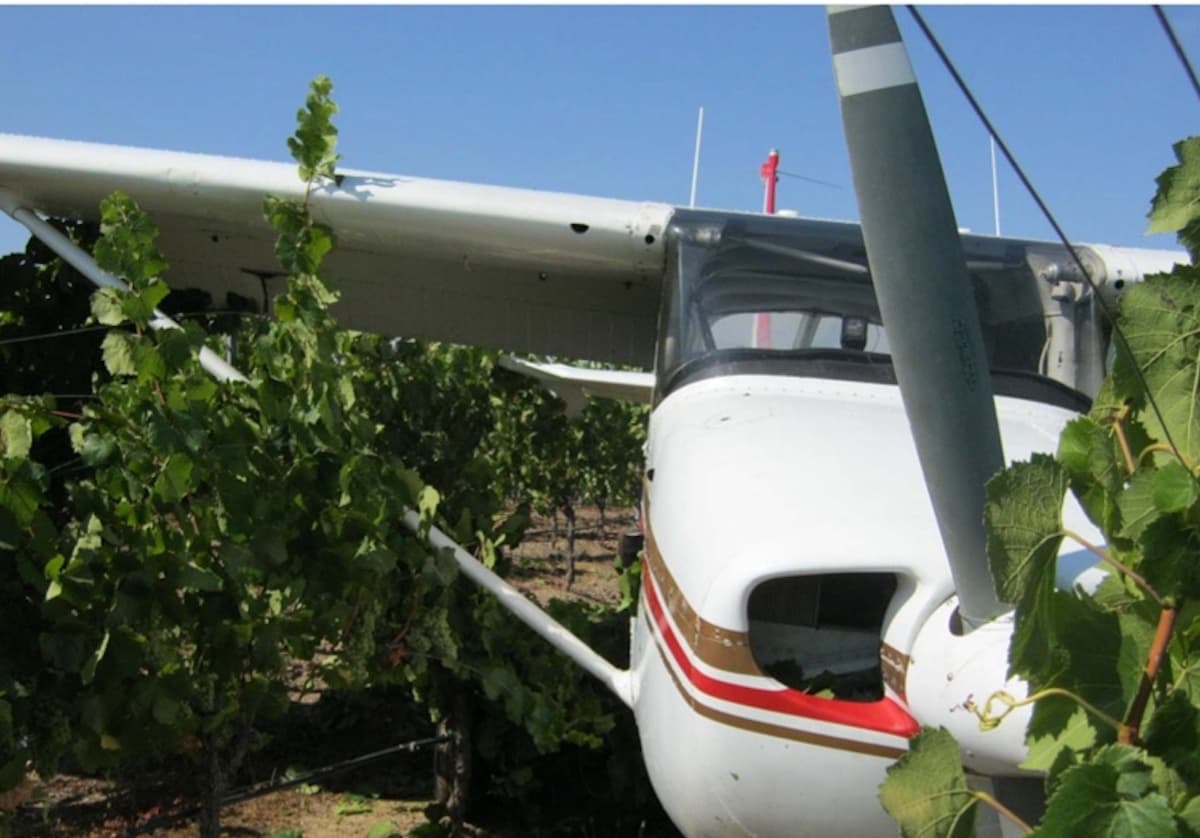
The pilot told investigators the Cessna 172H recently had an engine upgrade and he was flying it to break in the engine.
He had performed fuel calculations based on its previous consumption rate and did not realize the new engine was consuming more fuel than planned.
During final approach the airplane experienced a total loss of power due to fuel exhaustion.
The pilot performed a forced landing on an open field near Santa Rosa, California, with high vegetation, substantially damaging the right wing and right horizontal stabilizer.
The pilot reported that there were no pre-accident mechanical malfunctions or failures with the airplane that would have precluded normal operation.
Probable Cause: The pilot’s inadequate fuel management ,which resulted in a total loss of engine power due to fuel exhaustion.
To download the final report. Click here. This will trigger a PDF download to your device.
This August 2023 accident report is provided by the National Transportation Safety Board. Published as an educational tool, it is intended to help pilots learn from the misfortunes of others.
And that’s why I remain a “hobby flyer”. Being a “professional flyer” sounds too dangerous!
Pre-flight GA planning seems similar to commercial flights — a welter of details and tricky considerations that — given the anecdotal data — exceeds the mental capabilities of some pilots. When will GA aircraft become as easily operated as modern cars? What happened to this pilot’s understanding of having an hour’s extra fuel than initially guessed? Too expensive? Then you’re in the wrong hobby, sir.
Regards/J
FYI;
– the pilot is responsible for the pre-flight, navigation planning, and aircraft inspection…no co-pilot, no office planner, no crew chief.
– aircraft will never be as easy/simple to fly as cars are to drive. The pilot needs to aviate, navigate and communicate. There are no roads, so the pilot needs to know where the aircraft is going, and where it will be in 15 minutes, since it will be there with or without his knowing.!
– aircraft burn fuel at 5+ times that of a car, 10 gph vs about 2 gph [ 30 mpg at 60 mph]
So, an aircraft has many fewer hours of fuel than the average car.
– this pilot was not a ‘hobby ‘ flyer, but a professional pilot who utterly failed to know the performance and endurance data.!!
The early Cessna 172s, including the ‘H’ have 39 gallon tanks, with only 36 gal. usable, NOT 38. [ 1 st mistake]
The O-360 leaned at 2,500 rpm will use about 10 gph. But, for breaking, it should be run full rich, to keep the cylinder temps from overheating. So, the engine op manual shows about 12 gph, full rich at 2,500. [ 2 nd mistake ]
So, with full tanks, running full rich, there is 3 hrs of fuel to empty.!!
This experienced CFI pilot should have known or looked up the exact data. He then would have not flown for more than 2.5 hrs.!!
Oh and the 3rd mistake is not remaining within gliding distance of the airport with a new, unknown engine.
Infant failures for engines will typically occur within the first 100 hours of use.!
Breakin time varies, depending on the cylinder type; steel, chrome, nitride…1-2 hrs to 8-10.