

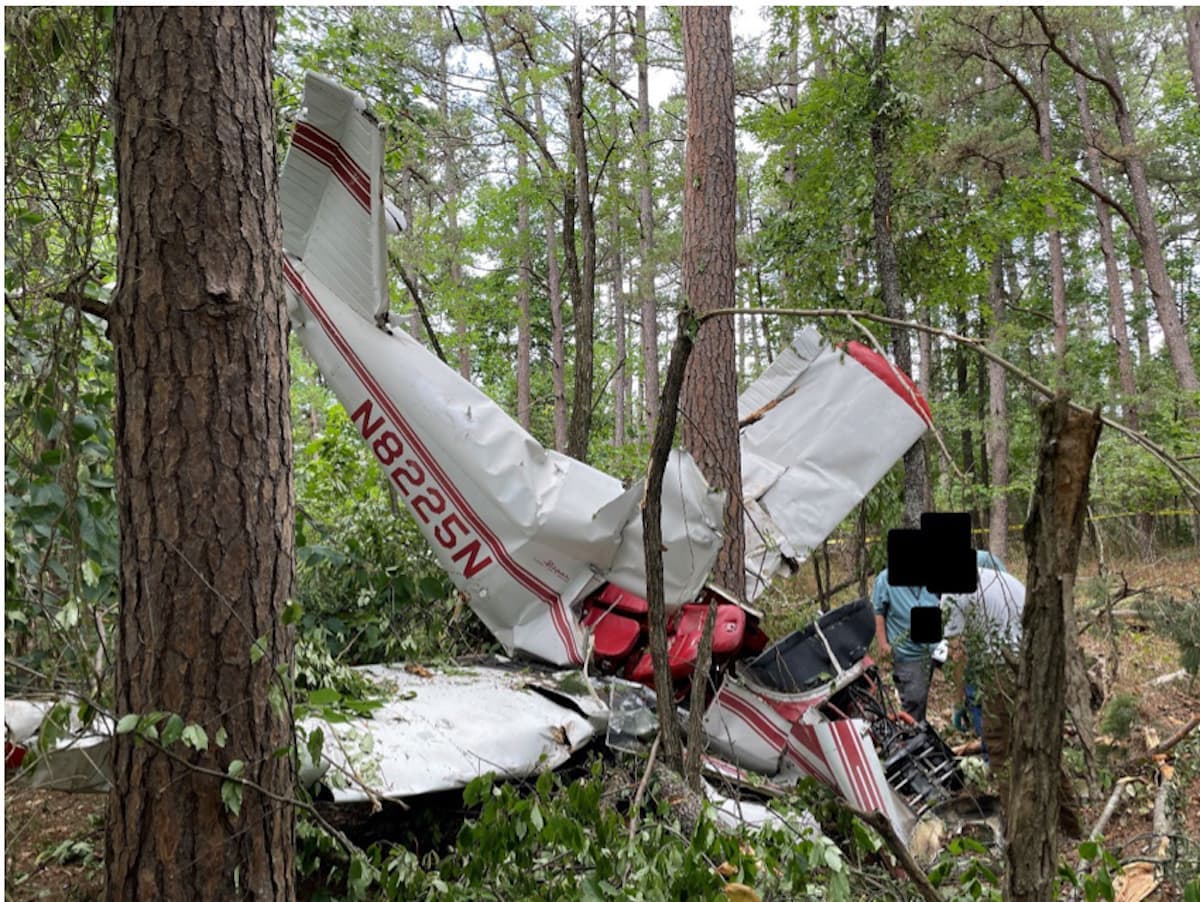
The crash happened a half-mile from the departure end of the runway. After briefly fighting with the controls — according to the sole survivor, a passenger — the pilot lost the fight.
The airplane, a Piper PA-28 Cherokee, made a “violent” turn to the right, snapped nose-down, and plummeted into a heavily wooded area, shredding the cabin, and killing two of the three men aboard.
According to the NTSB’s transcript of an interview with the surviving passenger, who was riding shotgun, shortly after takeoff the pilot said, “What the f***?”
Those were the pilot’s last words.
The Flight
The day before the accident, the young pilot took off from Carrollton Memorial Airport (K26) in Missouri, where the airplane — owned by a friend of his parents — was based, and flew about 90 miles down to Grand Glaize-Osage Beach Airport (K15).
The next day, the mission was to take two passengers — the brother and father of his girlfriend — on a half-hour sight-seeing flight around the Lake of the Ozarks.
Security footage shows the three men loading up for the adventure shortly before noon. Although mid-July and warm, it wasn’t overly hot, with the mercury kissing the low 70s.
According to the survivor, the girlfriend’s father, the pilot did not ask either passenger how much they weighed, nor did he conduct a safety briefing. Neither passenger used their seatbelts. It’s not known if the pilot did, but probably not, as all three men were ejected from the cabin during the crash.
One witness reported observing the airplane immediately after takeoff with its nose “pitched up in the air,” and another said that “the tail was lower than the nose.”
Clips from surveillance cameras confirmed a nose-high attitude prior to the stall that brought the Cherokee down from the sky.
The Pilot
The pilot was a 22-year-old male with a commercial certificate, instrument rating, and first class medical certificate. The NTSB estimated his total time at 240 hours, so he must have graduated from a Part 141 program, which have a 190 hour minimum to reach commercial, compared to 250 hours required for the certificate under Part 61.
The deceased pilot’s father told investigators that his son was scheduled to take his CFI check ride in five days. If he went through a 141 CFI program, that requires a minimum of an extra 25 hours of flight time.
All of which is a long-winded way of saying that he wasn’t sopping wet behind the ears and appears to have had some real world experience, although not a whole lot.
Hours aside, his CFI training, or more correctly, perhaps, the lack of proper CFI training, is highly relevant to this crash. More on that in a bit.
After the Crash
Employees of a nearby medical center saw the airplane go down, called 911, and then reported it to hospital security. The security guards patrolled the area, but as there was no post-impact fire, there was no smoke to guide them to the location, and they were unable to find the wreck. Nor were local firefighters either, who were on the scene looking for the airplane following the 911 call.
At that point, it occurred to one of the security guards to ask a colleague to check the hospital’s exterior security camera recordings. The colleague did, and she was able to view where the plane went down and basically gave “vectors” to the probable crash site, allowing the security team to successfully locate the wreck and provide the location to EMS about an hour after the airplane went down.
When the security guards arrived on the scene they found all three occupants had been ejected from the wreckage and were laying on the ground. One was already dead. The other two, while in bad shape, were responsive.
Sadly, one of the two, the pilot, passed away before the medical professionals could arrive, despite the best efforts of the security guards to keep him alive.
The NTSB
It would seem to be a departure stall crash, but what caused the pilot to stall?
Given the statements of the survivor about the pilot fighting the controls, and the ground witnesses reporting the airplane flying nose high, the NTSB investigators naturally wanted to rule out some sort of mechanical problem.
But “examination of the wreckage did not reveal any pre-impact mechanical malfunctions or failures with the airframe or the engine that would have precluded normal operation.”
However, the investigators did note that the stabilator trim was set in the full nose-up position, a setting normally used for landing, leading the investigators to theorize that the trim had not been reset for takeoff following the landing at K15 the day before.
This trim setting could cause the stabilator to pitch the nose of the plane up beyond critical AOA with full power triggering a little-taught flavor of stall called an elevator trim stall.
In this kind of stall, the trim setting appropriate for power-off gliding descent pitches the airplane into a nose-high attitude as power is increased. Although called an elevator trim stall, a Cherokee, with its stabilator, can suffer pretty much the same issue — perhaps even more aggressively so — as the entire horizontal tail moves.
While often regarded as a threat on go-around, nose-up trim is an elevator trim stall risk for any takeoff operation.
But how and why was it not correctly set before takeoff? The NTSB investigators pointed out that setting the trim is both on the airplane’s checklist and placarded right on the panel.
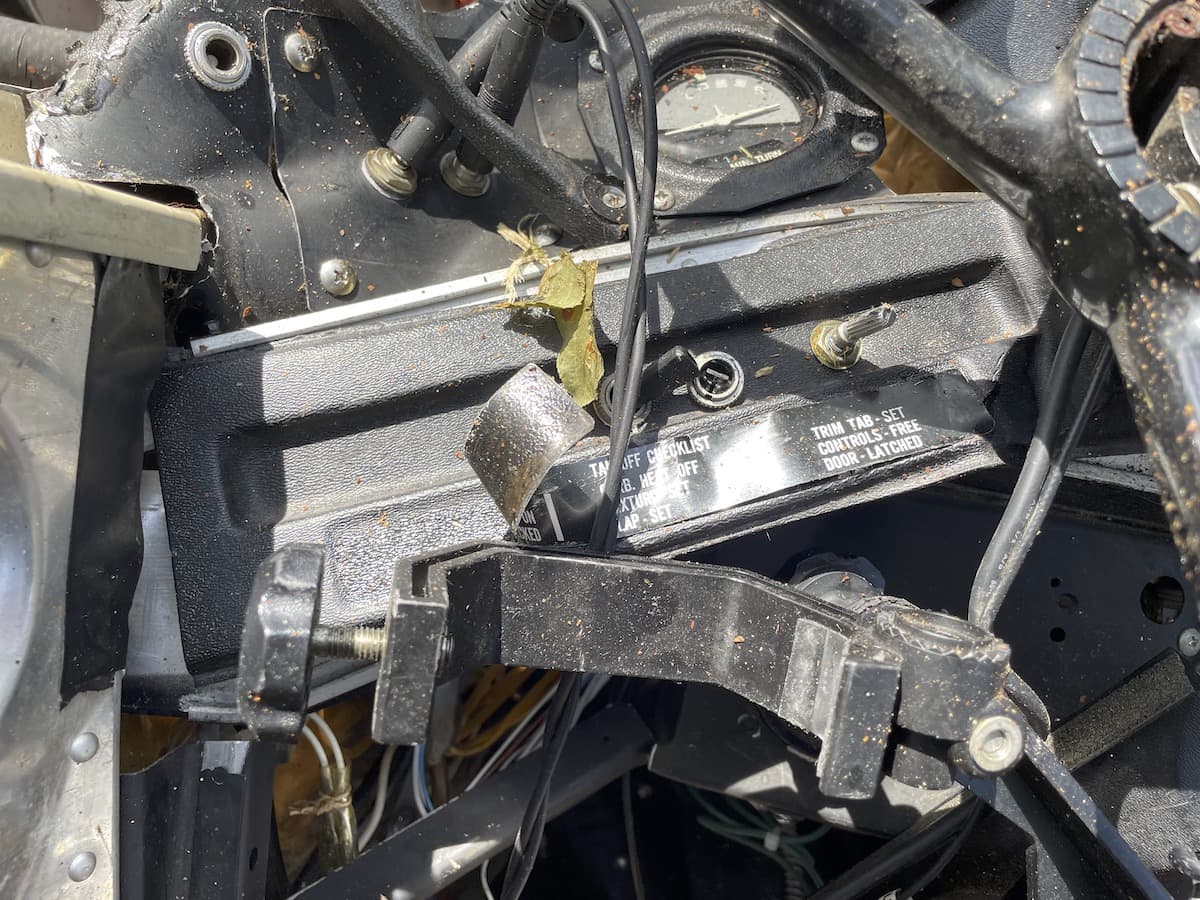
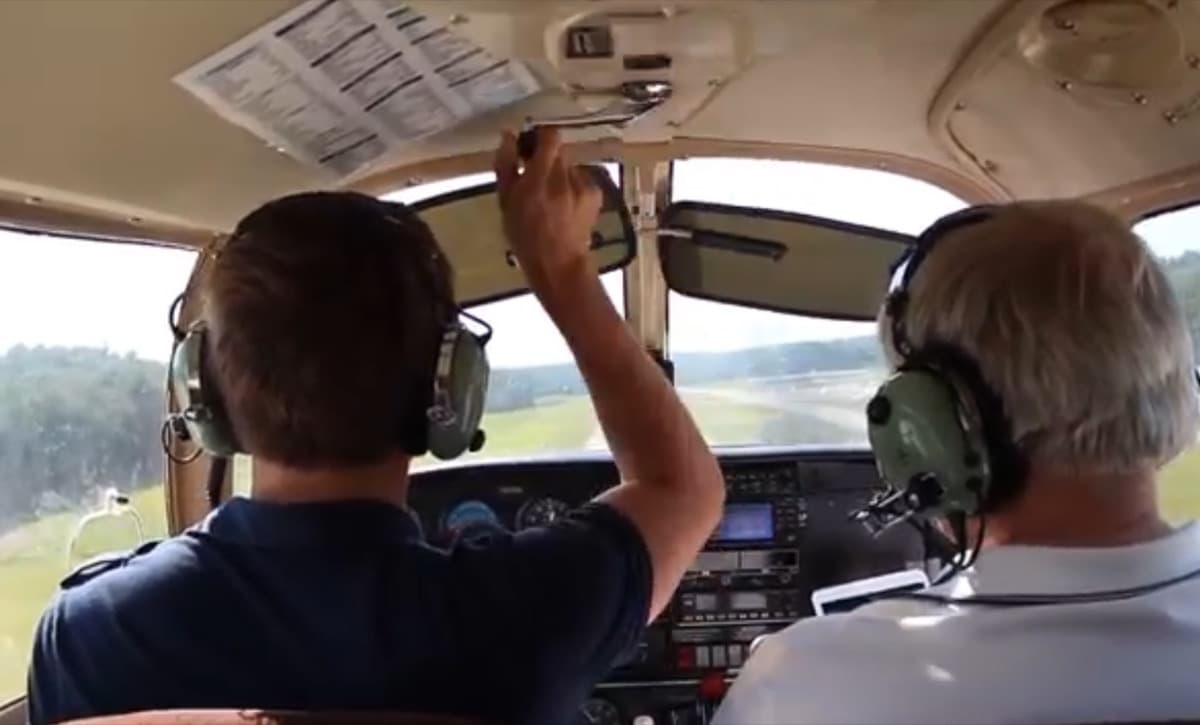
Of initial interest to me, the airplane was a 1969 model, and as with many vintage Pipers, the stabilator trim is located up on the cabin roof, rather than down on the floor like in later models, or up on the yoke as with the newest descendant of the model.
My first thought was that as it appeared the pilot attended a 141 program, and with most 141 shops using newer airplanes, perhaps he was unfamiliar with the operation of the vintage trim. Or that in an emergency, he fell back on his training and his hand went to the wrong place.
But buried in the various items on the docket was a statement from the aircraft owner, stating that the pilot “learned to fly” in the airplane. So the old-fashioned roof crank seems unlikely to be an issue in this accident.
Analysis & Discussion
The survivor did not recall the pilot using a checklist, but had no aviation experience, so how can we determine if the pilot did and simply missed the critical item or if he didn’t run the list at all?
The timeline of the takeoff can give us some clues.
The airport security footage shows the pilot getting into the airplane at 11:52:40. The front seat passenger enters the cabin 33 seconds later. Literally 48 seconds after that, the prop swings. Taxi starts 64 seconds later, and they start their takeoff roll four and a half minutes after leaving the parking place. The taxi distance from parking to the threshold was about 3,000 feet.
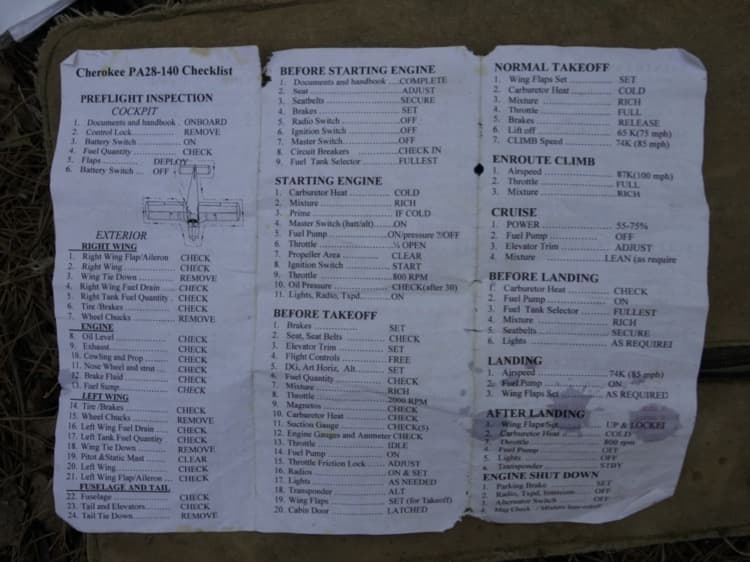
So what does this likely lack of checklist use, along with the reported lack of safety briefing, the lack of a weight and balance calculation, and obvious disregard for seatbelt use, tell us about the pilot’s personality and training?
Now, I’ll admit, although required by 14 CFR § 91.107, GA pilots are often lax in the passenger seatbelt briefing department. Although as the pilot was ejected from the plane in the crash along with his non-belted passengers, it sure looks like he was ignoring § 91.105’s requirement for pilots to buckle up too.
GA pilots are often cavalier when it comes to weight and balance as well.
But most know that anytime you’re putting more than one additional person in the airplane, a weight and balance is pretty much mandatory, as with most GA airplanes you can’t come close to filling both the seats and the fuel tanks.
That said, the NTSB investigators crunched the numbers and the airplane was well within its envelope, so it didn’t “matter,” at least from the perspective that had he done it, there would have been no reason not to proceed.
But the lack of weight and balance in a clearly airline-bound pilot graduate of a 141 pilot program is unsettling.
The Takeaway
An awareness that the position of trim for takeoff is not something to be taken lightly is one solid takeaway from this accident.
A pilot’s ability to overcome trim is highly variable depending on the make and model of airplane, its weight, its power setting, and the environment it’s flying in on a given day.
Sometimes it’s quite easy to overpower trim with yoke. Other times, there may not be enough yoke travel to save the day and, in some aircraft, while there may be yoke travel to spare, the pilot may not have enough muscle power to use it.
Trim tabs are like ants: Small but mighty.
But there’s a deeper takeaway that bothers me: The elevator trim stall is part of the CFI training curriculum. It’s even one of the testable maneuvers on the CFI check ride.
It’s considered a “demonstration stall,” a stall that isn’t supposed to be taught to students as a maneuver to practice and master, but rather one demonstrated by CFIs to their students so that the students are aware of the risks.
In fact, in the Airplane Flying Handbook’s brief discussion of elevator trim stalls, the manual calls it a “demonstration-only” maneuver to “show what can happen.”

Now, what frustrates me as a professional trainer of flight instructors is that CFIs are not — generally — demonstrating this demonstration stall to their students.
I often get that blank deer-in-the-headlights stare from my CFI candidates when I first bring elevator trim stalls up, as they never had one demonstrated to them in their flight training and never learned a thing about them.
Why isn’t the demo being demo’d?
Largely, I’ll bet, because students aren’t tested on it at any certificate level other than CFI, and there’s a tendency in flight training to focus on testable items, to the detriment of good airmanship.
I’m calling on all CFIs to start demonstrating the elevator trim stall, along with the other two demo stalls you’ve been taught.
Meanwhile, it’s sad and mystifying to me that this young man was lost to a type of stall he should have just been trained to demonstrate, even if it was — as with most pilots — skipped during his fast-paced initial training.
And even though there’s no excusing the operational sloppiness that were the first several links in the accident chain, I might have expected him to be able to figure out what the airplane was telling him, given that he should have just been trained in demonstrating an elevator trim stall.
Unless, of course, his training was, you know, less than desirable.
The Numbers
Want to read more? Download the NTSB’s final report here or view the items on docket here.

I did not receive thorough trim training initially.
On a check ride, an instructor taught me to use a little trim on short final to reduce C172 tendency to float on landing.
On another check ride, another instructor had me demonstrate how trim cannot be fought in a C182.My C182 with Madras wingtips and VGs will literally hang in the air nose up with full trim with the stall warning blaring without stalling.
I follow the checklist.Plus, on the 360, visually check the tab and elevator alignment and then the white line once in cockpit.
I had flown for 20 years 1500 hours when ,on an approach ,I over trimmed.Then initiated a go around.On the flare, the nose trimmed up sharply with the stall warning blaring.I got the nose down by trim and yoke and continued the takeoff.A salutary lesson.I had failed to to move the trim wheel to the white line on the takeoff roll.Gotcha!
We get paid peanuts as a CFI and you want to demonstrate trim stalls to primary student? The stuff that can be easily avoided if the checklist is properly ran through? No thanks. I’d rather put more emphasis on the proper checklist usage and flight deck discipline, which the kid who died in this accident lacked.
Although I wasn’t specifically instructed on trim tab stalls, regardless of which aircraft I’m flying I have always made it a point during preflight to verify the trim tab position relative to the wheel position in the cockpit, making doubly sure it is in the proper takeoff position. Sometimes it takes a couple trips back and forth between the cockpit and elevator but so what.
Not sure if I instinctively knew to do that or maybe an instructor did mention it at some point along the way, but I am just about neurotic about it being set correctly for takeoff.
For ALL . . . the above reasons MAY it be (RESPECTFULLY) suggested to eliminate touch and go operations !!!
Such operations make a mockery of G.A. check list importance TRAINING, eliminating at least 3 check lists; after landing cleanup, taxi and take off plus the added stress on applicant. This operation also puts primary concerne on the touch down NOT on roll out directional control issues like proper aileron use.
Cheers
There may be a psychological component. Was he in the proper mental state to fly? He was giving a ride to his girlfriend’s father. He may have been nervous and anxious. In his nervousness, he forgot to use the checklist. I not making excuses for him, it’s just a sad situation. Another reason to always use the IMSAFE checklist.
This accident report (and NTSB report) reminded me that I was flying a volunteer medical transportation mission that day from St. Louis to Lawrence, KS. On the return trip, as part of our SOP, we monitored 121.5 and as we got near Lake of the Ozarks we picked up the wail of an ELT sounding off. We reported it to Kansas City Center and they informed us a few minutes later that they just had a couple other calls about the ELT and had informed authorities around Lake of the Ozarks. It was this crash that we heard the ELT from. We heard several days later that they had trouble finding the crash site (heavily wooded area) and there were fatalities. Such as shame that this crash happened, so preventable.
At one point in my career, I test-flew a wide variety of aircraft after heavy engine and airframe maintenance and/or overhaul. Pre-flight actions and flight prep could be extensive depending on the work accomplished, but each one of those flights included a physical inspection of the elevator trim tab position relative to control neutral. Often, the tab did not trail with the control surface due to indicator inaccuracies or rigging issues, but if it was close, that was good enough for small GA aircraft.
Years later, I still find myself looking back at the elevator when setting the tab for takeoff. One less surprise on the roll.
What happened (1) to basic training ,(2) The supervision of ab initio instructors ? That a pilot can go from going solo to being an instructor in 240 hours of flying shows a total lack of understanding & the absolute stupidity of the current training regime. There needs to be a minimum number of closely supervised hours training in instructing techniques. No doubt the attitude prevailing among the new generation entering the workforce that they know better than their mentors doesn’t help. I’m glad that I was given my grounding in aviation by instructors who were there because they had survived WW2 fighter combat. Being taught what trim can be used for enabled me to return to my home airfield using only trim control after experiencing loss of normal elevator control. FAA et al need to have a thorough critical look at the depth of ab initio training.
Paul.
The rest of the world gets into 737 and A-320 between 250-1000 with no issues, so I don’t think anything is wrong with someone becoming a CFI at 240. I think the bigger problem is forcing people to instruct for poverty wages until 1500
Up to a certain point I don’t do weight and balance calculations anymore. I DO perform performance calculations when I think the margins may be tight – shorter runways, higher temps and elevations… Why don’t I always do W&B? It is because I already know how many adults, children, pets, bags and fuel I can load into my machine, and where they can be placed, before I reach that limit number. It comes from years of empirical data… So, the question is not, “How much weight can I load aboard before I reach my MGW.” The sole question is: “How much weight I can I depart safely with from this runway at this temperature?”
As a CFI I like to demonstrate flight with full up and full down trim and point out that the airplane is still controllable. That does not work in jet transports as was pointed out in the DC-8 crash noted above. I assume that was the United Airlines DC-8 in Detroit. I have several years flying that flight sequence at about the same time as the accident. United had two total loss fatal accidents on that trip sequence. Both United accidents had pilot fatigue as a factor and preceded the Colgan Air crash that was IMHO unduly blamed pilot fatigue and resulted the drastic duty time and flight time changes that we have today.
Based on this report I will add a full power demonstration to my extreme trim demonstrations. During the preflight is the first opportunity to detect an out of trim condition. On the walk around note the trim tab position and determine if it is in agreement with the cockpit indication.
It sounds from reading all the comments, that everyone was looking for an excuse as to why this person crashed and killed two people. The reason it happened was he was a jackass and had no business flying an airplane, he didn’t follow the rules and training that he had been given and consequently didn’t give a damn either. This is a tragedy that happened sooner instead of later, it was bound to happen judging from all the bad habits that this person was showing… Just very bad decision making, nothing would of prevented this person to do other wise, his mind was made up from the get go, to do what he wanted to do, regardless of anything else. This is the worst cause of killing people I have ever read about. Such a JERK !!!!! Be very aware of people calling themselves pilots, they will kill you, no pun intended. Unbelievable !!!
A tragedy!……..Sad…..Could it have been prevented…..??
240 hours with A commercial/ Instrument under FAR 141……?
CFI training done and waiting to take flat test?
Check the training…..
Was it over weight?
fuel load?
It’s keeps happening……and Happening and is nothing new!!
What does the NTSB recommend to the FAA on what to do on prevention???
Probably nothing ….as NTSB investigators do not have…..to….be ……pilots….
NEXT!!!!!!!!!!
I have two words……..CHECK LIST…….
At the risk of stating the obvious, the first opportunity to set the pitch trim for takeoff occurs right after the preceding landing. i.e. Add ‘reset trim’ to the After Landing SOP (and possibly to the Parking Checklist as well). This was a hard-earned lesion from a DC-8 crash that killed the entire flight crew.
I learned to fly in a tired, mud brown 150 owned by a flying club, when avgas cost 60 cents a gallon (yes, really!).
One fine day I took off and the 150 decided to emulate an F-4 and go straight up. I was able to avoid an immediate stall by pushing forward on the yoke to get the nose down to something at least approaching a normal climb attitude. Worked the trim off a bit at a time and then started breathing again.
Turns out the previous pilot had left the trim in full nose-up position, absolutely as far as it would go. (error #1). I missed it on preflight (error #2) and as a result got a tad more excitement than I expected.
Some years later, a flight student here got into a (different) 150, started it up and it shook his teeth out. Turns out the previous student had refueled, then snagged the ground cable in the prop, pretzeling it right and proper, then tip-toed away, hoping no one would notice. We noticed.
Moral of the stories is TRUST NOBODY except yourself. There is no way of knowing how someone else left the airplane. A thorough, unrushed preflight is the foundation for a safe flight.
It is pointed out that the pilot was familiar to the aircraft’s trim mechanism from past experience, so it would seem that if an out of trim condition was noticed, reaching up for the control might have been a regular response. This familiarity for using a particular model my create ‘too much familarity’ which may manifest as complacency. My question is just how would the investigation reveal a weight and balance was not calculated? In my training via Part 141 I don’t remember that a formal form or subsmission of such data was ever necessary or recorded – did I miss something?
I have on many occasions adjusted pitch trim during the takeoff role because it didn’t feel right. I do believe the vast majority of crashes are a result of lack of innate mechanical sense. Indeed being the importance of the check list when one is not cognizant enough to know what’s going on around you.
To your point: Given all the info available to the pilot, both in the plane and from his training, you actually need to pay attention to it before taking off into the woods rather than the Wild Blue Yonder. Some just aren’t predisposed to such details. You can lead a horse to water, but you can’t make him drink. RIP to the deceased.
Regards/J
I like the Cessna trim wheel on the floor, with a trim position indicator, which also has a ‘take-off’ marking. easy to see and use and a glance shows the trim position.!!
I could find any info on the PS-28 overhead trim, and if there is any trim position indicator.?
Yes, there’s a little scale with a pointer (up on the ceiling by the crank), similar to the wheel type. There’s a central mark for takeoff trim, which isn’t perfect but is pretty close to Vy.
On takeoff, my Cessna trim setting is the ‘takeoff’ reference marking, which gets the aircraft climbing at Vy, 79 mph. Once at 500 ft and at the end of the runway, I roll the trim about a full turn forward, to ‘cruise climb’ which is 100 mph.
Who uses full nose up trim on landing ?
On initial descant, past the numbers, I trim my Cessna 175 for 80 mph with 10 degrees flaps. I get over the ‘number’s at 60-65…
In most aircraft, full nose up trim will yield best glide speed, but isn’t a good idea using it on landing, in case a go-around is needed.
This sounds like poor pilot training.
I have never used trim on landing instead utilizing flaps and yoke instead. I got my flight training from a WWII “SBD” pilot who trained heavily on “stick & rudder” flying relying very little on trim settings. That said, I check trim setting before engine start up.