

According to family members of the passengers, the purpose of the flight was a scenic tour of downtown Miami.
One of the passengers occupied the front left seat, the flight instructor occupied the right front seat, and the other passenger occupied the rear seat. Neither of the passengers held pilot certificates and there was no luggage.
The Cessna 172 departed North Perry Airport (KHWO) in Hollywood, Florida, on Runway 10R, a 3,255 foot-long by 100 foot-wide asphalt runway.
Two security cameras from different angles showed the airplane’s takeoff ground roll and rotation.
During the initial climb, the airplane’s pitch increased rapidly before reducing several seconds later until the airplane reached about 125 feet above ground level.
The airplane then began a left descending turn, rolled further to the left, and descended steeply until hitting terrain on airport property about 650 feet northeast of the departure end of the runway.
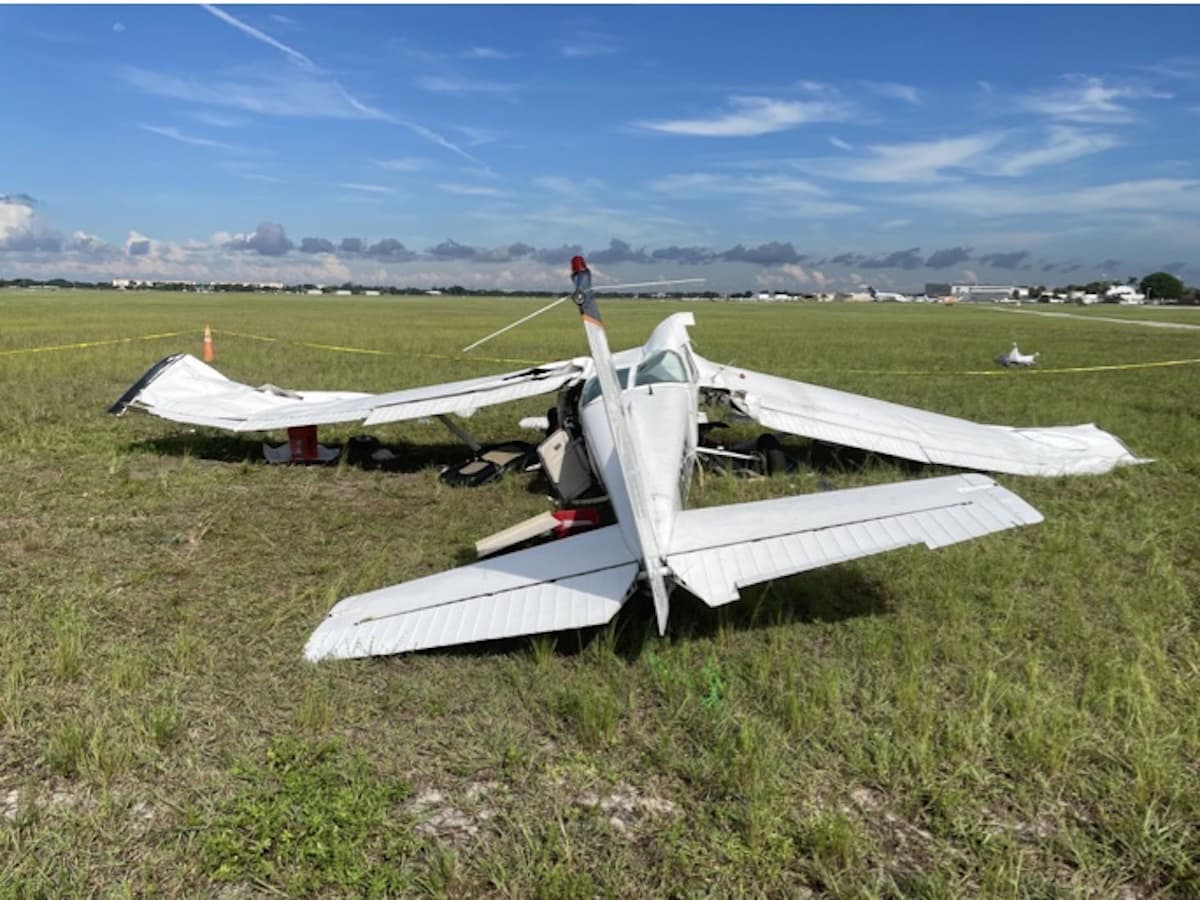
The airplane hit the ground in a steep, left-wing-low, nose-down attitude before coming to rest upright.
The flight instructor and front seat passenger died in the crash, while the rear seat passenger was seriously injured.
Following the accident, the surviving passenger was unable to recall any details about the flight.
The wreckage was oriented on a heading of 287° at an elevation of 12 feet. Both wings were impact separated downward. The wreckage path was compact, and all major components and flight control surfaces remained attached. There was no post-impact fire.
The fuselage was buckled and deformed through about 50% of the cockpit area, with the most severe damage in the front seat area and floorboards. The engine compartment was significantly compromised by impact forces, displacing the engine and propeller upward and aft into the firewall, which also displaced the instrument panel.
ADS-B data provided by the FAA showed the airplane on the takeoff roll as its ground speed increased to about 45 knots. There was about a 10-second gap in track and groundspeed data until the ADS-B data resumed and showed the airplane at about 74 knots and an altitude of 50 feet MSL. The highest ground speed recorded was 75 knots before the speed decreased immediately preceding the left turn and descent.
The wind speed and direction were fluctuating before and shortly after the accident. The airport’s surface observation report, recorded about 7 minutes before the accident, showed a wind from 170° at 6 knots, which would have resulted in a headwind component of 2 knots and a right crosswind component of 5.6 knots.
About 4 minutes after the accident, the wind had shifted to 210° and 9 knots, which would have resulted in a right crosswind with a tail wind component of about 3 knots.
In addition, there was a reported thunderstorm in the area. However, video recording of the flight did not show any precipitation or a thunderstorm over the airport.
A video study was conducted by the NTSB’s Office of Research and Engineering based on visual information obtained from airport security camera footage. The objective of the study was to estimate the airplane’s altitude, pitch angle, and wing angle of attack.
Taking a simulated Cessna 172P for the program model, along with security camera footage and ADS-B data, the study concluded that during takeoff and initial climb there was a large wing AOA preceding a bank to the left. Immediately before the left bank, the AOA was estimated to be 14.5°. The large wing angle of attack was caused primarily by the large airplane pitch angle. When the airplane started banking to the left, its ground speed was a constant 61 knots.
Probable Cause: The flight instructor’s exceedance of the airplane’s critical angle of attack during the initial climb, which resulted in an aerodynamic stall and subsequent rapid descent into terrain.
To download the final report. Click here. This will trigger a PDF download to your device.
This August 2023 accident report is provided by the National Transportation Safety Board. Published as an educational tool, it is intended to help pilots learn from the misfortunes of others.
Bad decision making again, all the training in the world not have saved these poor souls, It shows in the aftermath of this wreck. Another Jerk at the controls of an airplane, airplanes are to be taken seriously, they are not play toys, they are very unforgiving like the sea, if a person doesn’t have respect for airplanes or the sea, it will do you in, whether you think you are bigger or smarter,, no contest, it will beat you senseless and quickly.
Bad decision making again, all the training in the world not have saved these poor souls, It shows in the aftermath of this wreck. Another Jerk at the controls of an airplane, airplanes are to be taken seriously, they are not play toys, they are very unforgiving like the sea, if a person doesn’t have respect for airplanes or the sea, it will do you in, whether you think you are bigger or smarter,, no contest, it will beat you senseless and quickly.