

The pilot reported that he departed on the flight with about 18 gallons of fuel on board the Cessna 172.
While flying at 3,000 feet mean sea level over Delaware Bay, the engine lost total power. He established the airplane’s best glide configuration and prepared to ditch in the water.
His personal flotation vest became entangled in the seat belt and headset wire and he did not feel that he had sufficient time to refer to the emergency procedures checklist.
He attempted to restart the engine, but was unsuccessful.
Shortly after declaring an emergency, the engine regained power.
He attempted to reach Millville Municipal Airport (KMIV) in New Jersey, as he climbed from 1,200 feet.
The engine lost power again, so he established best glide speed and performed a forced landing in a farm field.
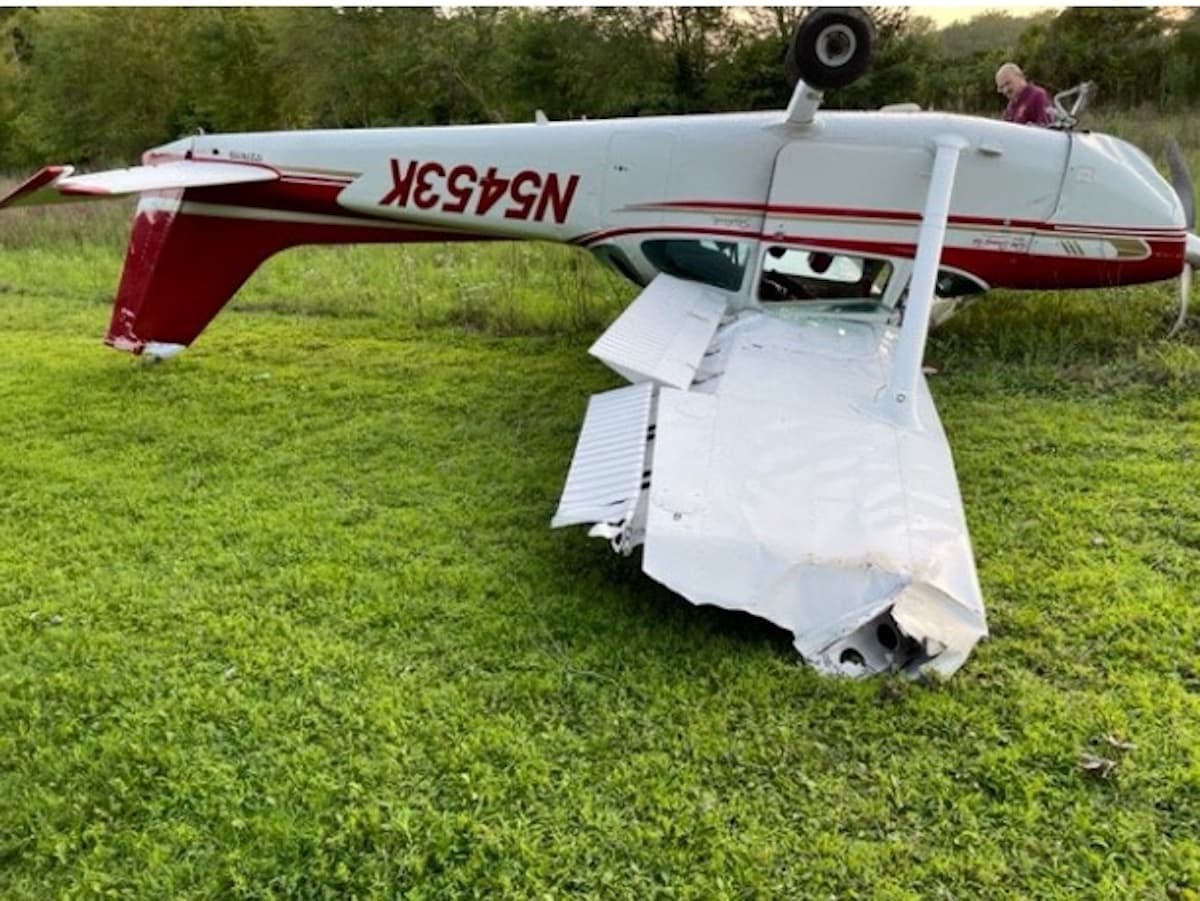
After touchdown, the nose landing gear dug into the soil and the airplane nosed over, coming to rest inverted.
Post-accident examination of the wreckage revealed that the wings and fuselage were substantially damaged.
The wreckage was found inverted, however the fuel caps were secured and there was no evidence of fuel leakage.
The left wing fuel tank was intact and contained about 1.5 gallons of fuel. The right wing tank contained about 10 gallons of fuel. According to the Cessna 172P Pilot’s Operating Handbook, the standard fuel tank configuration includes 1.5 gallons of unusable fuel per tank.
The pilot reported that, after the accident, when he went to check the fuel selector, he found that it was in the “LEFT” tank position. He further stated that he had only been running on one tank.
Probable Cause: The pilot’s improper fuel management, which resulted in fuel starvation and a total loss of engine power.
To download the final report. Click here. This will trigger a PDF download to your device.
This August 2023 accident report is provided by the National Transportation Safety Board. Published as an educational tool, it is intended to help pilots learn from the misfortunes of others.
It’s real simple folks. All an engine needs to run is fuel, air, and ignition. Starve the engine of any one of the three and it is sure to quit. Regarding check lists, professional airline pilots have specific memory items they have to demonstrate during training and certification. A checklist/flow that is performed from memory. When it comes to an engine failure, the checklist should be a memory item/flow beginning with mixture, carb heat, fuel (switch tanks back to both or to another tank), and ignition. In this particular case, all the pilot had to do was switch tanks. It was that simple.
Giving the amount of experience he had in this particular airplane…and how ‘current’ he was…it’s kind of shocking that he couldn’t remember one of the most BASIC checklists: With a few minor variations, it’s applicable to every carbureted engine…Lycoming or Continental…mounted in Cessna airframes:
ENGINE FAILURE DURING FLIGHT
1. Airspeed—65 KIAS.
2. Carburetor Heat –ON.
3. Fuel Selector Valve –BOTH.
4. Mixture — RICH.
5. Ignition Switch– BOTH (or START if propeller is stopped).
6. Primer –IN and LOCKED
(Source: Cessna 172P POH, Section 3.)
It takes less time to DO it, than it does to RECITE it. That he had to ‘refer to the checklist’ is a big red flag.
I am glad he acknowledged, in his “Safety Recommendations”, that having a PFD in the back seat doesn’t help much if you happen to have an emergency, at low altitude, over open water…beyond gliding distance from shore.
OTOH, I’d be a bit more concerned about the “One (1-inch) crescent wrench” the inspectors discovered inside the engine compartment. Based on the damage they found, sounds like it might have been rattling around in there for a while…
With a replacement 180 HP engine, it uses fuel at 8-10 gph. So 18 gallons in the 40 gallon tanks are good for 1.3 hours of ‘legal’ flight, with 5 gallon , 30 minute reserve.
The #1 rule is to ‘fly the aircraft’, no fiddling with other stuff. This pilot didn’t think to check the gauges and fuel selector, and change tanks.
This guy needs a 709 ride to learn/ re-learn proper scan flow…
After reading about all of these “fuel starvation” incidents, I am amazed that the airplane isn’t filled up prior to flight (most GA aircraft hold approximately 35-60 gallons of fuel). If avgas is too expensive for a fill up (as an airplane owner, gas is the least expensive cost of owing an airplane!), try another hobby…
Small airplanes are subject to the same fueling considerations as the airliners – full fuel plus payload may exceed MGW, it costs fuel and money to carry extra (excess) fuel, and extra weight has a negative impact on performance.
Fuel is my #1 expense at about $4,800 for 100 hrs a year. Then hangar , insurance and annual costs. But the aircraft has a value 40x the fuel on board, so no excuse for not having sufficient fuel .
But not having at least 3 hrs of fuel on board is a ‘stupid pilot trick’….not safe or prudent.
“he did not feel that he had sufficient time to refer to the emergency procedures checklist.” It’s a shame he didn’t have at least the first two items on the checklist memorized – carb heat and fuel on both.
Decades ago the original Volkswagon beetle designed by Dr. Porche at Hitler’s command featured two gas tanks with an A-B selector switch and no dashboard gauge – such were reserved for Hitler’s airplanes. If you ran out of gas, that was your cue to pull over and switch to the second tank, then hit the petrol station for a fill-up. Guess that’s the rationale for GA airplanes. Engines quit? Then switch tanks. It continues to escape me why there is a choice between tanks, particularly as the wing mass shifts with fuel consumption. Why not just keep the switch on ‘both’ or have no switch at all — just a cross-connect tube to provide symmetrical drain from both tanks. Anybody care to explain that to me? It just bewilders me.
This pilot is lucky to be alive. Could have been grieving relatives at his funeral. “Dad loved his airplane so much….” As car and truck designs have evolved over the ages to compensate for the idiot factor in drivers, it’s long past high time the same rational were applied to GA airplanes. Remove the need to choose between tanks and just have one fuel supply to the engines. Am I missing something here, gents/ladies? Please explain.
Regards/J
Per the POH, left or right can be used for in-flight balancing, to prevent cross-feeding during fueling to maximize fuel load, or to prevent cross-feeding when parked on an unlevel surface.
The early VWs had the fuel valve below the dash, since the fuel tank is just forward of the cowl. The normal position draws fuel from a pipe about 1 inch above the bottom of the tank.
The ‘reserve’ position draws fuel from the bottom of the tank, about 1-2 gallons remaining.
High wing aircraft can gravity feed fuel from both tanks, while low wing aircraft must pull fuel from 1 tank at a time, requiring a fuel pump and selecting tanks alternately at 30-45 minute intervals to maintain fuel balance.
Why?
The fuel valve was on the left tank and there was 10 gallons in the right tank.
The fuel valve is in the center console….How did he miss it?
Amazing ……..nothing else to be said!