

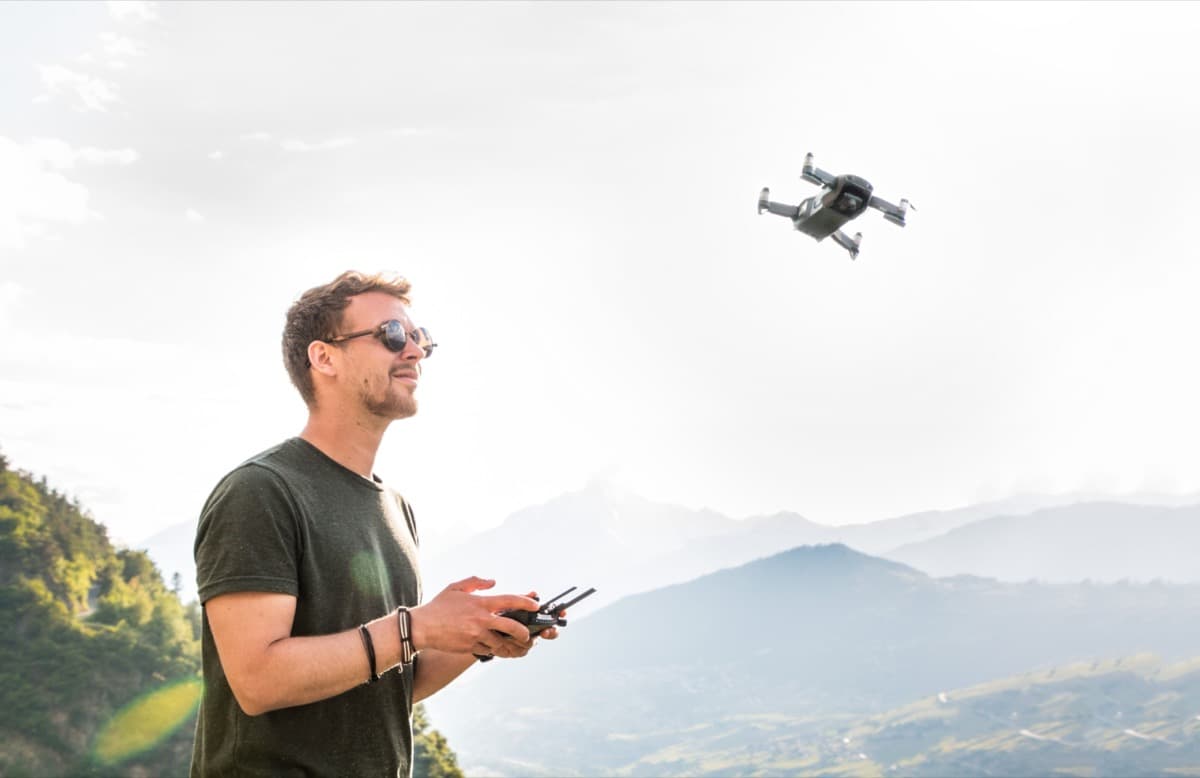
A nationwide analysis of drone activity led by researchers at Embry‑Riddle Aeronautical University documents increasing growth in the use of drones and reveals “hot spots” where the risk of a mid-air collision with manned aircraft may be higher.
The study, which was conducted for the FAA, characterized patterns of when and where small unmanned aircraft systems (UAS) are flying in order to assess and possibly mitigate any potential hazards associated with those patterns as drone use increases, researchers said. Small UAS refer to drones weighing less than 55 pounds.
The researchers found that small UAS operators sometimes fly above the 400-foot ceiling established by the FAA for drone flight.
“Study data suggests that a sizable number of small UAS flights take place above that altitude, which could impact the operation of manned aircraft,” said Dr. Ryan Wallace, associate professor in the Aeronautical Science Department and principal investigator of the project.
Of 6,037 documented flights that had associated altitude information, at least 573 hit an altitude of between 400 and 500 feet, and at least 781 flew to 500 feet or above, according to the study.
Taking flight duration into account, the researchers calculated that drones flew in airspace typically used by manned aircraft about 10% of the total cumulative flying time that was observed.
The data also suggested that flights above 500 feet were probably recreational, rather than commercial, based on the types of drones used.
Some of the drones that flew above 400 feet may have still been operating with FAA approval — such as under a waiver or certificate of authorization — but the research did not discern those distinctions, the researchers said.
Heightened risk is also associated with small UAS flying near airports, especially heliports. Heliports are not noted on aeronautical charts, according to Wallace, and “are often hidden within urban sprawl.”
Dr. Stephen Rice, a professor in the Human Factors and Behavioral Neurobiology Department who participated in the research, said he was surprised by “the sheer number of drone flights operating near airports.”
The researchers analyzed 43 aerodromes, meaning airports of all types. Small UAS were detected operating closest to heliports at distances within 0.5 nautical miles, about 3,000 feet.
Wallace said the report specifically recommends including heliport locations on aeronautical charts to make drone operators more aware of those locations.
Also involving researchers from Kansas State University and Wichita State University’s National Institute for Aviation Research, the study was conducted using sensors placed across the country that collected data from Remote Identification signals, which the FAA has required registered drones to transmit since 2023.
Wallace praised the FAA Remote ID policy, saying it was “bearing fruit by providing the FAA with important information on small UAS activity hot spots or areas of elevated risk” that can aid the agency in developing effective safety regulations.
The most important part of the analysis was its creation of “a real-world, data-driven picture of how small UAS are actually being used in the National Airspace System,” said Dr. Brent Terwilliger, associate professor in the Embry‑Riddle Worldwide Department of Aeronautics and a contributing researcher.
He added that this information is “essential for shaping informed, practical policies and technologies that will enable safe, scalable integration of UAS as operations and autonomy continue to expand.”
Wallace said the commercial applications of drones — which are already used in crop monitoring, public safety, search and rescue, safety inspection and more — will expand. Also, changes in beyond-visual-line-of-sight rules — regarding flying drones beyond where a pilot or other observers can see them — are expected to increase the use of the uncrewed aircraft.
On Aug. 6, 2025, the FAA released a new proposed rule for Beyond Visual Line of Sight for drones.
Previously, drone operators would have to get individual waivers or exemptions to use their drones without visual line of sight. These were approved on a case-by-case basis, and the process was cumbersome, according to FAA officials.
“By eliminating these requirements for BVLOS operations, the proposal will significantly expand the use-case for drone technologies in areas like manufacturing, farming, energy production, filmmaking, and the movement of products, including lifesaving medications,” agency officials noted.
“Normalizing BVLOS flights is key to realizing drones’ societal and economic benefits,” said FAA Administrator Bryan Bedford. “Package delivery, agriculture, aerial surveying, public safety, recreation, and flight testing are just some of the uses we expect to see as we enable these innovative technologies while maintaining the safety of our National Airspace System.”
Comments on the proposed rule will be accepted until Oct. 06, 2025.
Surprised it took this long for the FAA to pony up money for a “study” to confirm what’s been identified as a problem for quite a while now:
https://airfactsjournal.com/2020/01/drones-a-clear-and-present-danger/
On 29 May 2018, I had the “first plausible fixed-wing collision with a drone in the US”according to the NTSB.
Flying from Lenhardt’s Air Park, Oregon (7S9) to Crest Air Park, Washington (S36),in my Cessna 170B I had a midair with what the NTSB determined to be a small drone at 1800ft agl in Aurora, Oregon (UAO) Class D airspace while in contact with the tower. Fortunately contact was with the right wingtip and damage was confined to the wingtip and outboard leading edge.
If it had gone through the windshield, I would most likely not be writing this, however I can assure you that the drone operator was never in any real danger….
As a seaplane owner, it is the nature of my flying to fly low over water doing takeoffs and landings. The risk of colliding with a hobbyist drone is very real. I am terrified that I may be killed by a kid with his toy. Nobody seems to think there is a risk below 400 feet. That is just plain wrong. Maybe after somebody is killed, the FAA will require ADSB-out on these missiles.
FAA regulations, it is said, are written in blood. But what will ADSB-out do when most aircraft don’t have ADSB-in? Since the FAA can’t seem to regulate Drones efficiently, so, more than likely they will slap new requirements on aircraft owners. These requirements are sure to be intrusive and very expensive.
And only 53% of the GA aircraft are equipped with ADSB-out, so use your ‘mark 1 eyeballs ‘!!!
So, almost 1/2 of the GA aircraft will not be displayed on your ADSB-in, so keep looking outside.!
https://www.bts.gov/content/active-us-air-carrier-and-general-aviation-fleet-type-aircraft-number-carriers-0
https://www.faa.gov/air_traffic/technology/equipadsb/installation/current_equipage_levels
Jim, if you think you can see a standard sized recreational drone from your 90-130 mph [or more] aircraft in time to avoid it, you’re just delusional.
“Jim, if you think you can see a standard sized recreational drone from your 90-130 mph [or more] aircraft in time to avoid it, you’re just delusional.”
Exactly. At least if they had ADSB-out, we could equip ourselves to see and avoid their reported position.
Have you ever flown is an area with migrating birds, that are 800 to 2,000 ft agl. ??
I have…!
So, how many drones have ADSB-out, that you might see on your panel display.???
My point was that about 1/2 of the GA aircraft don’t have ADSB-out , so they won’t show up on the display either, unless the ATC has primary radar. Then they show up as a target and altitude only.
And lakes and rivers are natural attractions for drone flyers. It’s only a matter of time until a seaplane hits one.
In the wrong hands, these things are “Satan’s Aircraft.” Yesterday I was at a Saturday morning breakfast gathering and Young Eagles event, and some knucklehead was flying a drone up and down the parallel taxiway near the approach end of the runway. I was in my plane doing a runup, and called out this idiocy on the radio, hoping someone would take action. It’s only a matter of time until someone gets killed.