

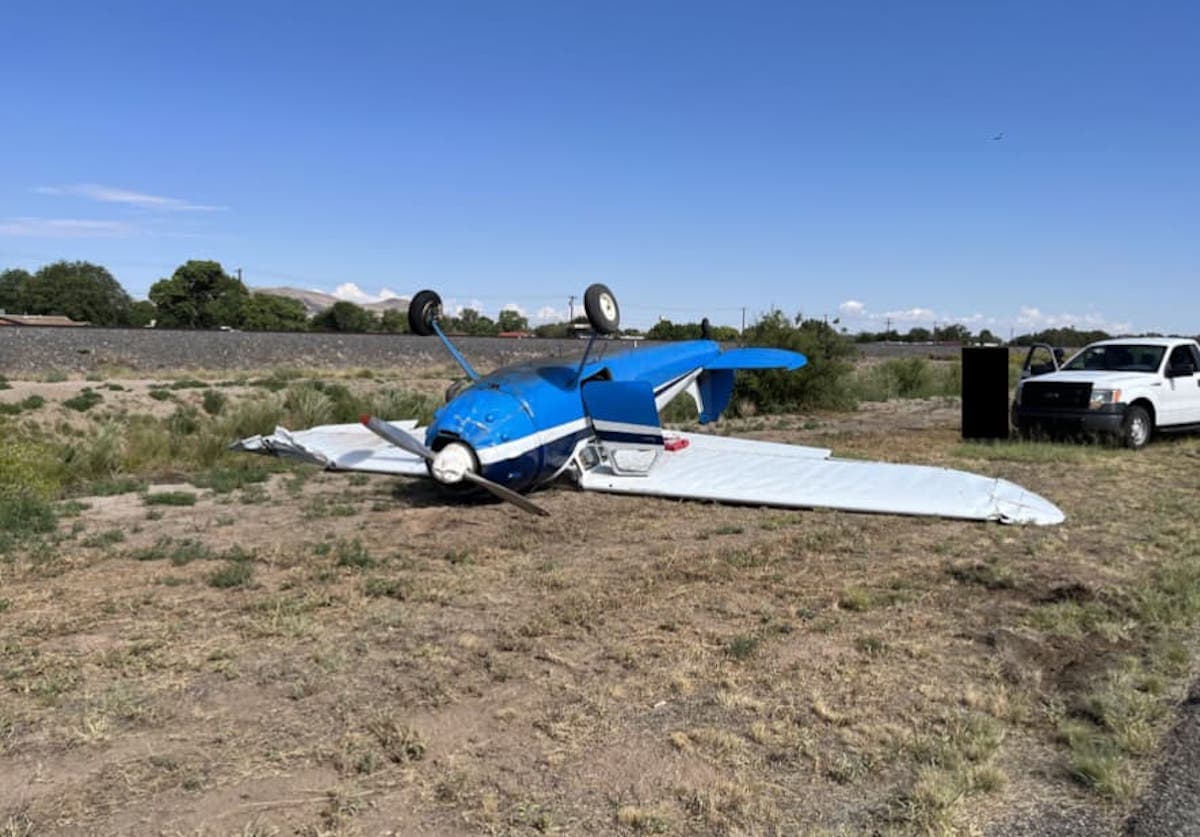
The pilot told investigators that during the takeoff roll at the airport in Los Lunas, New Mexico, his seat slid aft on the seat rails and he could not reach the rudder pedals.
He reduced engine power and stretched to reach the brakes, however he no longer had forward visibility.
The Cessna 195B drifted to the right and then to the left of the runway. He applied the brakes hard and the airplane nosed over.
Both wings, the vertical stabilizer, and the rudder were substantially damaged. The pilot was seriously injured in the crash.
He later realized that the seat position peg had not been fully seated in the seat rail detent, and that the rear seat rail cotter pin was not installed.
Probable Cause: The pilot’s failure to secure the seat’s position in the seat rail, which resulted in a loss of directional control and nose over.
To download the final report. Click here. This will trigger a PDF download to your device.
This August 2023 accident report is provided by the National Transportation Safety Board. Published as an educational tool, it is intended to help pilots learn from the misfortunes of others.
Cessna came out with a kit to prevent the seat from sliding back on takeoff. It consisted of an initial reel seatbelt that attaches to the seat and the floor when you lift the handle to adjust your seat forward and then release it it locks so the seat can’t slide. When you go to exit the plane and move your seat back and lift the handle it releases so you can move the seat. I installed one a few years back on my Cessna 180 and I believe that Cessna provided the kit and also that I was reimbursed for the cost.
Note that he forgot to re-install the secondary seat stop, which is a required part per an AD.
This prevents the seat from sliding too far back, preventing the pilot from not being able to reach the yoke or trim wheel.
BTW, don’t we all trim for initial climb , 500-700 fpm, so letting go of the yoke would have little affect on attitude. ?
The seat tracks and latch pin are a required inspection item during an annual inspection..!!
So, 2 reasons why this crash should not have happened.
Cessna seat rail system is a KNOWN problem. As far as I know there is an AD for this that covers C150, 152, 172, Cardinals, & 182s. Isn’t it time that Cessna figured out a better way?
I’ve not had such a problem in any Piper I’ve flown (Cherokee 1xx through the “6”, Archers, Seminole, Lance, Toga…)
In fact this is such a problem that as a student pilot in the 1990’s (15x aircraft), I was told by my instructor that if my seat were to start sliding backward to immediately let go of the yoke so that I wouldn’t pull up into a vertical stall/spin. And we discussed how to recover from this, including getting rid of the seat belt and pulling one’s self forward using the door handle(s) OR changing seats to get control. This is life or death situation.
At the risk of accidentally unlatching the door on top of the problem you have on your hands?
ABSOLUTELY!! You are the pilot with no one else in the plane.
But with two in the plane and the other person doesn’t have this problem and they are not a pilot, tell them to push gently on the yoke until about level….. Keep them from panicking.
So to prepare yourself for this, get with an instructor — run up to full power holding the brakes and try to open that door. This will be eye-opening for 2 reasons: You will see that you have to fly the plane and not concentrate on the door. Don’t let that distraction turn into a crash.
Now take off and once level but, before reducing power, pop the door. And now fly the plane to either altitude, or through the pattern to landing.
I’ve had this happen in a Cherokee 180 (IFR Plan, not IMC), out of a towered airport and we had to turn back because it was 10F and we could not deal with the amount of cold air (even with coats and gloves).
Back to the Cessna: Seconds matter when that seat slides all the way back. Hopefully you automatically released the controls. Meanwhile the CG has just moved back because of you having slid back. So the door opens a bit and you have air coming in. You have to get in control of this plane.
The nose pitches up, airspeed starts to fall off, you are heading into a stall. You may climb to about 200′ AGL. Once that stall happens, you will not have enough time to break it and stop your descent nose first into the ground. If you don’t get to where you can control the plane, it may snap over into rotation (stall SPIN). Which is worse? The door being open a bit, or that sudden stop when you hit the ground? 100′ or more to the ground, you will not survive that crash.
Now, if you have your wits about you and you can do it fast enough run trim all the way to nose down. That yoke will be heavy once you get to it, but you won’t stall and spin. You might actually get to level where you can control it. But remember all this is happening fast and you just rotated and lifted off. You don’t have time to think — you have time to react with the correct actions. Just like a twin, you have to be armed with exactly what you are going if an engine fails on takeoff. You have to be ready if that seat drops back. If you and a pax have it happen at the same time….. CG shift toward AFT will cause that nose up to put you in stall spin almost immediately.
BTW – my instructor actuallly had us do something like this with a popped door to understand it is an annoyance but not an emergency. And to practice “seat slide” to understand what to do. And this was just before I got to solo.
Hopefully can be rebuilt losing to many beautiful airplanes.
I agree. I read an article recently by Ben Sclair where I believe he said that 4-5 aircraft a day are lost or damaged to accidents. Thats a pretty sobering number considering the number of older planes that are still active.