

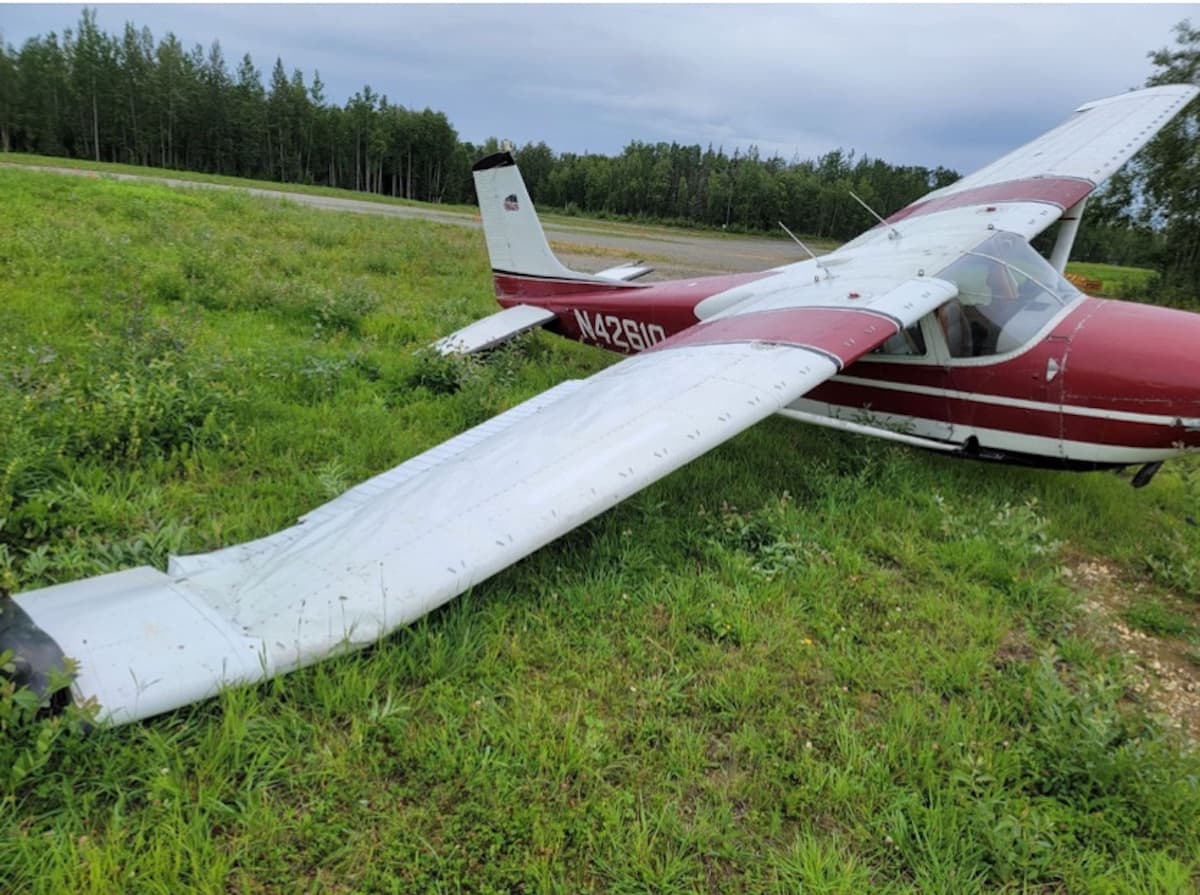
The pilot and passenger were performing a pass over a remote airstrip in Chaka Creek, Alaska, to ensure the surface was suitable for landing.
About ½ down the 850-foot airstrip, the pilot initiated a go-around with the throttle, mixture, and propeller controls in the full forward position and then realized the Cessna 180’s engine was not producing full power.
With rising terrain ahead and the airspeed near the stall speed, the pilot elected to attempt a forced landing on the remaining airstrip.
During the forced landing, the right main landing gear hit brush, and the airplane spun about 120° and came to rest upright.
Post-accident examination of the airplane revealed substantial damage to the left horizontal stabilizer and right wing.
The pilot told investigators that the engine likely experienced carburetor icing during the approach and attempted go-around.
Based on the pilot’s report of the temperature and dew point at the time of the accident, the airplane was operating in conditions conducive to the formation of serious icing at cruise power. The pilot reported he did not apply the carburetor heat when the engine began to lose power due to the low altitude and airspeed during the attempted go-around maneuver. It is likely the engine sustained a partial loss of engine power due to the formation of carburetor ice.
Probable Cause: A partial loss of engine power as a result of carburetor ice. Contributing to the outcome was the pilot’s failure to effectively use carburetor heat in conditions conducive to the formation of carburetor ice.
To download the final report. Click here. This will trigger a PDF download to your device.
This August 2023 accident report is provided by the National Transportation Safety Board. Published as an educational tool, it is intended to help pilots learn from the misfortunes of others.
0-470’s Can make ice on a hot summer day with the right humidity. Carburetor temp gauge is a great tool. If you have carb ice that makes loss of power and apply full carb heat, it can make the engine quit due to excessive rich mixture at that point. If you were to put carb heat on and then lean the engine would probably then restore power. Most people aren’t going to think that quick in a go around. And then you’re gonna be needing to put the mixture back in as power is restored so you don’t cause other problems. Definitely better to be proactive.
I would leave a comment, but I don’t want to jinx myself!
A carb temp gauge is available for the MS carbs. I have one on my MS MA4-5 and I have to use it in the cold months here on my initial taxi, before the oil warms the carb.
It is inexpensive and easy to install, so no excuses if the aircraft is operated in potential carb ice conditions.!!
I know that some of these aircraft are over 30yrs old. But wouldn’t a perm fix be to have a probe in the Carb to sense when it is at a temp where ice can form so it can light a carb-heat required light? Led’s use very little power. And if that light comes on, or flashes (better to get your attention with), you know to put on carb heat until that light goes out.
And maybe this needs be done via AD? How many crashes a year do we see becasue of carb ice? I hate doing it by AD, most do not have to follow SAIBs.
I know in flying carb Pipers, carb ice in the summer with 80F temps does take one by surprise when at full power and climbing out!! Hardly ever have to use carb heat with them vs the carbed Cessnas, where you know to add carb heat in the summer upon reduction of power on entry to pattern… so if you have to go around, you know full throttle is going to work.
As the Wise Man once said: “He who hesitates is lost.”
Regards/J
But also there is ..’look before you leap !!’
So, there must be a middle action..???