

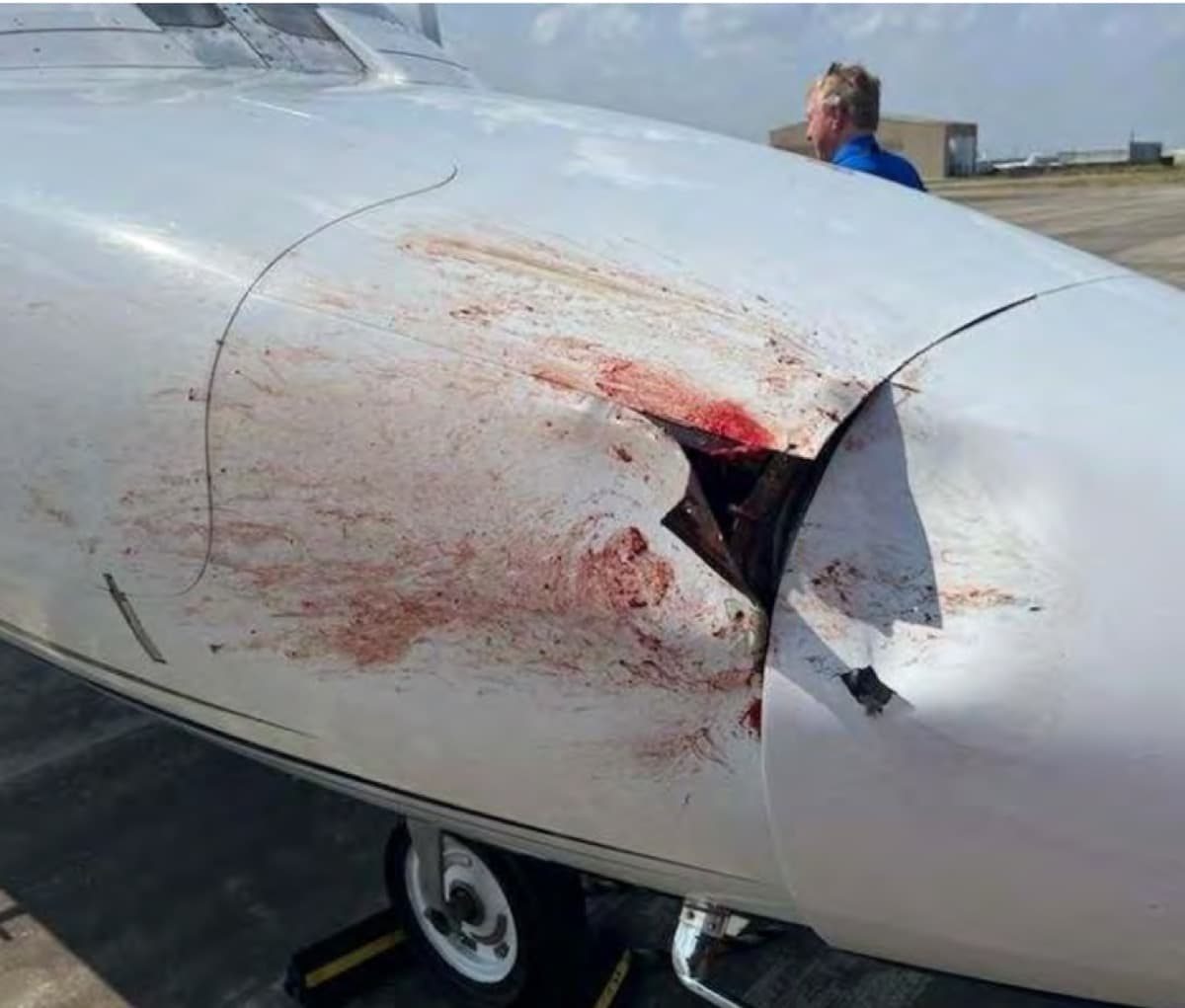
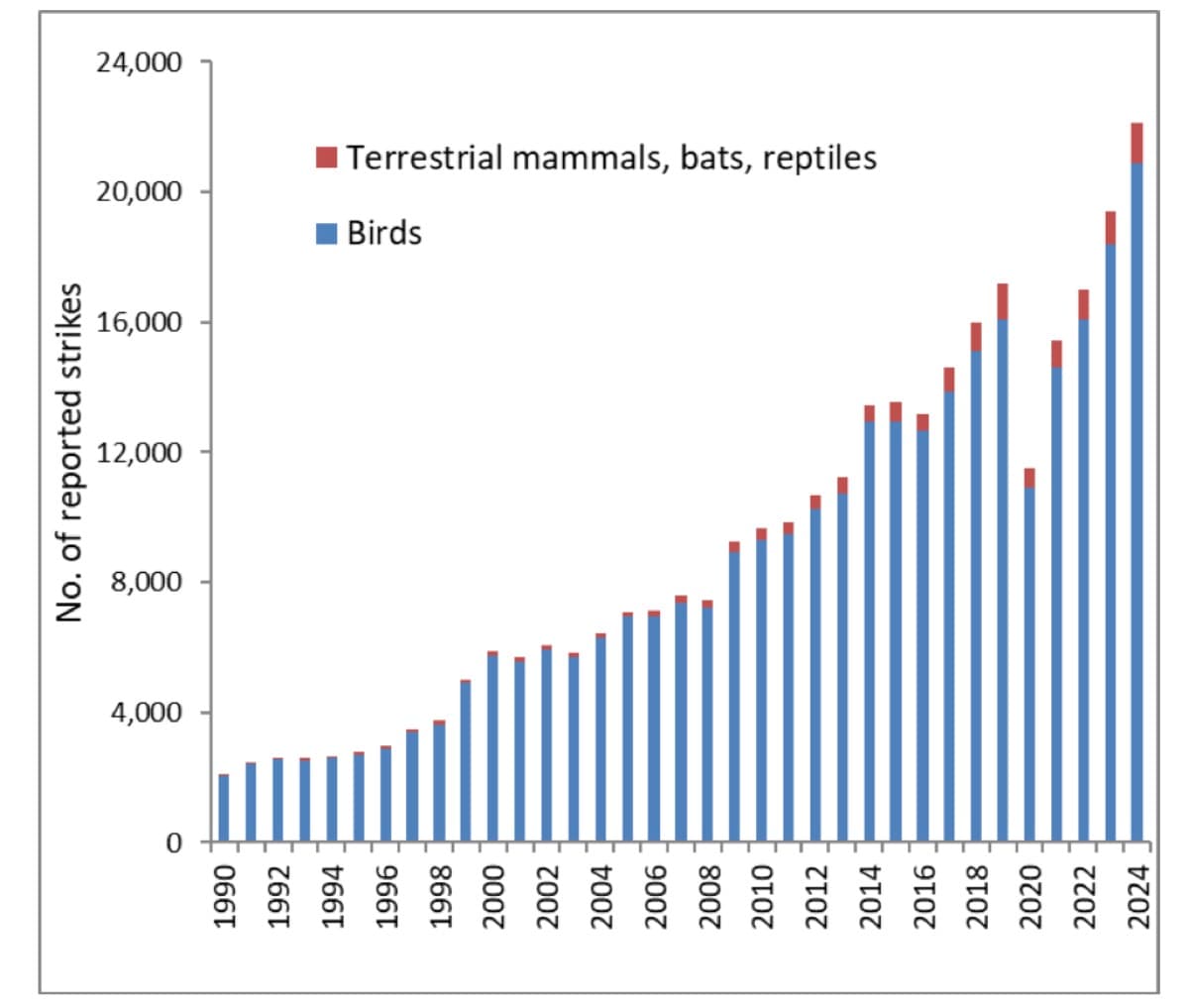
A new report from the FAA shows that wildlife strikes on civilian aircraft in the United States were up 14% in 2024.
The report, “Wildlife Strikes to Civil Aircraft in the United States 1990-2024” released in June 2025, notes that the 22,372 documented wildlife strikes in 2024 equated to roughly 61 wildlife strikes every day.
“Aircraft collisions with birds and other wildlife have become a growing concern for aviation safety,” according to the report’s executive summary. “Factors that contribute to this threat are increasing populations of large birds and increased air traffic by quieter, turbofan-powered aircraft.”
The report notes that globally, wildlife strikes with both civilian and military aircraft killed more than 643 people and destroyed more than 360 aircraft from 1990 to 2024.
In the United States, wildlife strikes killed 82 people and destroyed 126 aircraft in the same time frame.
Landing seems to be the most likely time for a wildlife strike, with the report showing that birds (62%), terrestrial mammals (63%), and bats (84%) are all more likely to be struck during the arrival phase of flight compared to departure (34%, 32%, and 12%, respectively).
For commercial transport aircraft, 71% of bird strikes occurred at or below 500 feet AGL, compared to 54% for general aviation aircraft.
Above 500 feet AGL, the number of strikes declined by 34% for each 1,000-foot gain in height for commercial transport aircraft.
However, the report shows that strikes occurring above 500 feet were more likely to cause damage than strikes at or below 500 feet.
From 1990 to 2024, about 41% of the bird strikes with GA aircraft occurred when the aircraft was at 0 feet AGL, 75% occurred at 500 feet or less AGL, and 96% occurred at or below 3,500 feet AGL. Less than 1% of bird strikes occurred above 7,500 feet AGL.
The record height for a reported bird strike involving a GA aircraft in U.S. was 27,500 feet AGL.
Strikes occurring above 500 feet AGL had an even greater probability of causing damage to GA aircraft. Although only 25% of reported strikes were above 500 feet AGL, these strikes represented 50% of the damaging strikes.
Wildlife strikes are seasonal, according to the report.
The analysis shows that 54% of bird strikes occurred between July and October, while 38% of deer strikes occurred between September and November.
Terrestrial mammals are more likely to be struck at night (62%) while birds are struck more often during the day (62%).
From 1990 to 2024, 656 species of birds, 57 species of terrestrial mammals, 52 species of bats, and 45 species of reptiles were identified as struck by aircraft (810 species total).
Waterfowl, raptors, and gulls are the birds with the most damaging strikes, while artiodactyls (mainly deer) and carnivores (mainly coyotes) are the terrestrial mammals with the most damaging strikes.
About 22% of terrestrial mammal strikes caused aircraft damage, compared to 6% for birds.
Deer remain a significant hazard, responsible for over 80% of damaging mammal strikes.
Mitigating The Problem
In the 16-year span since the emergency forced landing of US Airways Flight 1549 Airbus into the Hudson River on Jan. 15, 2009 — known as the Miracle on the Hudson — more than $400 million of Airport Improvement Program (AIP) funds have been allocated for wildlife-related projects, such as assessments, plans and airport perimeter fencing.
Additionally, the FAA dedicated more than $30 million in research funds since the Hudson River forced landing.
“However, much work remains to be done to reduce wildlife strikes, especially during the climb and approach phases of flight outside the airport boundaries,” the report claims.
And that work needs to extend outside airport boundaries, the researchers noted.
They recommend five-mile wildlife-related separation distance around airports.
“This separation criteria can be used by airports to identify and monitor hazardous wildlife populations, attractants, and strikes. Trends in strike data have shown that on-ground wildlife mitigation activities extending out five miles from an airport can have a positive effect on risk reduction for 82% of all wildlife strikes.”
Secondly, the aviation industry needs to realize this is also an airspace management problem that encompasses Air Traffic Control, flight crews, and aircraft manufacturers, the report said.
“Long-term goals include the integration of avian radar and bird migration forecasting into airspace management and the development of aircraft lighting systems to enhance detection and avoidance by birds,” the researchers said.
Lastly, there is a need for increased and more detailed strike reporting.
“When reports are filed, it is important that relevant information be provided whenever possible regarding species identification, number of wildlife struck, time and height of strike, phase of flight, and damage to aircraft components,” they said. “A problem that is not well defined cannot be properly managed.”
You can read the full report at FAA.gov

Something has to be done about the overpopulation of deer. They are everywhere and are becoming a real hazard at all rural airports. There are so many near my airport that they are on the runway all day long, not just early morning, dusk and night. A buzz down the runway scares them off but they are often back by the time you circle around to land.