

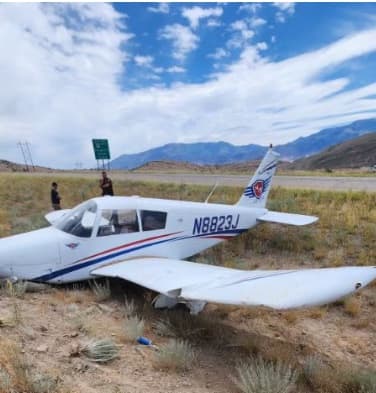
The pilot reported that, after flying for about four hours, the Piper PA-28-180’s engine began to surge.
Concerned about fuel, he switched to the other fuel tank and turned toward a highway for a potential emergency landing.
While descending, the engine experienced surges again and then sputtered, followed by a complete loss of engine power. The pilot noticed that both fuel tank gauges were showing empty.
While maneuvering over a highway near Ritchfield, Utah, for a forced landing, the airplane’s right wingtip collided with a semi-truck, causing the airplane to strike the highway and veer off into a median.
The airplane sustained substantial damage to both wings.
Probable Cause: The pilot’s improper preflight planning that resulted in the loss of engine power due to fuel exhaustion.
To download the final report. Click here. This will trigger a PDF download to your device.
This August 2023 accident report is provided by the National Transportation Safety Board. Published as an educational tool, it is intended to help pilots learn from the misfortunes of others.
“Probable Cause: The pilot’s improper preflight planning that resulted in the loss of engine power due to fuel exhaustion.”
If the loss of life and limb is not enough of an incentive to ensure enough fuel is on board for the mission and any contingencies, maybe a loss of insurance coverage in the event of “improper preflight planning” would be.
It’s real easy to “Monday morning quarter back”. In my five, almost six decades of flying, combat, GA from Aeronca C2- HU16/DC3, I’ve had full tanks show empty and empty tanks show full. I’ve ferried my share (‘C’ model Cats, factory to Surinam). I HAVE landed off airport, with without fuel. Best I advise I can offer is physically look at, dip, measure what’s in the tanks EVERY TIME YOU CAN. Don’t ASSUME anything… except perhaps that Murphy is a flaming optimist. Be the last one to touch the gas caps ( Turbo Aztec, KBDR to KICT and see blue trailing the starboard cap just as you climb into the CLAG..). Convince yourself you ought stop even though it’s going to put you a few hours/a day back. It beats sitting across from the Safety Puke (also me in another life, even carried an NTSB badge for a training stint..) esplainin’ why your logic was faulty ‘n you’ll do better. Ease up folks. Unless you’ve seen 1/2 showing but it’s sputtering, you weren’t there. Accident investigation axiom: if you weren’t there you don’t have a clue. If you were there, you still don’t know all the pieces. Go fly something. I’m going to ….as soon as we get all these damned boxes un packed. 😎
Running out of fuel doesn’t happen suddenly, it’s an ongoing process that begins the moment you start an engine. What does happen suddenly is becoming aware of a low fuel state. Know your airplane, know your rate of fuel burn. It’s simple math, if you’ve got 5 hours of “confirmed fuel” onboard at startup, you’d better be on short final after no more than 4 hours. I wonder how many airports he overflew on the way to the crash site?
Add to Ronny’s preflight list: 4. Remove the fuel cap and look in the tank. (See Rich comment above.)
Typical outcome for the “FAT DUM & HAPPY”. He has proved himself to be worthy of dunce’s hat – aka reusable traffic cone.
I always dip the tanks with a calibrated dip stick.
But if the gages said E. I would believe them.
The only way to be safe
Ha ha ha ha ha, another person that calls himself a “pilot”, This kind of third grade arithmetic is not funny any more, insurance premiums going up some more, because of these jackasses, could be killers just as easily. We definitely need a good book on how to make good decisions, the ones people are making today are very poor to say the least. I think the best way to attempt to stop this rhetoric is to start pulling licenses and start saving lives in the interim. Do these jackasses vote ????
“We definitely need a good book on how to make good decisions…”
You mean like…for example:
• AC 60-22: Aeronautical Decision Making
• FAA-H-8083-2A: Risk Management Handbook
• FAA-H-8083-25C: Pilot’s Handbook of Aeronautical Knowledge, Chapter 2 — Aeronautical Decision Making
• FAA-H-8083-9B: Aviation Instructor’s Handbook, Chapter 1 — Risk Management and Single-Pilot Resource Management
• FAA Safety Team (FAAST) Course: The Art of Aeronautical Decision Making
• Jan/Feb 2017 FAA Safety Brief; Risk Management
I have three ways determining how much fuel I have in the tanks…
1. The amount of fuel in the tanks from fuel sensors in the tanks..
2. The amount of fuel in the tank from calculating the fuel burn from the fuel flow computer.
3. The amount of fuel in the tanks from fuel gauges.
None of these match but are really close and I go with the most conservative.
This pilot has 5,000 hrs in type and 10,000 hrs TT, so he should have know the fuel use and if there was any ‘leaks’…..which I guess is his excuse for the poor fuel calculations.!
Were the tanks really full, 50 gal.? Is the unusable fuel really only 2 gallons ?
The gauges are required to be accurate at ’empty’…
The pilot indicates probably a fuel leak. If so how can a pilot know there is a leak and that his calculations are out the window?
I would be the first to climb his frame but perhaps not in this case. I honestly would like to know how you can tell. Would not the gauge give you some indication, but if you do not trust gauge then what?
Back in the day of the dinosaurs, we used paper navlogs for cross-country flights. Each leg is entered on a separate line which includes estimated eta and estimated fuel burn for each leg, calculated from the old-fashioned whiz wheel. Proper leaning is required to get book figures. The departure time and starting fuel load is put at the top. As you fly each leg, the arrival time of each checkpoint is noted. Then the estimated fuel for that leg is subtracted from the fuel remaining on the preceding line to get current fuel remaining. That can be cross-checked to the fuel gauges. If there’s a discrepancy, then there may be a leak and a precautionary landing can be made.
I know there are a lot of complaints made about fuel gauges but I’ve never run into that problem. Possibly in some cases they are just used as an excuse. They are easy to check by comparing the gauges to the quantity of fuel pumped when the airplane is refueled.
The accuracy of fuel gauges on GA aircraft are known to be unreliable, therefore the option is the close calculation of fuel burn, engine rpm, etc. to determine flight limits and parameters. Seeing full needles may be ok for taking a turn around the patch, but x -country needs more serious attention beyond cheap gas and checking the gauges. The result of strictly using the gauges will one day either be calamitous or at the least cause heart burn as one watches the needles bounce while stretching a leg to the next planned landing field.
Well, the pilot’s report includes a detailed discussion of his fuel calculations using the POH which is quite thorough and indicated his fuel load was sufficient. He also mentioned “I always fly my watch” and “never trust my gauges”, referring to flying his own airplane. His conclusion was there apparently was a fuel leak “probably taking 2 gallons per hour from useable fuel”. The irony is the fuel gauges are where a fuel leak is going to be identified.
Exactly, assume the lowest reading and/or calculation is the correct one.
Bad planning is the only thing that makes you run dry.
1. To the pilot of this accident aircraft…go directly to the local FSDO and relinquish your pilot certificate. If you run out of fuel you are too stupid to be a pilot.
2. Cheap fuel usually comes from facilities that have substandard fuel systems and little if any quality control. Take a good look at the system you are getting your fuel from. Ask questions. Ask to see their quality control procedures.
Does anyone keep stats on crashes by type, e.g., fuel exhaustion? And what is the root cause of these? My guess: the price of AV gas is so high the average recreational GA pilot can only afford to buy down to the last teaspoon and no more. Am I right?
Regards/J
The price of 100LL is SO different, from place to place. $4.10 forty miles away, $6.52 at my home airport. That kind of price differential can make a pilot try to get to where the fuel is what, 59% cheaper? Which CAN make a guy run dry, yup. Bad gas gauges can make a guy run out, too.
I hope calculations of fuel usage are better than this price comparison example. The savings of $4.10 v. 6.52 is about 36% not 59%.
The cheap fuel is 37% cheaper, the more expensive fuel is 59% more expensive. Both percentages are correct with the proper description.
The pilot mentioned he owns and operates a PA-32-300 (Cherokee Six), so the price of fuel probably isn’t an issue.
Reading the accident report closely you can see it was a ferry flight. He failed to do a medium distance hop to confirm fuel burn. Tonopah would have been the logical first stop, past the Sierras.
Stats? The National Transportation Safety Board, which is the source of the accident report keeps statistics. NTSB.gov is a wealth of knowledge.