

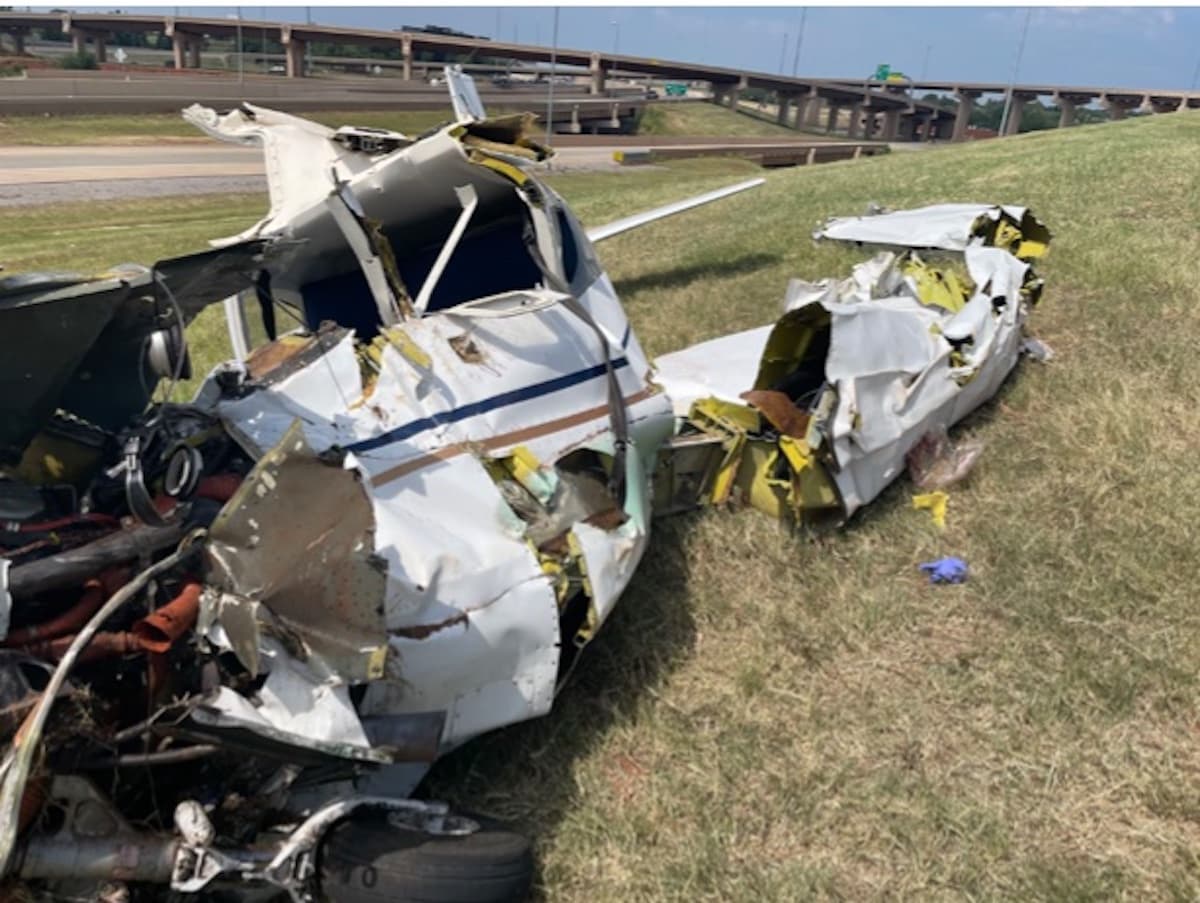
ADS-B data revealed that the Piper PA-24-250 departed North Texas Regional Airport/Perrin Field (KGYI) in Sherman, Texas, on Aug. 13, 2023, and proceeded to Wiley Post Airport (KPWA) in Oklahoma City, Oklahoma.
Shortly after being handed off from Oklahoma City Approach to Wiley Post Tower, the pilot told tower controllers that he was losing engine rpm and that he was going to make an emergency landing on Interstate 35.
During the approach to the interstate, the plane hit power lines and skidded off the interstate down a grassy slope along Interstate 235 about 8 nm east of KPWA. The pilot was seriously injured in the crash.
The airplane was equipped with two main fuel cells and two auxiliary fuel cells. The main fuel cells each held 30 gallons of fuel and the auxiliary cells each held 15 gallons of fuel. The fuel selector valve had five options: Left main, left auxiliary, right main, right auxiliary, and off.
The airplane was filled with 26.5 gallons of fuel at the Weatherford Stafford Airport (KOJA) in Weatherford, Oklahoma, on Aug. 10, 2023.
According to ADS-B records, the airplane departed KOJA on Aug. 10 and flew direct to KPWA, which was about a 20-minute flight. The next flight occurred on the morning of Aug. 13 when ADS-B records indicated the airplane departed KOJA and flew direct to KGYI, which was about a one-hour and 10-minute flight. The next flight was the accident flight on the afternoon of Aug. 13, when the airplane departed KGYI for KPWA.
The airplane was not fueled again after it departed KOJA on Aug. 10 and it flew for about 2 hours and 30 minutes after that refueling.
The airplane was airborne for about 50 minutes when the loss of power occurred.
At the accident site, investigators discovered that the left main and left auxiliary fuel cells were crushed, torn, and breached. However, both doors covering the fuel cell filler openings on the left main and left auxiliary cells were closed and latched. There was also a significant amount of fuel blight in the form of brown grass that fanned out from the initial ground scar and was consistent with the fuel escaping from the left main and left auxiliary fuel cells.
The right main fuel cell did not have any fuel in it, and the right auxiliary fuel cell was full of fuel (15 gallons). The fuel selector valve was found set to the right main cell. The fuel selector valve moved freely to each detent position. The fuel boost pump switch in the cockpit appeared to be in the “on” position.
During the post-recovery examination, electrical power was applied to each of the fuel boost pumps and their operation was verified audibly. About 6 ounces of 100LL was drained from the strainer bowl via the fuel sump. The fuel strainer screen was free from blockage. The fuel filter screens for each electric fuel pump were free from blockage.
The fuel selector was moved to the “off” position, and the right wing main and right auxiliary fuel cells were filled with water to verify the integrity of the fuel cells. No water was observed leaking from either cell. The fuel selector handle was moved to the right main fuel cell position and then to the right auxiliary fuel cell position and water drained freely from both cells via the fuel strainer where the bowl was removed.
After the accident, the pilot shared with a friend that he received a low fuel warning light while operating on the right main fuel cell. He switched to the left main fuel cell, however engine power did not return, so he switched back to the right main fuel cell.
Investigators were unable to ascertain what other steps the pilot may have taken to restore engine power before the forced landing. According to the pilot’s family, he passed away on Dec. 23, 2023.
Probable Cause: The pilot’s mismanagement of fuel, which resulted in fuel starvation and a subsequent total loss of engine power.
To download the final report. Click here. This will trigger a PDF download to your device.
This August 2023 accident report is provided by the National Transportation Safety Board. Published as an educational tool, it is intended to help pilots learn from the misfortunes of others.
No comment, nuff said !!!
Generally speaking, we – those of us who fly for fun – don’t train enough – especially recurrent training – to maintain peak proficiency in day-to-day operations and effective management during emergencies. General Aviation’s collective safety record has and will most likely always be woefully trailing that of the military and the airlines. Could it be that those of us who fly mainly for fun and enjoyment simply don’t want to put that much effort into it?
According to local articles and Dr. Stanford’s memorial obituary he was a true humanitarian Pediatrician. For patients whose parents died In the OK City bombing, he continued caring for their children free of charge throughout their childhood. (4 families), and flew hundreds of Angel Flight patients. Even with his own patients, if someone had a complicated diagnosis, he would fly the patient to a noted hospital/doctor who specialized in that illness. While he was in the hospital with his crash injuries, he had streams of visitors. The local TV station also featured a tribute to him when he passed away. Fuel starvation and powerlines are unforgiving. What a loss all the way around. RIP, Dr. Stanford.
Thanks for letting us know. He sounds like an exemplary person and Doc who really cared for his patients.❤️
Obituary. He crashed in August, died in December due to an infection after surgery for the aircraft crash injuries. Notice how it says “engine failed,” in the obit.