

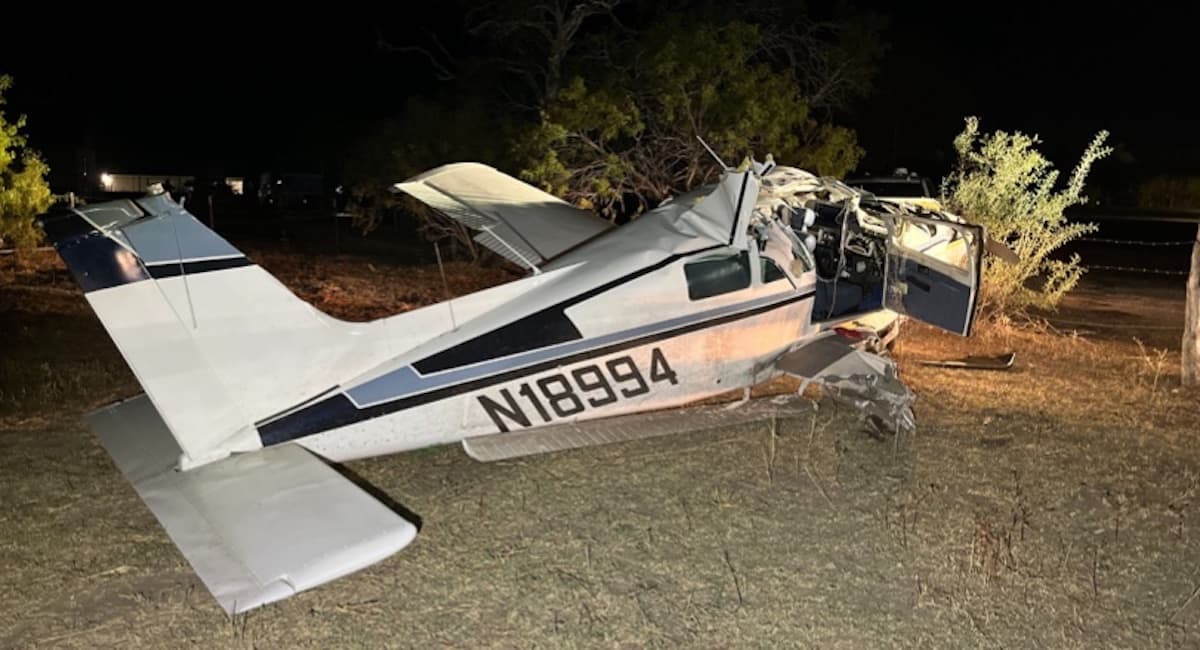
According to the pilot, he flew to Roger M. Dreyer Memorial Airport (T20), in Gonzales, Texas, in the Beech C23 on Sept. 23, 2023.
During the final approach to Runway 15 he experienced wind shear and elected to go-around. He applied full throttle and began to climb out when the engine sustained a loss of power, so he made a forced landing to a field off the left side of the runway.
The airplane hit a fence and a tree, which separated the right wing near the wing root.
The pilot received minor injuries in the crash.
A post-accident examination of the airplane revealed substantial damage to the wings and fuselage.
The undamaged exhaust system was examined using a flashlight in the tailpipe and a lighted borescope, which revealed a blockage in the tailpipe. The muffler was then removed and cut open.
The flame tube was blocking at least 95% of the tailpipe exit path. Investigators found the piece was lodged in the tailpipe.
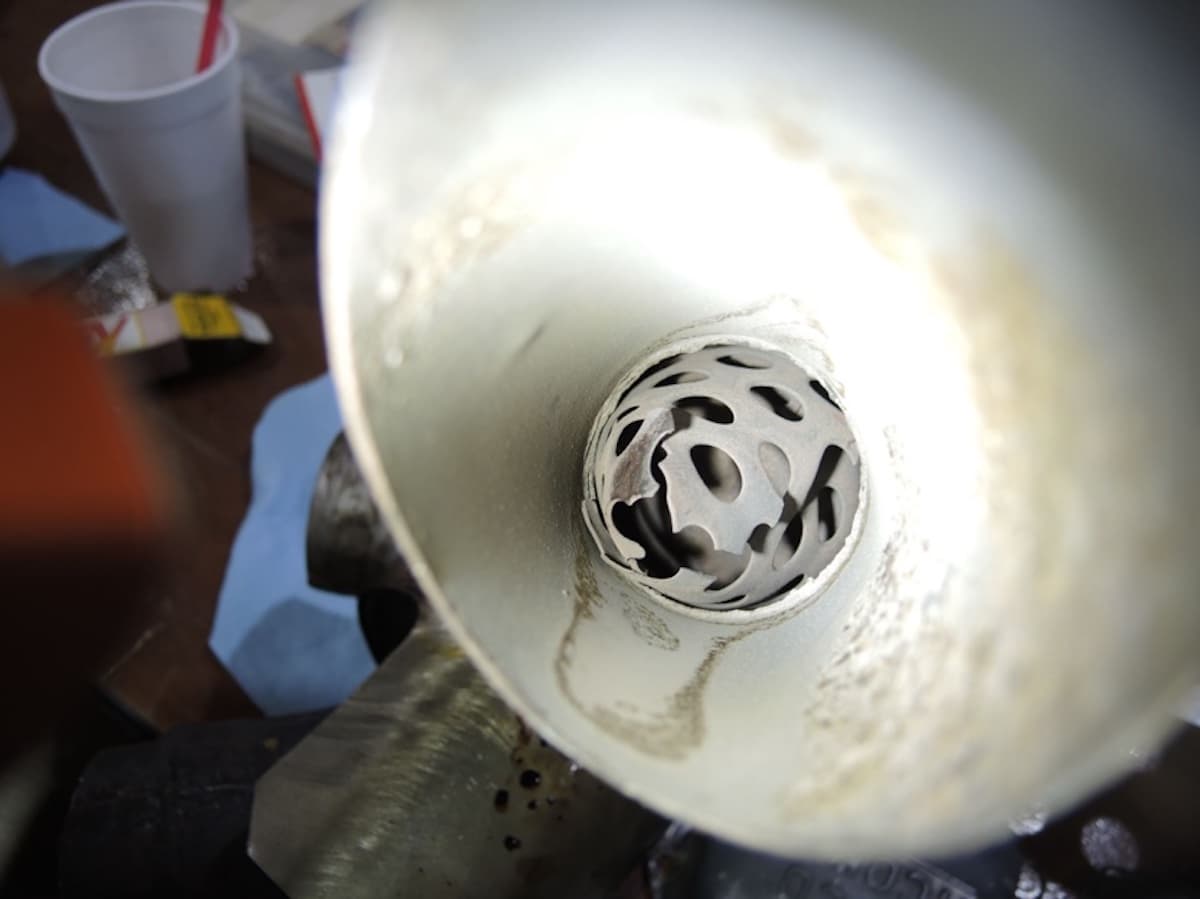
The fracture area appeared degraded and covered in corrosion.
A 3-inch crack was noted on the muffler endcap opposite of the separated flame tube.
The airplane maintenance logbooks revealed that, during a maintenance inspection on Dec. 24, 1997 (3,523.42 hours total time and 1,260.42 hours since major overhaul), the exhaust system was inspected “for leaks and cracks. System found to be satisfactory.”
On Jan. 2, 1999 (3,556.5 hours total time and 1,293.50 hours since major overhaul), another maintenance inspection was conducted by the same mechanic and there was no mention of the exhaust system.
On March 21, 2000, the airplane’s muffler was repaired and inspected by a separate exhaust system repair station. The work order for this muffler repair revealed that the muffler was to be inspected and repaired. The items replaced included: 3 tabs, the outer shell, 2 caps, 2 flame tubes, 2 elbows, 2 beaded ends, 2 end plates, and the tailpipe.
On April 1, 2000 (3,603.36 hours total time and 1,340.36 hours since major overhaul), another maintenance inspection was conducted by the same mechanic from 1997 and 1999, when they reinstalled the repaired muffler.
There were no additional maintenance logbook entries found specifically related to a muffler repair or replacement.
The most recent 100-hour/annual inspection was completed on Nov. 23, 2022, (4,052.8 hours total time and 1,789.8 hours since major overhaul), during which 8 exhaust clamps were replaced and a new exhaust stud was installed on the No. 4 cylinder.
There was no specific mention of the muffler, however, 14 CFR Part 43 Appendix D — Scope and Detail of Items (as Applicable to the Particular Aircraft) To Be Included in Annual and 100-Hour Inspections, states: Each person performing an annual or 100-hour inspection shall inspect (where applicable) components of the engine and nacelle group as follows: Exhaust stacks — for cracks, defects, and improper attachment.
The installed Dynon Avionics revealed that the airplane total time was 4,108.2 hours at the time of the accident. Therefore, the muffler had been installed on the airplane for 504.84 hours.
Beech maintenance and overhaul documents revealed that the exhaust system should be overhauled or replaced every 800 hours or when the condition warrants replacement. The exhaust muffler and shroud should be inspected every 100 hours.
The documentation states, “It is recommended that at each 100 hour and/or annual inspection, all exhaust muffler shrouds be removed and the muffler thoroughly inspected for cracks, leaks and (if applicable) deterioration of the internal tubes which could cause a decrease in engine power due to blockage of the exhaust.”
Probable Cause: The loss of engine power during go-around due to a failed muffler flame tube, which resulted in an exhaust blockage. Contributing to the accident was maintenance personnel’s inadequate inspection of the exhaust system during the most recent maintenance.
To download the final report. Click here. This will trigger a PDF download to your device.
This September 2023 accident report is provided by the National Transportation Safety Board. Published as an educational tool, it is intended to help pilots learn from the misfortunes of others.
Yes sir, the aircrafts’s exhaust system shall be inspected every 100 hrs/ annual inspection. On my 7KCAB the muffler was removed, disassembled, cleaned, inspected, reassembled and painted prior to installation on the airplane. I have also found cracks starting near the exhaust flanges and worn/ broken mounts in the past inspections. Most GA airplanes are the age of senior citizens and, like old guys, need a little more care to keep going. JMTCW
I had a C150 muffler blow apart one hour after an annual, all proper procedures followed, heat shrouds removed and inspected, new hardware, checked for exhaust flange/gasket leaks, both mufflers checked for cracks, signed off by a competent IA (and with picky me looking over his shoulder and helping).
Entire front end of one muffler (flat plate) blew off the muffler body while taxiing – BLAFF – what the heck was that?? Would have been really exciting on take-off.
Repair shop fabricated a complete new muffler, re-used ONE exhaust flange, which legally makes it a “repair” and significantly less expensive than buying a “factory new” muffler.
You have to disassemble and inspect the muffler every 100 hours? You can’t be serious! Car and truck mufflers last for years before replacement. What’s the deal with GA airplanes? Another example of crappy engineering and manufacturing in parts for quarter-$million toys. Sheesh!
Regards/J
There is little in common between aircraft systems to ground vehicles.
aircraft engines vibrate a lot, not having any balance shafts as auto engines do.
aircraft engines have compliant mounts to isolate the vibrations from the airframe.
So, the mufflers, usually made of lightweight Inconel are subject to the vibration, since they are rigidly mounted to the engine, unlike autos. Aircraft mufflers then run much hotter than auto mufflers so they have a shorter life than auto mufflers.
There is a shroud around the muffler that collects heated air for the carb heat system.
The other function is to provide heat for the cabin, like the VW Beetle had, with a concern that a crack could allow CO to leak into the heating system.
So, the annual inspection includes examining the mufflers along with all the other ‘stuff’ in the engine compartment.!!
Rigid exhaust systems with welded risers are prone to cracking and internal failure and offer little access for inspection. The use of borescopes are a must for these inspections but even then, complete coverage is difficult.
Every maintenance facility should be equipped with a handheld digital CO2 meter to record post-inspection values during the run up. It’s not foolproof, but it offers another layer of assurance the system is intact.