

It was a hot afternoon at Orlando Sanford International (KSFB) in Florida in late September, with the mercury hovering just below 90°. The pilot was planning to do some pattern work.
He preflighted his airplane in his hangar, completing, in his words, “what I thought was a thorough pre-flight.”
But as you’ll soon see, one item got overlooked, and a very rapid chain of events would conspire to bring the pilot and his airplane back out of the autumn sky almost as quickly as they ascended into it.
The Airplane
The airplane was a Sequoia F.8L Falco, an Italian-designed experimental amateur-built low-wing aircraft with retractable gear, two seats, a bubble canopy, and a Lycoming IO-360-B-E engine rated at 180 horsepower.
So basically a sports car with wings. As befits a hot airplane, it was painted bold, bright red.
The Flight and The Accident
The engine start, taxi, and run-up were all normal. The pilot, alone in the airplane, was cleared for takeoff from 9C, the shortest of the three parallel runways at KSFB.
Then, just a few seconds after lift-off, at 100 feet above the runway, the Falco gave the pilot the bird.
“The right engine access cover flew open and was standing straight up in the ‘fully open’ position,” the pilot wrote in his report to the NTSB.
The Falco is one of those lovely airplanes with a very large hinged canopy that allows significant access to the engine, so pretty much the entire right side of the canopy was open at this point.
The pilot radios the tower, requesting an immediate return to land. They clear him to 9L, which will require a long wide pattern, with four turns total. This makes the pilot uncomfortable, but he does not request anything different, and he “complied.”
The plane remains dirty with gear and flaps down, and the pilot says he elected to stay “low and slow, hoping to keep the open door from breaking off.”
Then fixation bites. He is so focused on the door that he lets his airspeed decay. And although he’s unaware of it, he has reached minimum controllable airspeed. As he makes his first turn to the left, a foreshortened crosswind leg that will cross over the much longer runway that is parallel to his flight path, the horizontal component of lift from the turn kicks in and triggers a stall.
There is one buffet. The left wing drops sharply, and “the airplane fell out of the sky.”
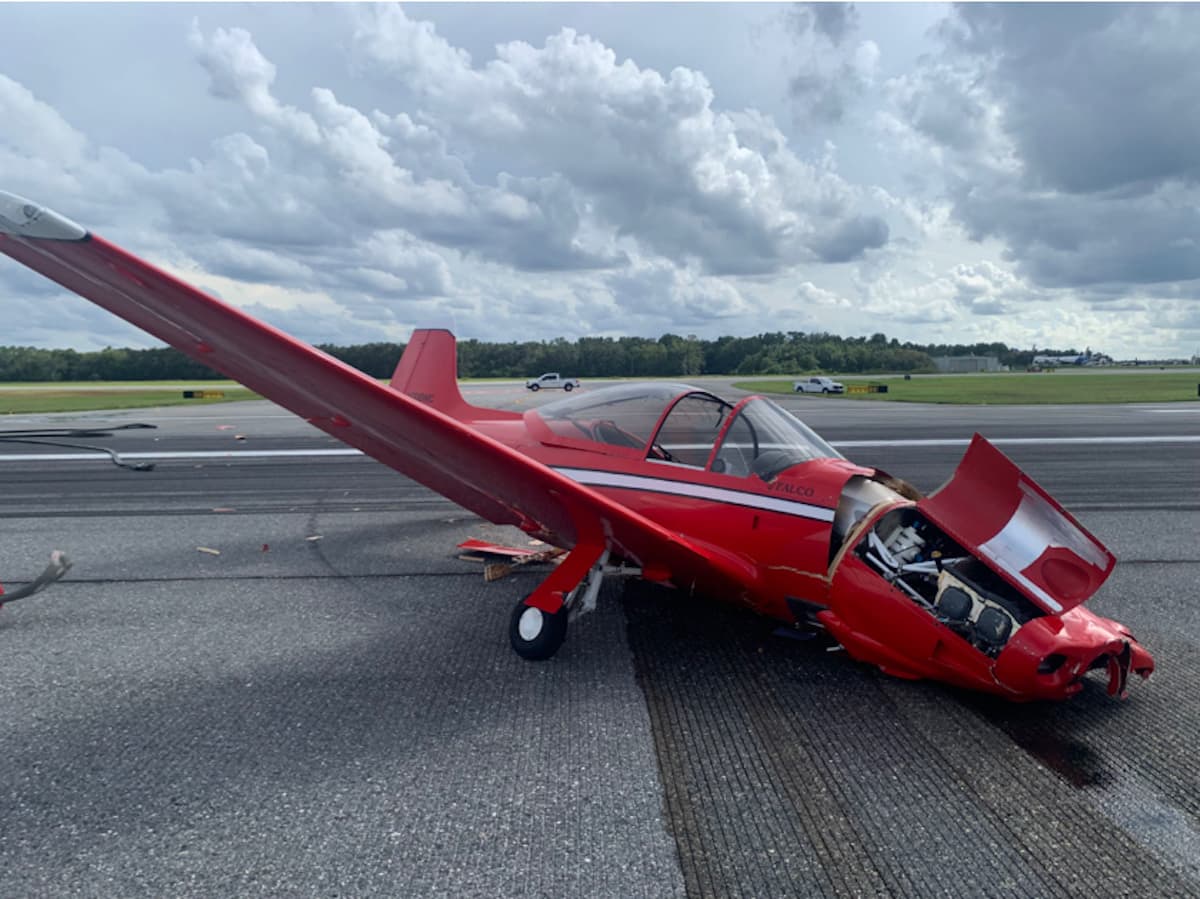
The Falco’s left wing is shredded as it encounters Taxiway B8 of the Parallel 9L, and then the remainder of the airplane slams onto Runway 9L, coming to rest just beyond the center line. Fuel is gushing out of the fractured left tank. The pilot kills the master and alternator switches and evacuates.
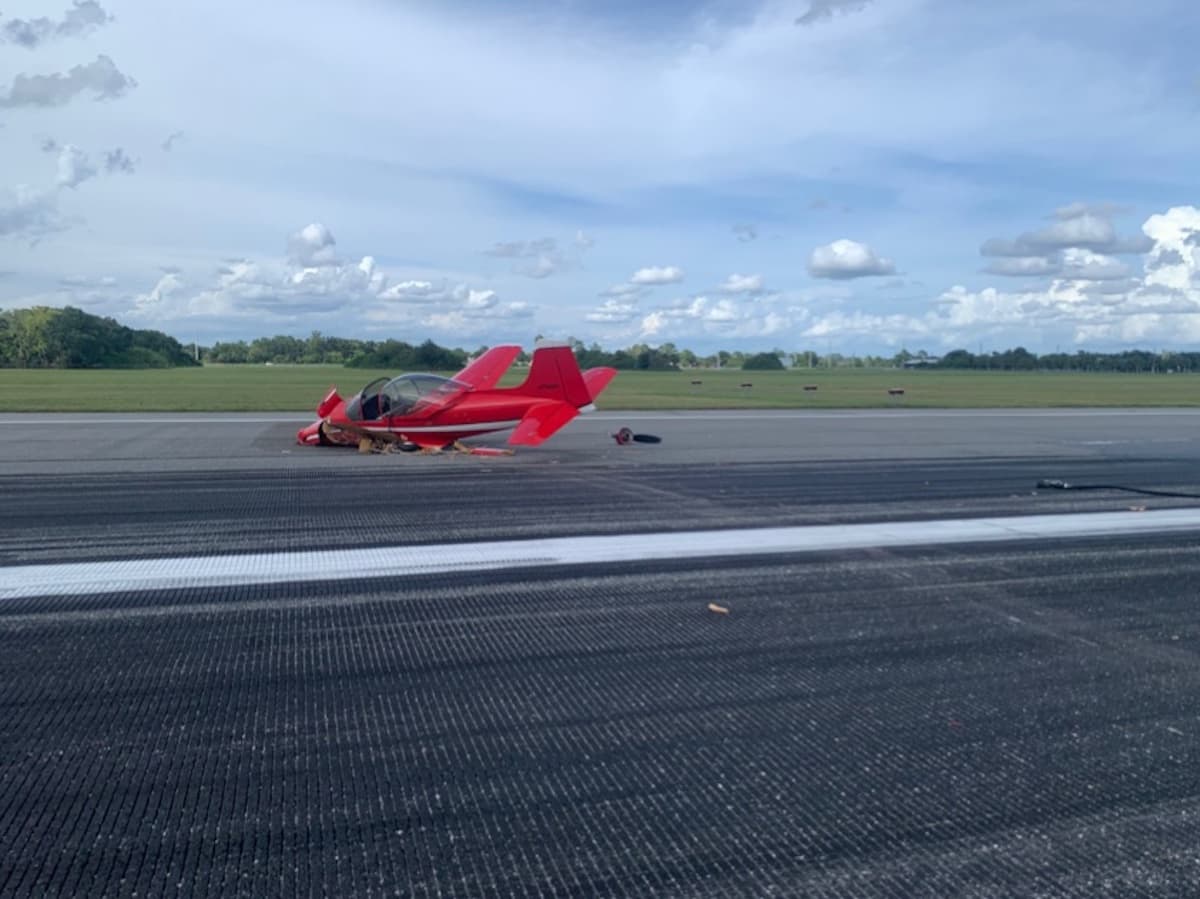
The airplane’s five point harness no doubt had a big part to play in the happy outcome, in terms of the pilot’s mortality. He walked away from a typically fatal accident — a low level stall — with only minor injuries.
The airplane, however, didn’t fare as well.
The Aftermath
The Falco, although being fully aerobatic, and widely regarded as one of the stronger experimental designs with 6g positive and 3g negative capability, is a wood aircraft made of a laminated spruce structure with Finnish birch plywood for the skin. As such, it doesn’t score well on the easy-to-repair scale following an accident.
The pilot summarized the damage in his report to the NTSB: “Left wing disintegrated, aircraft broke apart on impact in 3-4 locations, prop broke off at engine crankshaft, engine and exhaust system extensive damage.”
The nose gear broke “in half,” he continued, noting the beautiful canopy was cracked and “not serviceable.”
Only the right wing and tail feathers emerged unscathed. He summarized the airplane as “probably damaged beyond repair.”
The Pilot
The pilot was a 72-year-old male, with a commercial/instrument ticket who was flying on a third class medical. He had 1,875 hours total time, with 167 in make and model.
But his recent flying had been on the light side with eight hours in the previous 30 days and only 15 in the previous 90 days.
The NTSB
The probable cause statement from the NTSB was straight forward: The pilot’s failure to maintain airplane control after an engine access cover opened during the initial climb.
Analysis & Discussion
In his report to the NTSB the pilot said, in summary, that he overlooked the right engine cover not being locked down, and did not catch it on his final walk around.
After it flipped open in flight, “I focused way too much on the open engine cover and way too little on flying the airplane, maintaining proper airspeed, attitude, and altitude.”
“The result was a classic stall/spin scenario too close to the ground,” he told investigators.
The pilot’s recommendations included “double check everything on preflight. Use a checklist ALWAYS” and “When/if something does happen and the aircraft is stable and you are in control…Fly the Aircraft!!”
The Takeaway
We’ve all been taught since pretty much day one that the order of actions when the you-know-what strikes the prop is: Aviate, Navigate, Communicate.
And our unfortunate pilot basically admitted that he didn’t do the first one well enough (refreshing when people take responsibility, isn’t it?).
But in fact, he really did do all three, as trained. He initially kept control, continued on course, and then called the tower. He followed protocol, but then he fell down the rabbit hole of fixation and stopped aviating.
And that’s where the takeaway from this accident lays hidden. It highlights a gaping hole in how we teach people to be prepared for the unexpected in flight.
On thinking about the accident, I realized that we often teach the emergency hierarchy of actions as if it were a checklist:
- Aviate: Regain or maintain positive control of the aircraft.
- Navigate: Ensure the airplane is pointing in the direction you want it to be pointing (often away from the ground).
- Communicate: Once jobs one and two are done, get on the radio.
One, two, three, and done!
But in reality, it isn’t, and shouldn’t be, a checklist.
Instead, it should be an ascending and descending cycle, repeating over and over again until the situation has safely resolved itself and normal flight operations (or landing) have occurred.
After coms are squared away, step back down the ladder again to check your Navigation. Are you still pointed where you want to be pointed? Then back to the Aviator stuff. Check attitude, airspeed, vertical speed, engine health, fuel status. Next, back up to Navigation. Then communication if needed. Back to Nav. Back down to Aviate. Wash, rinse, repeat. Wash, rinse, repeat…
That’s my takeaway. We need to think of this age-old advice not as a checklist, not as a flow, but a dynamic cycle that once launched, should be repeated again and again like an instrument scan.
The Numbers
Want to read more? Download the NTSB’s final report here or view the items on docket here.

I found this from a Facebook post… I do not fly but I am close behind in age and life experience. (I am 69 years old) I have to remember this cycle, or something very similar, when driving. Drive safely, plan route, communicate changes to home. An example is being distracted by a phone call or even a coffee spill. Do not let go of the steering wheel or eyes off the road. My common distractions are answering phone or reaching for paper towels to cleanup coffee spills.
Steering and avoiding road hazards are first tier responsibilities. This takes priority over third tier interruptions. Getting lost on a safe road is a second tier priority. Safe driving is before the coffee spill, which is a third tier priority. Park safely before cleanup.
Thanks for the good failure analysis. Thank God we both survived our experience.
Regardless of what we know or don’t know, there are three fundamental aspects of this flight that terminated in a crash landing. The pilot most likely had to open the cowling to check the oil. Either way, he should have made absolutely certain the cowling was secured properly, reorganizing the dangerous risk if wasn’t. If the latches were worn to the point of failure, this should have been duly noted on previous flights and repaired.
The pilot instantly became a test pilot when the cowling opened in flight. No one knows for certain just how the plane is going to behave in flight with a large cowling door flapping in the wind. Slowing down to protect the cowling door was a fundamental mistake considering the drag the door was creating. Maintaining a higher airspeed was fundamentally the safest thing to do. So what the door flew off! It might have been safer to just let it fly off.
The cowling flying open after takeoff by all means is a serious emergency. The pilot should have immediately declared an emergency. The tower would have stopped all operations and most likely told the pilot he was cleared to land on any runway of his choice.
The pilot made three fundamental mistakes that unfortunately resulted in a crash landing. Fortunately, he survived to live another day.
First thought after realizing there was an issue should have been: Let’s not destroy the airplane to save a part! This decision set the stage for the entire failure scenario.
I have seen this in multiple accidents, many of which were deadly, including open baggage doors, open entry doors, loose oil caps, and loose fuel caps.
Just imagine what your first thoughts would be and adjust your “checklist” attitude.
For this guy’s Falco, replacing a cowling door would have been an easy fix compared to rebuilding the whole aircraft.
Dunno what the fuss is all about! I had the oil door on my Cessna 150 fly open, so I landed and secured t. No drama required.
Same as the door my 195, we opened the door to release some ashes and t decided to not close, same as in the Bonanza. Life is not perfect, nor should it be. life throws stuff at us and we just deal with it. Osar
Not fully explained, this accident started with the failure of some sort of fasteners holding that engine cowling down. Either the pilot didn’t tighten them correctly or they were worn?
It’s not mentioned and the picture isn’t large enough to see how that engine cowling is fastened down. IF it’s something like the fasteners on a PA-28, there’s a couple of dzus fasteners on long straps tieing the upper door with the lower cowling. I’d like to offer an idea to all owners of airplanes with such setups.
Over time, the dzus fasteners wear and the gripping effect isn’t as strong as it once was. What we do is get an O-ring slightly smaller than the dzus fastender washer head and stretch it over the head after warming it up. This way, when you turn the dzus fastener, you’re squeezing the O-ring and ensuring a tight fastener grip. Obviously, if it’s really worn, R&R of the dzus fastener is called for but I’ve seen these things even loose when new. I always double checked those fasteners when I owned a PA-28 for fear of what happened here. A simple O-ring might have saved this airplane ?
Door Opens
Pilot admits expletive
Pilot configures aircraft for downwind (or base, if paranoid) flight parameters.
Pilot informs Tower that he is returning to land (but without taking eyes and remainder of brain away from Rule #1)>
Pilot takes his eyes and brain away from the )*^$*& door and continues to comply with Rule #1 and completes traffic pattern.
Pilot removes aircraft from Movement Area and proceeds to prep for shutdown and any followon actions he might deem advisable.
Don’t make mountains out of molehills AND
ABIDE BY RULE #1 and forget about everything else
In stories like this one, I would like from experienced pilots in the comments what they think the better course of action would have been? Not as arm-chair quarterbacks, but just to share some experienced views on what the better courses of action should have been. For example, would it have been justifiable to declare an emergency then kick the rudder over and do a 180 degree return to the same runway that he just departed from, instead of attempting to fly the whole pattern back to the starting point of the departure runway? Of course you don’t want to have a head-on with other departing aircraft, so that is why an emergency must be declared.
I look forward to hearing what others have to say about this, especially the CFIs and FAA reps.
If the open cowling was not causing any flight issues, I would have declared an emergency and told the tower he wanted to land on 27R a short 180 degree left turn and land on the long runway. [ turning right might affect the open cowl and would block his view to the right.]
BUT, fly the aircraft, maintain airspeed and a moderate banked turn.
Runway 27L is 11,000 ft long so no hurry turning around.
[ BTW, no ‘kicking the rudder’, that can cause a skid and stall-spin. Turns are coordinated with initial use of rudder to counter any adverse yaw .]
To your points:
“For example, would it have been justifiable to declare an emergency…”
Absolutely…if you have the presence of mind to do that while you’re maintaining aircraft control and executing your plan…declaring an emergency is never a bad idea.
Once you say the “E-word”, ATC is going to do everything they can to keep other traffic out of your way …even if you don’t provide them with a lengthy dissertation of your plan. By the same token, if they “clear” you for something that doesn’t sound like a good idea to you as PIC…don’t do it!
Tell them you’re “unable”, and fly the plane.
“ ….then kick the rudder over and do a 180 degree turn…”?
Not exactly sure what you mean …but if you “kick the rudder over” to tighten up your turn, chances are you’re going to end up in a “skidding” turn …which will just increase the likelihood of a “stall/spin” accident. Which is essentially what happened.
“…return to the same runway that he just departed from, instead of attempting to fly the whole pattern back to the starting point of the departure runway?”
Probably the Number One issue that gets pilots killed when they have an emergency on takeoff: We usually associate the decision on whether or not to execute to the ‘impossible turn’ with an engine failure scenario.
But it’s also applicable in any situation where the likelihood of continued safe flight after takeoff is seriously in doubt.
Turning around and landing in the opposite direction on the same runway surface I just departed from …is way down on my “decision matrix”.
My first priority: Can I just get back “over-the- fence” into an obstruction-free piece of airport property. I don’t care if it’s a grass infield, a taxiway, a tie down ramp, or the airport parking lot. If I have enough altitude & potential energy left, I’ll evaluate whether or not I can line up with a/the departure
runway. Wind direction and velocity are a factor, but I’m really not too worried about style points; I just don’t want to hit anything or anybody.
Look at a diagram of KSFB: Based on where his flight abruptly ended, he probably could have just side-stepped to the left and landed on the remaining 4,200 feet or so of Runway 9L; not fly a ‘traffic pattern” all the way back to the approach end.
Disregard my “could’ve side-stepped to the left and landed on the remaining 4,200 feet or so of Runway 9L” …I miss-read the “Taxiway B8” part!
Tom C
Yikes GAN! The above cut off my whole “the rest of the story”…(must’ve been a solar flare). It should have said:
Disregard my “could’ve side-stepped to the left and landed on the remaining 4,200 feet or so of Runway 9L” …I miss-read the “Taxiway B8” part!
If the pilot was on his ADM A-game, which he obviously was not …he had the early option to move over (side-step) to the left and land on the remaining portion of 9L. Instead, he flew straight ahead until his attempted 90-degree crosswind turn put him abeam-ish to Taxiway B8. In this case, every second he continued straight ahead actually reduced his options.
By the time he started his crosswind turn, it was unlikely that he’d land safely on 9L, even though there’s about 1,800’ of pavement remaining (including overrun) and 3,000 feet of grass next to it.
According to the author’s narrative, the cowling door popped open at 100’ AGL, while still above the departure runway (9C/27C). Remember, it’s a ‘hot rod’: He still had engine power…probably at least enough to arrest any descent …even with a dirty configuration.
From the end of 9C, to the end of the parallel 9L is another @ 4,600’, including overrun.
If he had initiated a turn towards 9L when he was still close to the departure end of 9C, I think he had a good chance of landing safely. Instead of making any 90-degree turns, he could’ve used two 45-degree turns (left and right), or even 30-degree ones, and still had sufficient 9L length remaining to put it down.
He could’ve also still landed on the grass along the north side of the runway, parallel to the ‘furrows’ and had even more distance available.