

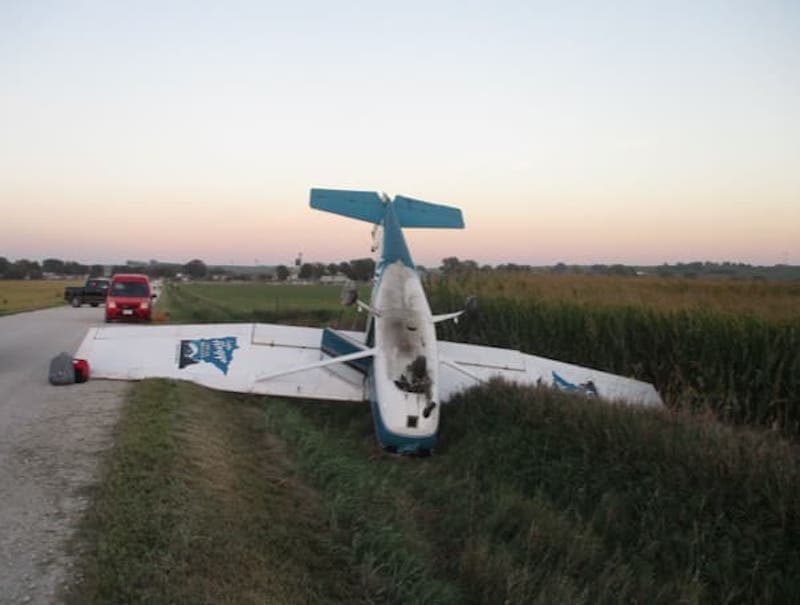
The pilot told investigators that the Cessna 172G was full of fuel before he departed for the cross-country flight.
After flying for about 2 hours and 50 minutes, with a significant headwind, he decided to divert to an airport to refuel.
After landing, he discovered that the fuel pumps were out of order, and he did not see the active notice to airmen (NOTAM) for the out of order fuel pumps.
He calculated the fuel remaining in the airplane and departed for his destination.
After flying for about 40 minutes, the engine lost power and he executed a forced landing on a road near Neola, Iowa, about 12 miles from the destination airport.
During the landing, the plane hit a swale and nosed over adjacent to the road, which resulted in substantial damage to the airplane’s fuselage and both wings.
The pilot noted that a more thorough flight planning and a more accurate use of the airplane’s performance charts could have prevented the accident.
Probable Cause: The pilot’s inadequate fuel planning and improper in-flight decision-making, which resulted in a total loss of engine power due to fuel exhaustion.
To download the final report. Click here. This will trigger a PDF download to your device.
This September 2023 accident report is provided by the National Transportation Safety Board. Published as an educational tool, it is intended to help pilots learn from the misfortunes of others.
I was flying from Sheridan to Cortez and I calculated a three and a half hour but when I encountered strong head winds I landed in Grand Junction. I planned on enough but I realized my ground speed was zilch and my way points were behind.I Do have a jpi that informs be of fuel consumption .
I think these crashes are posted for us to learn something from them. And what I am seeing is it seems that something is missing in the training of pilots.
Example: In the days of paper charts, a DPE would assign a X/C trip that you would have to plan, and then you would be questioned on it the day of your check ride. You would typically fly that trip to your first checkpoint on your chart.
We were, at that time being taught that fuel is bought by liquid measure that become time to engine stop. So we knew that if we got to a point of only having 1.5 hours of fuel left, if we were not within 30 minutes of landing we needed to divert for fuel. And we were taught to see if we were making our checkpoints within 2-5 minutes of what we planned, based on the weather report we had. So we would recognize we were having stronger winds than predicted…..
These crashes we have been getting lately indicate to me a lack of understanding of X/C planning. It isn’t a simple fuel mismangement problem. There seems to be a lack of understanding of these pilots that they need to use ADM and take action earlier to get fuel, which means, in this case that this pilot missed an important NOTAM. And this is part of X/C planning. So it seems that this is something that needs to be a special thing for BFRs .
………And another crash as the legacy aircraft fleet dwindles……!
Go directly to the Flight Standards District Office and relinquish your pilot certificate.
The weekly fuel mis-management story. Ka-ching go the insurance rates upward another click. I see an article in today’s newsletter celebrating increased interest in GA. Somebody better figure out how to reign-in insurance rates or that increased interest in GA will be beyond the reach of non-$billionaires.
/J
He “calculated” the remaining fuel? I have to wonder if that meant “sticking” the tanks, which gives a precise measurement of the remaining fuel?