

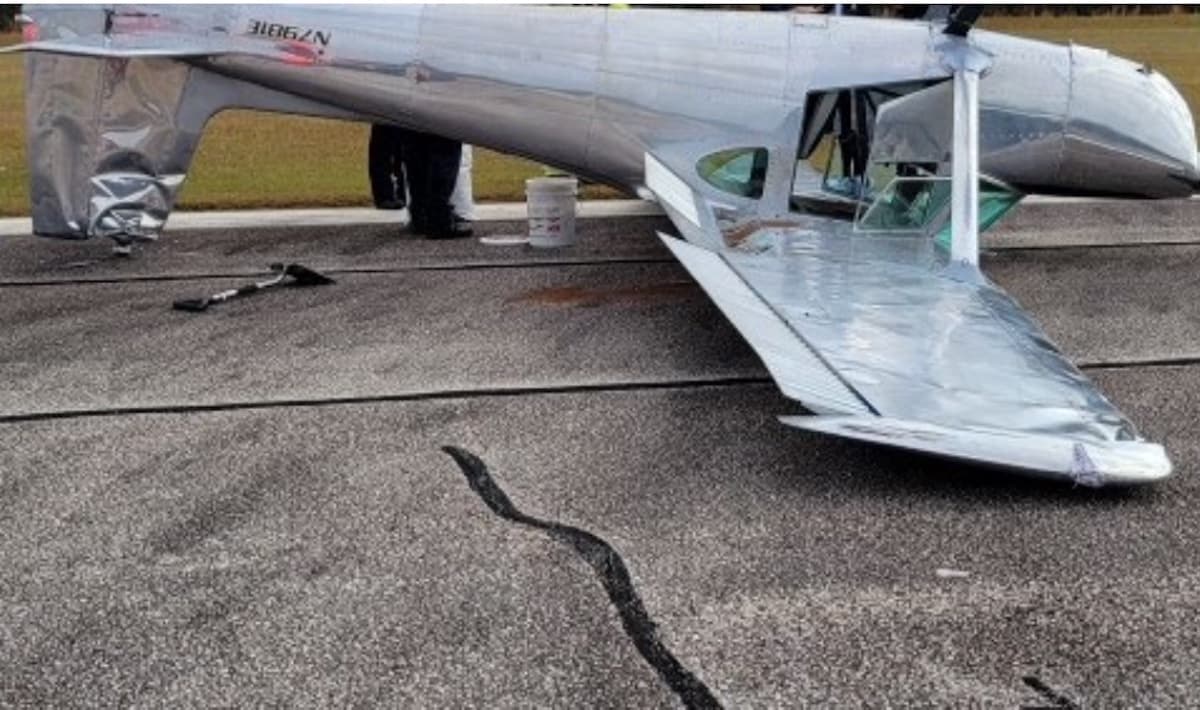
The flight instructor and the student pilot were landing the tailwheel-equipped Cessna 150 at Newnan Coweta County Airport (KCCO) near Atlanta.
The flight instructor told investigators that the student’s wheel landing was at the proper speed and aligned with the runway, but with a slight left drift.
The student applied right rudder along with (inadvertent) right brake pressure.
The flight instructor announced “I have the aircraft” but felt significant resistance on the flight controls. He repeated the call as the airplane approached the right side of the runway.
As the airplane progressed toward the grass off the side of the runway, the flight instructor again verbalized that he was trying to take control of the airplane as the student pilot applied both brakes.
The airplane then abruptly stopped and nosed over.
The airplane’s vertical stabilizer was substantially damaged during the accident.
Probable Cause: The flight instructor’s inadequate remedial action and the student pilot’s failure to relinquish the flight controls as directed by the flight instructor, resulting in a loss of control and nose over.
To download the final report. Click here. This will trigger a PDF download to your device.
This October 2023 accident report is provided by the National Transportation Safety Board. Published as an educational tool, it is intended to help pilots learn from the misfortunes of others.
All humor aside, recall from military training, “Train the way that you intend to fight!” Having numerous dry runs on the ground and in the air where the instructor says, “My airplane” and the student is drilled to immediately release the controls will go a long way to addressing this problem. I recall one of my early flights as a Naval Flight Officer trainee (VT-10) in the T-2 Buckeye (when another jet dropped out of the clouds too close to our airplane) and the instructor said, “My airplane” and I had been conditioned by a lot of practice in the simulators to immediately release the controls, holding my hands up where he could see them (like I was getting arrested). The training had conditioned me not to death grip the controls in times of stress and to immediately release the controls when the instructor said, “My airplane.”
It seems that there’s a chance that more PRACTICE of student to instructor interaction is the cause of more problems than I ever thought about. In the military way, fear of failure works wonders. In the civil norm the instructor is purchased time and therefore subservient to the payee. Added is age and any other personal development between the parties. This is a REAL situation and must be considered at every point. Respectful interests must be settled in every case. A 20 year old with an instrument rating working on a career is teaching a 55 years old CEO crosswind landings in a tail wheeler. What could go wrong?
All sounds good. And I’m in agreement with the methodologies discussed to get the student out of vapor-lock.
I hope you all like living at the FBO after the student sues you into oblivion for assault. It’s 2025, you know that is exactly what would happen, and the judge, depending on where you are, would agree.
Nose smash, Adam’s apple whack, rib thump… How do you know that there was time in this case for all that? This could have happened too quickly for those measures.
Sore ribs or a facial bruise is better than a broken neck. There are times when violence is warranted.
A cut-down baseball bat can be very effective.
A hard, strong elbow in the gut usually works.
This is a problem that few instructors are trained on how to get the student off the controls!
Ask once, twice, then they get my hand smashing their nose to make their eyes water, next is a hand to the adams apple(throat), and last an elbow to the ribs trying to brake them. I have lost count of how many female instructors have died because the student wouldn’t let go of the controls. My students understand if they don’t let go when I say so, something is going to happen painfully.
I’m going to invent electrified yokes that the instructor can apply to prevent this from happening again.
Reconsider. Electricity will cause involuntary muscle spasm and the poor student tightening there grip involuntary. Counterproductive.