

GUEST EDITORIAL By Shaun J. Germolus
Operating a multi-million-dollar airport as a business has always been challenging.
General aviation (GA) airports face financial challenges and have limited revenue sources compared to those typically available to commercial airline airports. GA airports may also struggle to compete for FAA Airport Capital Improvement Program grants, and some key airfield components, such as crosswind runways or aircraft parking aprons, are typically considered low priority funding items for the FAA.
Although costs have significantly risen over the past two decades, FAA funding entitlements for GA airports have remained stagnant. In addition, Florida airports will experience decreases in funding from the recent elimination of the jet fuel state tax and the sunsetting of COVID-era FAA infrastructure funds.
The city of Kissimmee in Florida operates the Kissimmee Gateway Airport (KISM) as an enterprise fund, meaning revenues produced by the airport are utilized to offset the annual operating and capital expenses. KISM operates self-sufficiently with the goal of requiring no general funds from the public. To ensure this continues, rates and charges are set based on the operating and capital improvement forecast over a five-year projection, which for KISM is currently $10 million and $70 million respectively.

Recently, KISM implemented a user fee, also known as a transient landing fee, to recover expenses and supplement revenue to meet rising operational costs. It was during this process that several articles and social media posts were published with misleading information. It became very apparent that our industry significantly lacks an understanding of airport financial operations.
Common statements included “I pay my aviation taxes, therefore I do not have to pay to use a public airport” and “the airport just received a multi-million-dollar grant. Where did the money go? The airport must be financially mismanaged and requires better oversight!”
It is important to understand the difference between taxes and user fees and how they are used at public airports.
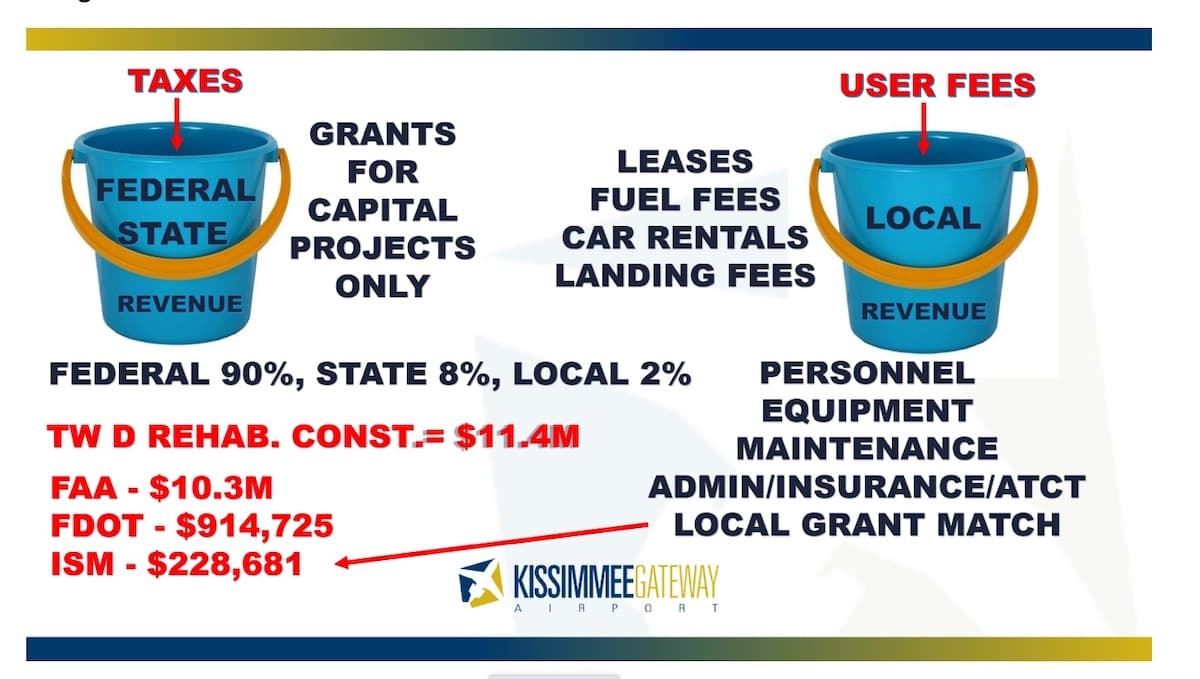
Aviation taxes collected by the federal and state governments are redistributed among several airports through grants. These grants are to be used for a specific capital improvement, such as a runway rehabilitation project. They cannot be used for daily operation and maintenance (O&M) expenses.
Aviation user fees are the local funds an airport collects to offset the O&M expenses. These revenue sources may include ground/facility leases, fuel flowage fees, car rental concessions, aircraft parking, and landing fees. The O&M budget is also used to pay the local match requirement when receiving federal/state grants.
This is where I experience the misunderstanding by many in our industry.
Aviation taxes (grants) are used to fund a capital project expense, while the user fees are used to maintain the project for its useful life, typically 20 years. The analogy is purchasing an aircraft and then financing the operating costs of fuel, maintenance, hangar, insurance, etc.
KISM’s current taxiway pavement and lighting rehabilitation project is $11.4 million. The FAA participated 90% and the state 8%, requiring the airport’s 2% match from the O&M budget as illustrated:
The recently proposed Pilot and Aircraft Privacy Act (PAPA) appears to support two positive intentions.
The first is to recognize the importance of ADS-B technology and its significant enhancement to aviation safety. It was invented for this purpose and will remain in place for this purpose.
Secondly, it appears to support Section 803 of the FAA Reauthorization Act of 2024 calling for aircraft owners privacy. Everyone in our industry seems to believe keeping this data from the general public is a good idea, so long as those of us within the industry retain access to this important information.
PAPA, as written, challenges airport operators by limiting the use of ADS-B data to impose fees on GA aircraft and will add burdensome financial disclosures, assessments, and reporting requirements.
Airports have been allowed to charge landing fees for a very long time without ADS-B technology.
Airports may elect to use older methods, such as installing cameras and providing additional staff time to track and invoice. Please understand this adds costs to the effort and those costs will more than likely be passed on to the users, raising fees.
The use of ADS-B technology is the most efficient and economical method of tracking and obtaining those same revenues.
Limiting an airport’s use of ADS-B technology will cause many other non-efficiencies impacting the aviation industry ecosystem.
In addition to aircraft safety, there are other ways ADS-B is utilized:
- Assist with accurate airport operation counts (FAA reporting requirement)
- Assist with based aircraft inventory counts (FAA reporting requirement)
- Assists airports and FBOs with accurate user fee invoicing
- Assist with overdue aircraft locations
- Assist with noise complaint investigations (usually in the pilot’s favor)
- Assist with law enforcement investigations (human trafficking, smuggling, theft, etc.)
- Tracking airfield movements to justify airport infrastructure grant funding requests
- Assisting aircraft brokers/lenders with ownership/title/lien information.
The proposed legislation requires further industry discussion and revisions.
There needs to be a better effort at educating the aviation industry on the challenges GA airports face both operationally and financially. Collectively, our aviation partners and our elected officials need to assist in ensuring safe, secure, and healthy airport environments for our industry.
Remember, GPS technology was intended for military use only. The internet was invented for high-speed use between computers. Yet this technology is used for many other purposes today.
Limiting the use of ADS-B technology would be detrimental for airport operators conducting daily business, causing inefficiencies and increased costs to the aviation industry.
Shaun J. Germolus, A.A.E., is director of aviation at Kissimmee Gateway Airport (KISM) in Florida.
I think that all the arguments for and against the landing fee implementation, lose sight of the fact that during ALL of the discussions with GA during the run up to the ADSB mandate,, it was repeated, over and over again, that the ADSB data WOULD NOT BE USED TO COLLECT USER FEES!!! It was implemented for the sole purpose of increasing the “safety” of the National Airspace, and enhance the “new” National Airspace control systems, again for “safety”. So, if your airport wants landing fees, knock yourself out, but you should not be allowed to use “safety” data collected, for monetary gain.
It’s worth nothing that Kissimmee airport is one of the most controversial and talked about airports when it comes to the misuse of ADSB. Specifically THEY are the airport that triggered the most action to start and support the pending legislation.
This is not about providing information. It’s about trying to protect their ability to misuse safety equipment.
The ‘real’ issue is the inefficiencies and incompetence (GA airports specifically) of those operating and maintaining the airports. VERY few overall airports utilize, nor need, the ADSB fee collection service. Why? Because they offer fuel at competitive prices to generate revenue, they BUILD ENOUGH HANGARS TO ACCOMMODATE the need, or ALLOW CONSTRUCTION OF PRIVATELY OWNED HANGARS and then collect appropriate lease fees to generate revenue. They utilize the land. They generate revenue other than just ‘assuming’ that pilots who are out practicing their skill should contribute to operational costs. The ‘biggest’ argument is that what we feared is coming true……ADSB was ‘never’ intended, and was actually promised, to not be used in this manner. Be a better airport. Be a better steward of the airport and quit taking the easy way out by 3rd party money-grabbing. Airports are WOEFULLY mismanaged.
I spend alot of time talking to the managers of the airports I fly into regularly and its eye opening how much it costs to build anything at an airport and costs more to properly maintain it. GA airports seem to be in an untenable position where nobody wants to pay for them but everybody wants to keep them open and use them. Somethings got to give – either more funding or they keep falling apart (like they are) and start closing. We can’t have airports close.
If an airport needs to collect a landing fee it should install some type of camera system and not rely on an ADSB signal. Its difficult to argue that an aircraft made a landing if the airport admin can show a photo. If the backwards state of California can use a license plate reader to mail a bridge toll bill to me with a photo certainly there must be something other than ADSB to collect a landing fee.
As mentioned fees have been collected since before ADSB, maybe that was just a no tech gut with a notepad on a clipboard. Maybe the new AI stuff the tech companies are trying to sell can figure this out.
I understand the need for user fees and you’re well within rights to collect them. But plenty of other airports are able to be successful without charging small planes directly by marking up fuel, hangar leases and other sources.
However, using ADS-B data for this purpose is just wrong. As a pilot, it’s frustrating to see data used for revenue purposes when it was invented for air safety. If airports need that revenue so badly, they should monitor all activities personally or with cameras. All planes have visible tail numbers.
We are very lucky in this country to have such a freedom to move about the country without undue burden. The more systems like this spread, the more it will slowly kill general aviation like it has in Europe.
Note that nearly 1/2 of the active GA aircraft are not equipped with ADSB-out. So, unless the tail number is noted,…no fee.
There are also a lot of ‘no-electrics’ aircraft, so no ADSB-out as well.
Wow. Sounds like a an excuse and these days tax payers and pilots are tired of both.
Pure and simple – ADSB was never supposed to be for tagging planes to charge N’s for arbitrary tolls. Managing an airport is no different than running a corporation. You have a budget and you work with it. I’ll never land in Kissimmee and you can figure out another way to increase revenue. Maybe convince all the kids using the airport and the airspace they can pay more.
You can clearly see here in the comments that KISM’s approach to dealing with this has alienated pilots and caused friction. The way this was passed in KISM has created some very poor optics for our local government and airport management. This has been very poorly handled in my opinion. Look at the firelight comments for KISM and compare to other airports. I think that speaks for itself. There are better airports to visit in the Orlando area for sure.
Pilots are vacating hangars and flying to alternate airports at a staggering rate. I hope one day it will turn around through either a change in leadership or for the current leadership to re-evaluate their approach.
#Boycott KISM Kissimmee
I don’t begrudge airports for charging modest GA landing fees. Indeed, when I fly into places like 42B (Goodspeed, CT), I happily pay the suggested or voluntary fee. The problem is with using ADS-B data to bill automatically. ADS-B isn’t precise enough to tell whether a maneuver was a low approach versus a touch-and-go. If I fly 15 feet over the runway without my wheels ever touching, I’m still in FAA airspace, not the airport’s. To complicate things further, ADS-B reception at low altitudes is often spotty, so there may be no reliable record either way. Weeks or months later, how would I, or the airport, prove what really happened? This is exactly why Brasher Warnings exist: to alert pilots of potential issues in the moment, when they can document and prepare to respond. Delayed, automated billing based on incomplete ADS-B data invites too much error.
It is your airport’s decision to charge landing fees. If I know there will be a fee, I don’t have to go there. I do not agree that ADS-B should be used to collect your fee and give a private contractor a piece of the funds. It is up to you to determine how to collect your fees. I paid to install ADS-B in my airplane and I should own the rights to my data. Stop trying to wiggle out of using my data to pay your fees. This is why people have no trust in government. You find a way to take more money from us. And yes, I do realize that it takes money to run an airport as I am a member of a privately owned public use airport. We do not usurp people’s ABS-B data but collect overnight fees from non members.
I have managed a medium sized airport in NH and owned the mid sized FBO that went with that. I found the article well written and very much meat for GAN. That said, with 56 years in non airline, professional aviation, two points; 1). ADSB was implemented to enhance safety and must never be used for other purposes. 2) there is a significant “gloss over” in this article. The local municipalities benefit greatly from the presence of the “local” airport. The article implies that the local municipalities don’t participate in the necessary funding. There in lies the more appropriate funding.
ok I dont have a problem with user fees. I had fees when I sailed into port and stayed at the marina. I paid to park at the Steelers game and many other places as well. So Ok I land pay a fee and go about my business.
But in todays crooked world I find ou that the guy next door to the airport manager doesnt have topay the fee cause he is somehow privileged. And the flight school doesnt pay , why cause there a flight school and we can’t afford to lose the gas sales if we charge them everytime a student lands. And your are telling me that the guy that has the really nice RV-10 at your local airport pays a fee for EVERYTIME he lands. Yeah right!
So how ’bout we do this. Every year each plane pays a fee that goes to our home base airport. Bigger the plane, larger the fee. Easy enough to find your home base its on your insurance papers.At least that way my local airport is getting the funding and I have reasonable assurance that Special People, Flight schools and the like are also paying there fair share.
My comments here are not meant to provoke anyone to do anything other then to open a larger discussion how we as pilots can keep our airports open and pay the good people that work and manage the airports. Regards.
Good artical – but …
I don’t know of a single governmental agency that has not wanted more funds.
Taxes and fees continually increase with a decrease in actual services. Govenment in general needs to focus on it’s core mission and the monies would be available, not every thing the airport managment wants, but enough to provide it’s basic function.
If your funds are lacking figure out how to aquire them without raising fees or taxes, by this I mean your local and state and federal not airport entity. If the local and state governments do not want to support the airport sell it to a private entity. The private entity stands a better chance of providing a better product to the public
Great collect the ADSB data, however the ADSB requirement personal data provided to the FAA or any other oginization does not enhanse safety.
No safety data is lost by just knowing you have a target on ATC or Aircraft displays
The only reason to collect aircraft and owner data is to go after the owner of good and bad reasons, and I believe perdominently bad reasons
Well stated.
If there is someone at the FBO to help said aircraft when it lands then that person can collect the fee. There is no additional personnel needed. Hundreds of airports around the country do it this way with no issues. The fact is, you can collect fees after the fact and often times erroneously because ADSB has proven not to be accurate enough to verify an aircraft actually landed at your airport vs just flying over or conducting a missed approach. So collecting fees are fine but have the people you are already paying to be there collect them instead of collecting less money after having to pay VECTOR their cut.
You realize that FBOs do not collect airport fees for free right? They also take a cut as well so there is always a cost to the airport whether it is airport staff, the FBO or someone like Vector.
Great, well written and informative article. I have never complained about paying fees at airports, even if just dropping off a passenger. It is the cost of convenience and our freedom to fly.
BUT this is an unnecessary ABUSE of ADS-B and some pilots are starting to turn it off. This has lead to visibility and involvement of AOPA and congress:
https://www.aopa.org/news-and-media/all-news/2025/june/26/bills-to-stop-ads-b-misuse-introduced-in-congress
Nevermind that KISM is so extreme that they are even charging light aircraft (all weights) for toun-n-go’s if not locally based (I’ll give you that one landing per day is free if aircraft is under 6000 lbs though).
Well written article. Thank you, Mr. Germolus.
Once the funds are distributed for Grants at GA airports own by small cities the funds are not properly spent and there is a huge wast because some of the municipalities do not properly investigate the best use of spending the funds. FAA needs make sure the funds go toward the project are not wasted by over spend for work performed. My Local airport did not go out to bid aggressively and over spent on installing an AWOS system witch was non standard system. The received on bid from a company witch in my opinion was 200K over the normal price at that time. I requested the contract for review and they asked me what part of the contract I wanted to see. Never got the contract. Miss use of funds by over spending is part of the problem.
Seems Taxes and Drugs have more in common than we sometime think.
“Florida airports will experience decreases in funding from the recent elimination of the jet fuel state tax and the sunsetting of COVID-era FAA infrastructure funds.”
So, KISM along with a lot of other airports, got hooked on the extra funding. Now they can’t stop spending it.
Really two options:
[1] Increase other funding (in this case user fees) or
[2] Cut spending (and that means some services)
This will be painful, government never likes to shrink.
It’s pretty simple. The ADS-B technology was developed for SAFETY ONLY. Not for government, local, state, federal, or individuals, corporations to benefit financially.
One of my thoughts as well. Several technologies were available before the FAA settled on ADS-B. Remember mode S or the Zaon XRS. The decision to go with ADS-B was a compromise between technologies. This compromise certainly included the ability to generally monitor aircraft. A strong argument against ADSB at the time was airport fees.
Not sure why it matters which party led the
drive to reduce our taxes and stop Covid related handouts. But yes, canceling $ from the Covid era makes sense, as the Covid era and its hysteria is, thankfully, over. And yes, it makes sense that any drive to cut taxes would certainly not be Democrat led.
I don’t care for ADS-B being used in this manner, either. It wasn’t presented as such when it was developed. But, it is. The market found a way to monetize it, and they are doing so.
If you just can’t stomach it, don’t land at KISM. Go somewhere else and explain to your fellow aviators why you don’t fly there so they are aware of it.
Let the market will take care of it.
The author of this GA NEWS article is Shaun Germolus is a paid employee of this airport, and is not a pilot. The new education for pilots will be in the future strategic methods of “Going Completely Dark”. Privatize your N number, use an anonymous LLC, block your N number, disable your ADSb when flying near these airports. They can’t track you, they can’t find you, they can’t bill you. We don’t need any more Shaun articles, and we certainly don’t need his big color picture. Video to follow.
Please be careful what you recommend to others–
“disable your ADSB when flying near these airports” is not a legal solution.
Reference FAR 91.225 (f).
I have my PPL but not current due to medical. Thank you.
We understand your position. Do you understand ours ?
I can say it takes funding to run an airport. Are you able to say pilots are extremely freedom biased. Do you understand the repugnance generated ? As with other matters we have compromised all the way to where we are. Where we are isn’t an improvement from where we were.
In my opinion general aviation enterprise airports should do everything to work towards the benefit of general aviation. Managers should not forget this fact. That being said enterprise airports have ways of increasing revenues that have nothing to do with landing fees. As I see it, adding landing fees effectively take away or tax an existing privilege that has been around for over 50 years.
Generally, any kind of fee should equate directly to some direct benefit. I’m just not convinced that these monies are directly benefiting the people who are general aviation.
How are other airports able to survive without this over-step of technology usage?
Perhaps it’s time to do a full audit of all airport operations both revenue and expenses. Something isn’t right here.
Really surprised GANews put this editorial forward. This entire thing runs counter to what GA is all about.
The issue I have is safety related. Imagine landing fees assessed on every landing while training, even though it is a taxi back for another takeoff. Students and instructors will become expert at low approaches, and will avoid airports that charge thereby crowding airports that do not. Obviously, controls on charging must be considered.
When revenue is produced, airports deserve their fair share. So business and corporate aircraft should pay landing fees but GA pilots who are flying for proficiency to keep the airport and airspace safe as well as non profits who are flying for the care of our communities should not be paying landing fees. As a non profit, we just received a billing from KISM using ADS-B information, this fee adds to our costs and will reduce the assistance we provide to those who are sick and cannot afford commercial aircraft. ADS-B was created for safety not for the convenience of those looking for a more efficient way to pick pockets indiscriminately. Keep it focused on safety or it will be cause some to sacrifice safety. Business aircraft use FBO’s that is where necessary fees should be collected.
I’m looking at my logbooks from 1978 when I was a student pilot. I made 211 landings during the course of earning my certificate. Even if the “modest landing fee” had been “only” $10, that would have added $2,110 to the cost of my training. I was the stereotypical broke student pilot back then and an extra two grand would really, really have hurt. Many of the airports I flew in and out of offered NO services at all, some were grass fields, so that $10 just to say hello each time would simply have been a grift. What’s next, will ATC be charging us by the word?
The problem not discussed is the use of ADSB to send a bill for a landing fee for a landing that never happened. Just becasue an aircraft was in the area of the “participating” airport does not mean they landed there. If one were to shoot an approach or 3, to an airport does not mean that even one landing occurred. One may have broken off the approach a half-mile from that runway to do the published missed approach. But the ADSB capture system logs this as a landing.
I think this is what started the complaints about ADSB being used to generate bills for landings that never happened. And then a possible lien on an airplane via the FAA. And what does it cost to get this fixed? It is effectively leaglized extortion.
But wasn’t it said that ADSB was not to be used for this purpose when we all got told we were going to have to be ADSB compliant to fly….
Thank you for sticking your neck out there with this article. I don’t like it, but I appreciate learning more about your position on the issue.
FL is one of just a few places in the US with a very high density of training and recreational flyers. If you can’t make the numbers work there with fuel taxes, land leases, and rent revenue, I would submit that the answer is not user fees.
As someone charged with the public trust of managing and maintaining an airport, you are obligated to work within a very restrictive framework. When I look, for example, at the rules and regulations around the procurement process, municipal hiring practices, or the steps necessary to build a hangar, I see a long and winding road built with the best of intentions of fairness and transparency. Unfortunately, the unintended consequences are extremely high burdens of cost and time.
I know that dealing with pilots and aircraft owners is not easy (because I am one!). However, educating us and enlisting us in the process is the only way forward.
Locally, anyone who pays you rent for the land or buildings needs to be almost forced to understand your budget. Statewide, in FL, the issue of the high training activity and the “tragedy of the commons” that results in high traffic with no benefit; that needs a consensus solution (ugh, politics).
Good luck, but please find a better solution that adopting EZPass for airplanes.
Can’t disagree more with this article. ADSB should never be used for the things listed here. It was implemented at OUR expense for the sole reason of safety and avoidance. Now you want to change the game. Find other ways to fund your airport!
Join the cause to fight this abomination .
Sign the petition to the FAA and Dept of Transportation to protect ADS-B for safety only:
https://www.change.org/p/calling-on-the-faa-to-halt-the-use-of-adsb-data-for-billing
Helpful resource
http://www.stopadsbabuse.com
Have your housing costs gone up more than your income has over the last 5 years? The answer is probably yes. Well Airports are in the same boat with construction costs rising 25% – 40% over the last 5 years. Pay to play model unfortunately like everywhere else is coming to airports. Just like city parking that used to be free is not anymore. Going to the beach that used to be free isn’t anymore. There are few ways to makeup funding so I think most of us can handle $10 to land somewhere if it keeps the airport in business.
Boycott KISM Kissimmee
An interesting and informative article and discussion about the issue. Though it does leave out one critical piece of information. Both of the initiatives discussed – elimination of the jet fuel state tax and the sunsetting of COVID-era FAA infrastructure funds – were Republican led.
Your point being what, exactly? Is it somehow less of a problem for you if some arbitrary expenditure of tax revenue (that you clearly approve of) was eliminated by Democrats rather than Republicans? Or is it that you feel that “COVID-era” funds should continue indefinitely? Or perhaps you opine that Democrat politicians and other wealthy, left-leaning jetsetters somehow don’t benefit from the elimination of taxes on jet fuel? Please, enlighten us.
Covid is over buddy
Enough with the political crap. The article wasn’t about politics, so quit forcing it where it doesn’t belong.