

By MACK McKINNEY
We pilots are a pragmatic bunch. We use common sense, trust our machines, know our numbers — most of the time — and lean heavily on experience.
That’s why it’s dangerous when we start trusting the wrong experience. I call it the “Titanic Thought Trap,” officially known as the Normalization of Deviance.
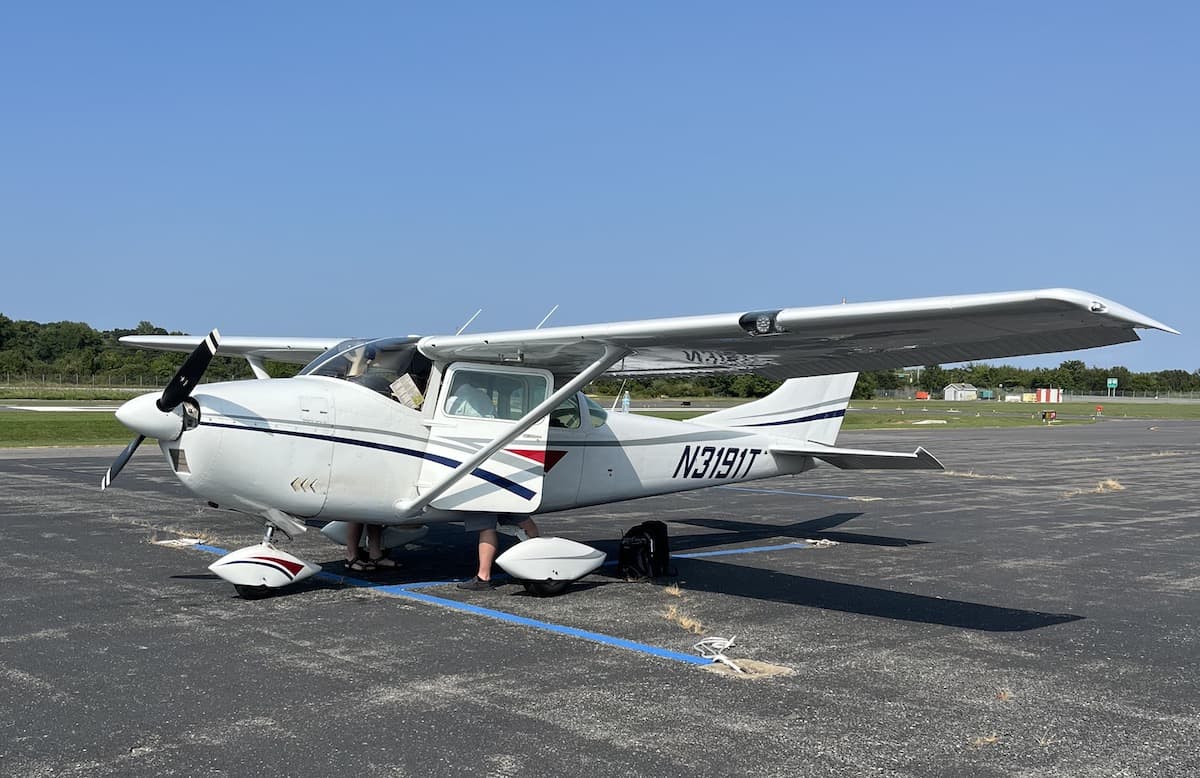
It’s the same faulty thinking that doomed the Titanic and — almost — my beloved 1963 Cessna 182.
Three Big Mistakes
You’ve probably heard it before: The Cessna 182 is not just a 172 on steroids, it is the pickup truck of general aviation. It hauls anything.
That’s not just hangar talk — it’s a badge of honor worn by Skylane owners.
And it is not true.
That reputation lured me into complacency on a hot summer day when I flew our vintage Skylane into a small field near my son’s college. It had been a great visit, and he was sending back home with us a lot of appliances, books, household items, and assorted junk from his apartment.
The airport had a paved runway of more than 3,500 feet — shorter than our home field, but not alarming. After all, I’d flown in and out of shorter strips before.
That was mistake #1: I didn’t run the takeoff performance numbers. No density altitude check. I just “knew” we’d be fine, because we always had been.
Mistake #2 was not weighing the load. My wife and I are full-sized adults and we packed the rear seat and baggage area with lots of moderately heavy stuff.
I even remember thinking the tail looked a little low.
But instead of investigating, I rationalized it away: “The nose strut’s probably just sticking up there again. Happens all the time.”
And, without a payload weight, I failed to perform a weight and balance calculation.
Mistake #3 was the worst one: I trusted my luck more than my training.
I’d flown overloaded before and “gotten away with it.” So I pushed the throttle in and rolled down the runway, a little “puckered” (ask any pilot) but I launched.
The Ugly Reality
It was more a leisurely departure than a launch. The takeoff roll was long. Really long. I blamed it on the heat — it was over 90°.
I finally eased the old girl off the ground, but the controls were sluggish and heavy. We were barely climbing.
I glanced at the cylinder head temperature (CHT): Over 360° and headed for 400.
Again, I told myself this was normal for hot days, and did what I’d done before — reduced power slightly, nudged the nose down, kept the cowl flaps open for better cooling, and retrimmed.
That’s when I realized we had a much bigger problem.
There were mountains and trees — lots of trees — surrounding the airfield. I remembered how pretty they were when we arrived. Now, not so pretty.
The airport was in the bottom of a cereal bowl of mountains. In a straight line to the lowest of them, I would not be able to clear them.
So I circled. Once. Twice. Three times. Each lap barely buying me a few hundred feet. My climb rate was an anemic 200 feet per minute, and the CHT number — 390 — seemed etched into the glass.
Finally, I judged we had just enough altitude to clear a low spot in the ridgeline, so we aimed for that. We made it with about 50 feet to spare. As we sailed over those trees, I clenched (pilots know what I mean), as if that would have helped.
The Hidden Threat
A few months later, during the annual inspection, my A&P called me over to look at cylinder head #3. It had broken its all-important seal with the cylinder, evidenced by a blackened oil ring at the seam.
The mechanic shook his head, telling me: “You were a few flight hours away from a catastrophic failure.”
Had that cylinder let go during our feeble climb-out, I might’ve been able to spiral back and attempt an emergency landing. But with that aft CG and near-gross weight? The odds were not in our favor.
Had it failed somewhere during our hour-long flight home — over forested, mountainous terrain — you wouldn’t be reading this right now.
What Happened?
This wasn’t a one-time mistake. It was the slow, creeping acceptance of a higher level of risk.
In aviation psychology, it’s called the Normalization of Deviance.
It happens when you start thinking, “I’ve done this before and it worked out, so it must be okay.”
You get away with it once, then twice, then 10 times. It becomes your new normal.
That’s what sank the Titanic.
Captain Edward Smith had made 19 high-speed Atlantic crossings without slowing for ice warnings. The ship was built like a fortress. Past success lulled him into a false sense of invincibility.
The same thing happens to all of us, from medium-time pilots like me to seasoned aviators.
Three Biases That Will Kill You
Normalization of Deviance: The longer you get away with breaking a rule or skipping a step, the more “normal” it feels to do so.
Overconfidence Bias: Believing you’re safer, smarter, or more experienced than the situation deserves.
Optimism Bias: Believing things will probably turn out fine, because they always have, even when indicators suggest otherwise.
That’s what nearly killed me: A near-lethal cocktail of all three.
Lessons for the Rest of Us
This near disaster taught me some harsh lessons, which I now treat as gospel:
- Run the numbers — always. Know your takeoff distance, weight and balance, and density altitude well before you climb into the airplane.
- Trust your training, not your luck. Past success does not equal future safety.
- Challenge your assumptions. Just because you think your nose strut is sticky doesn’t mean your CG isn’t also too far aft.
- Listen to your gut. If something feels off, it probably is.
- Teach this story. Someone else’s near catastrophe can be their wake-up call.
The laws of physics don’t care how many times you get away with bending them.
Fighter pilots, during safety training sessions on the ground, pass around a metal coat hanger and each pilot bends it and passes it to the next pilot who does the same. This mimics the cumulative, hidden stress of over-G-ing the jet. It eventually breaks, as will the jet’s underlying structure if repeatedly over-stressed during flight.
So the next time you feel tempted to skip a check, fudge a weight number, or rationalize something odd, remember the Titanic and the coat hanger.
And remember the Skylane that almost smacked into the trees.
Fly safe out there.
Mack McKinney is a USAF veteran, pilot, and author of books and aviation safety articles. As a business development expert and motivational speaker, he shares success stories and resilience strategies. He can be reached at [email protected] and MackMcKinney.com.
Mack,
Excellent article! Any pilot who thinks “oh, I would never go there” is just fooling him/herself. Your words remind us we need to be vigilant on EVERY flight! Thanks for reminding us of our responsibility to fly safe for ourselves and others!
Sam
Thanks Sam. I have flown with you, sir, and you are an outstanding pilot. Keep the shiny up.
The facts of the story are these – the plane was loaded over gross weight, no weight and balance was calculated, outside temp was 90 degrees, and the flight was in a mountainous environment with trees. What we don’t know was the field elevation. Wow! There is no way I would put my family in this guy’s airplane. After reading the story the FAA should yank his certificate because he is an accident waiting to happen. He’s going to kill someone. All I can say is he was one lucky bug. I have owned a 1981 Skylane/182 for 37 years, and I always run a w/b when I load it near gross weight, always! I know exactly how much everything weighs that I put into my plane, including the Depends I wear. It was said, “The same thing happens to all of us, from medium-time pilots like me to seasoned aviators”. Well, I beg your pardon, no it doesn’t happen to “all” of us. It only happens to those who approach aviation irresponsibly and stupidly. Call it what you will but this is not good Airmen Decision Making at its best. The story makes a point we can learn from but remember, we can make aviation as safe as we want to make.
Kelly, I was a younger and much less experienced pilot in those days. I didn’t weigh everything and I didn’t top-off the tanks, so I don’t know for a fact that I was overweight. But I suspect the CG was near the aft envelope of safety.
Whenever I read articles like this, I make a mental note NOT to make the same error in judgement. And that is the purpose, right? Articles like these are offered as a service to the entire aviation community, much like the NASA Aviation Safety Reporting System (ASRS) that captures self-reported, confidential reports, analyzes the resulting data, and disseminates vital information to the community. I also reported this flight via ASRS, so others could learn. Enjoy that Skylane, Kelly, they are great airplanes. And thanks for your comment.
Great thoughts Mack…and I am one of those fighter pilots who played with that hangar many times. I try to keep myself in the “green” by always remembering that “Aviation is only and always ONE IN A ROW!” Every event, no matter how many performed, is always the first time doing it. Thanks for sharing…. Check 6..,
Thanks Garry. Great saying – – – I’ll remember that one!
Well put Mack and certainly an important reminder for us all…speaking for myself, I believe there to be a “sprinkle” of complacency that plays into this “near lethal cocktail.” I suppose you could argue that complacency is merely the cumulative result of the three biases but nevertheless it comes to play in this recipe for disaster…I appreciate the lesson and it always helps when tied together with a good story.
Spot on, Andrew. I was complacent and had a “I have slightly overloaded airplanes before” attitude. “There are old pilots, and bold pilots, but no old, bold pilots”, right!?!
Excellent article. As an “old guy” I find myself “normalizing” a few mis called but “I got away with it” steps. I’m a professionally trained flight and ground Safety Officer back in GA the last 30ish years. Recently I’ve started reading articles like this saying to myself, “self… that last time we landed really skosh on fuel…”. Yup, really easy to normalize dumb stuff. Check lists and performance charts are written in blood. Thank you for the poke.
Happy to provide a feindly “poke”, Terk. We all need truth-tellers in our lives, people (or a little voice in our heads) who cause us to really think hard about possibly dangerous actions we are about to take. Glad to be of service.
Excellent article, with important lessons to learn as takeaways. Thank you for sharing this. Aviation is an unforgiving sport when we get on the backside of the curve. Best for each of us to learn and respect the laws of physics that govern our craft, before it’s too late.
Thanks for your comment, Kyle. I liked your reference to the “backside of the curve”, Being there can be lethal. Fly safely.
Great story, glad you are still here so we can learn from it. Safe flying to all!!
Thanks Gordon. I, too, am glad to still be vertical and on the correct side of the grass roots. I have more hair-raising aviation stories but most are military related and I don’t think this publication accepts those.
Excellent article. I have always wished we could offer civilian flight training that instructed as thoroughly as the military- but the cost factor would be enormous.
Thanks for your comment Richard. I was fortunate to have some outstanding flight instructors through the years. Tom, Rob and Gary tought me lots of tips and tricks to keep me safe, including W&B checks! Thanks again for commenting.
“Captain Edward Smith had made 19 high-speed Atlantic crossings without slowing for ice warnings. The ship was built like a fortress. Past success lulled him into a false sense of invincibility.”
Sorry, but this is an inaccurate statement. Smith had a reputation for being a competent, careful and risk averse captain, and was known for slowing down when the conditions called for it. For example, on the Olympic’s maiden voyage (Titanic’s older sister ship) they encountered fog and immediately slowed down, causing a loss of an hour and a half to their arrival time. Titanic’s officers had indeed received ice position information (not “warnings” per se, as it was part of general correspondence between vessels) and had calculated when they would encounter ice and were actively looking for it. Speed was (and still is) directly related to *visibility* and on that fateful night they could see clear to the horizon so maintained speed expecting to see the ice long before there was any need to take action. The fact they were wrong on that count is nothing to do with Smith taking risks or any “overconfidence” in the design of the ship. The “unsinkable” label applied to most ships being built at least ten years prior to Titanic.
So while your points about the three biases are critically important – Captain Smith and the Titanic is not really a fair illustration to use as an example.
I am glad that you made this correction. I was always amazed that the Titanic’s water-tight integrity did not extend all the way up to the main deck. That one design flaw let the flooding become a cascading casualty as the water spilled over the top of one compartment barrier to the next.
When I read these lessons learned and accident summaries, it is remarkable how often no pre-flight checklist was completed. I applaud Mr. McKinney for honestly sharing these very important lessons learned. The FAA needs to incentivize pilots to openly share their experiences, even when there was no catastrophe.
One of the things that i really liked about flying with our Navy was how the pilots and flght officers were so painfully blunt about sharing lessons learned, including from mistakes that they had themselves made. A lot of civilian aviators are the same way and I think that the aviation community would be even better if we encouraged the sharing of lessons learned, like Mack has done here, even more.
Excellent point about post-flight honesty, Tyler. I, too, have attended many USAF and USN post-mission debriefings and the bluntness and honesty was always refreshing. I have also attended debriefings by pilots of a foreign air force where there were blatant lies engineered to “save face”; There were no air combat lessons learned, no tactics changed. Just face-saving.
Blunt debriefings are one thing we do right in the US military flying community. Thanks for your comment.
One other point here, Tyler. NASA has the Aviation Safety Reporting System (ASRS) that “captures self-reported, confidential reports, analyzes the resulting data, and disseminates vital information to the community”. It encourages self-reporting of potential flight safety issues and, under most conditions, protects the reporter from FAA enforcement action. The idea is to dessiminate lessons-learned so others can benefit. If you are not familiar with ASRS, go here: http://https://asrs.arc.nasa.gov I encourage all pilots and controllers (I have been both) to sign up for the free, monthly “Callback” newsletter via the button on the website.
Keep the shiny side up!
Hi Dan,
You grasp of maritime history is better than mine. With some icebergs barely showing above the surface, and their mass being mainly below the surface, why would Capt Smith have “maintained speed expecting to see the ice long before there was any need to take action”? Just curious about that and would appreciate your thoughts.