

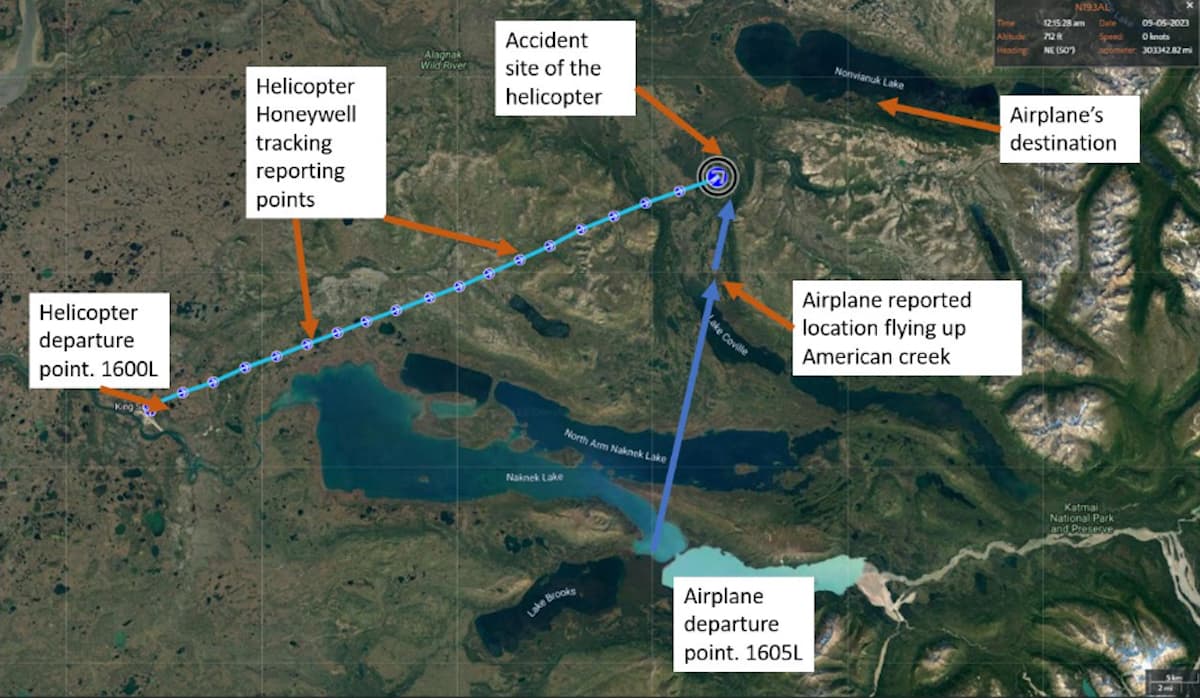
The float-equipped de Havilland DHC-2 departed from the Brooks River in King Salmon, Alaska, and flew north to the mouth of the American Creek on a return flight to a lodge on Enchanted Lake.
The pilot broadcast a position report over the common traffic advisory frequency while crossing over the mouth of the American Creek and proceeded to fly along the right side of the creek at an estimated altitude of 800 feet mean sea level (MSL).
About five miles past the reported position, he noticed the passenger sitting next to him looking across the cockpit to the left with a startled look.
The pilot looked left and saw a flash of white. He never saw the helicopter before impact.
The airplane was traveling at about 90 miles per hour. The airplane was not equipped with ADS-B, nor was it required.
The helicopter departed from King Salmon Airport (PAKN) en route to Homer, Alaska. The helicopter pilot reported that, after departure, he climbed to about 1,000 feet above ground level (AGL) and was flying direct to Homer Airport (PAHO). The helicopter was traveling about 115 mph.
As the helicopter passed under the airplane, the airplane’s propeller made contact with the helicopter’s tail boom and tail rotor drive system, which severed the entire tail rotor gearbox assembly from the tail boom.
The helicopter entered a spinning, uncontrolled descent into the tundra and tree-covered terrain below.
The airplane began to shake and vibrate violently. The airplane pilot then realized that the airplane had collided with another aircraft and he turned the airplane 180°.
The right seat passenger reported to the pilot that a helicopter had hit the airplane and he saw the tail of the helicopter separate and the helicopter crash.
The airplane pilot broadcast the downed helicopter’s location over the common traffic advisory frequency and began to direct other aircraft in the area towards the helicopter wreckage. The airplane pilot then made an emergency landing in a nearby river.
The airplane sustained minor damage to the floats and propeller, but no one was injured.
The helicopter pilot, who sustained minor injuries in the crash, reported that he was monitoring the local traffic advisory frequency at the time of the accident. The helicopter was equipped with ADS-B In and Out. The pilot was also using a Stratus that provided ADS-B data from other aircraft in the area on a moving map display on his tablet. He did not see any other aircraft along or near his route of flight on the display.
He added that he never saw the airplane and was unaware that his helicopter had collided with the airplane until after the accident.
The nearest weather reporting station, located 34 nautical miles west of the accident site, reported 10 miles visibility with few clouds at 3,500 feet AGL.
Neither pilot reported any difficulty or restrictions with visibility.
Probable Cause: The failure of both pilots to see and avoid while en route, which resulted in a midair collision.
To download the final report. Click here. This will trigger a PDF download to your device.
This September 2023 accident report is provided by the National Transportation Safety Board. Published as an educational tool, it is intended to help pilots learn from the misfortunes of others.
Both are claiming announcing on CTAF. The Helo pilot was scanning their system for other aircraft, nothing said about looking for other aircraft. Since ADSB didn’t show anything, I think we have a case of expectation bias.
Helo at airspeed at 115 and the fixed wing at 90, we can deduce that the Helo pilot was overtaking the fixed wing from behind and below to its left.
I think this is an excellent example for teaching why you have to look outside, since the fixed wing was not equiped with ADSB, nor was legally required to be for that airspace.
This is a scary reminder of what see and avoid is. It really takes more than looking outside 90% of the time because aircraft can gradually come near in a blind spot. The only way to prevent that is to at least occasional maneuver enough to inspect every blind spot – above, below, and behind.
See and avoid? 10 miles visibility? I guess it’s pretty dark while in HUA conditions. Thankfully nobody died!
It is a miracle that the helicopter pilot survived this incident with only minor injuries!