

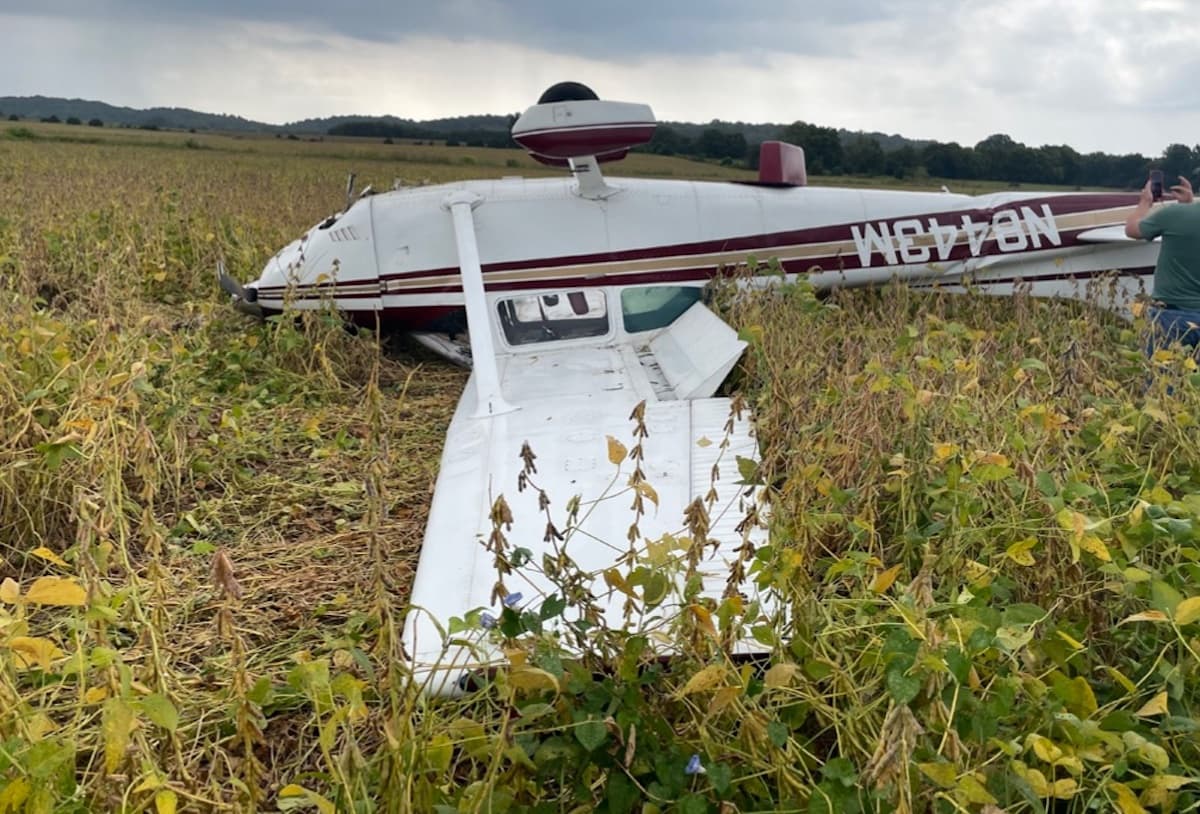
The pilot was performing a cross-country flight from Tuscaloosa National Airport (KTCL) in Alabama to Lebanon Municipal Airport (M54) in Tennessee in the Cessna 182P.
About an hour into the flight, at 3,500 feet mean sea level, there was a “sudden severe engine vibration and loss of power.” He reduced the throttle to lessen the engine vibration.
He elected to land in a soybean field near Prospect, Tennessee, since he was unsure if he would clear a large, forested area between him and the next closest airport.
After touchdown in the soybean field, the nose landing gear struck a ditch, separated, and the airplane nosed over, coming to rest inverted. He called 911 and was met by first responders.
FAA inspectors responded to the accident site and examined the wreckage. The fuselage and empennage were substantially damaged. The pilot and a passenger sustained minor injuries.
After recovery of the wreckage, the engine was examined on the airframe.
The rocker covers were removed to examine the cylinder heads and check valve action. The Nos. 1-5 cylinders were normal in appearance and the valve action was correct. When the rocker cover for the No. 6 cylinder was removed, pieces of the exhaust valve rocker boss, the rocker, washers, and the rocker shaft were loose inside. The exhaust valve was closed. The rocker boss was fractured in two places.
The loose parts recovered from the No. 6 cylinder were sent to the National Transportation Safety Board Materials Laboratory for examination. One of the rocker boss fragments exhibited features consistent with fatigue that initiated at multiple sites along the bore surface that had been in contact with the arm. The other boss fragment was fractured from overstress, exhibiting features consistent with rapid fracture of an aluminum casting.
A review of the engine logbook revealed that the engine cylinders were removed, overhauled, and reinstalled on May 18, 2020, at 2,609.8 hours total aircraft time. At the time of the accident, the airplane had accrued about 154 hours since the cylinders were overhauled.
Probable Cause: A loss of engine power due to the fatigue failure of the No. 6 cylinder exhaust valve rocker boss.
To download the final report. Click here. This will trigger a PDF download to your device.
This September 2023 accident report is provided by the National Transportation Safety Board. Published as an educational tool, it is intended to help pilots learn from the misfortunes of others.
There was an Ad; 94-05-05 R1, and a service bulletin, AWB 85-016 Issue : 1
Date : 2 August 2013. So, mechanics and pilots should have been monitoring the engine and valve operation…
It’s easy to remove the valve covers and do an inspection of the rocker bosses for cracks.
However, if a crack originates at the rocker shaft bore, the rocker shaft and rokers would have to be removed to examine the areas….very intrusive, and costly.
the cylinder that failed looks to have 2,400+ hrs and was overhauled, which can cause damage to the boss during the roker removal and installation.
So, this is why I opt for a new cylinder vs overhaul, with a reasonable higher cost.
Highway engines don’t fail this way because they aren’t stressed to the breaking point at sustained open-throttle speeds the way GA engines are. Vehicle manufacturers’ engineering departments struggled since WWII with mating iron and aluminum because of such failures. Aluminum never shrinks back to original geometry after heating and cooling cycles, whereas iron does. It’s a bad marriage with statistically predictable results such as revealed in this article. No way the average or any GA owner/pilot could predict this outcome, but the engine mfr’s can. You’re in the hands of God in the air. Glad the pilot and passenger survived this wreck.
Regards/J
Mature soy bean fields are a guaranteed arrested landing. Glad they received only minor injuries.
The Chinese bought Continental engines a few years back. The government should not have allowed this IMO.
New cylinders are available by after market manufacturers and I would go for them now as I do not trust the Chinese government. ……
2400 + hours over how many years?? at some point it pays to buy new…..How many hours would these overhauled go before a failure would occur……3000 hours ……4000 hours…..Time is a factor and if the cylinders were made 30 years ago it would have been safer to buy new…….A time limit should have been factored in….IMO
The pilot and passenger were okay and it could have been worse and those on the ground were not a factor!…….this time!
FAA should have a time since manufacture limit we all can agree to……
Continental Motors manufactures all the parts for their engines in the Alabama factory….per their site info.
https://continental.aero/genuine-continental-parts/
Mike Bush, the ‘engine guru’, recommends overhauling a cylinder only one time..
I’ve had early failures of overhauled cylinders, So, I have only used new cylinders from Continental .
5 of them now have over 400 hours on them and are still like new; good compressions, good borescope and the engine uses a qt of oil in 10-12 hours.!!
.
I had a couple of cylinders overhauled with worn exhaust guides and high oil use. They failed with cracks at the spark plug threads a few 100 hours later.
I have since bought 4 new cylinders which were only a few $100 more than overhaul.
They now have 400+ hours on them and they are still ok…great bosescope and compressions.
Oil use is 11-12 hr per qt.!!