

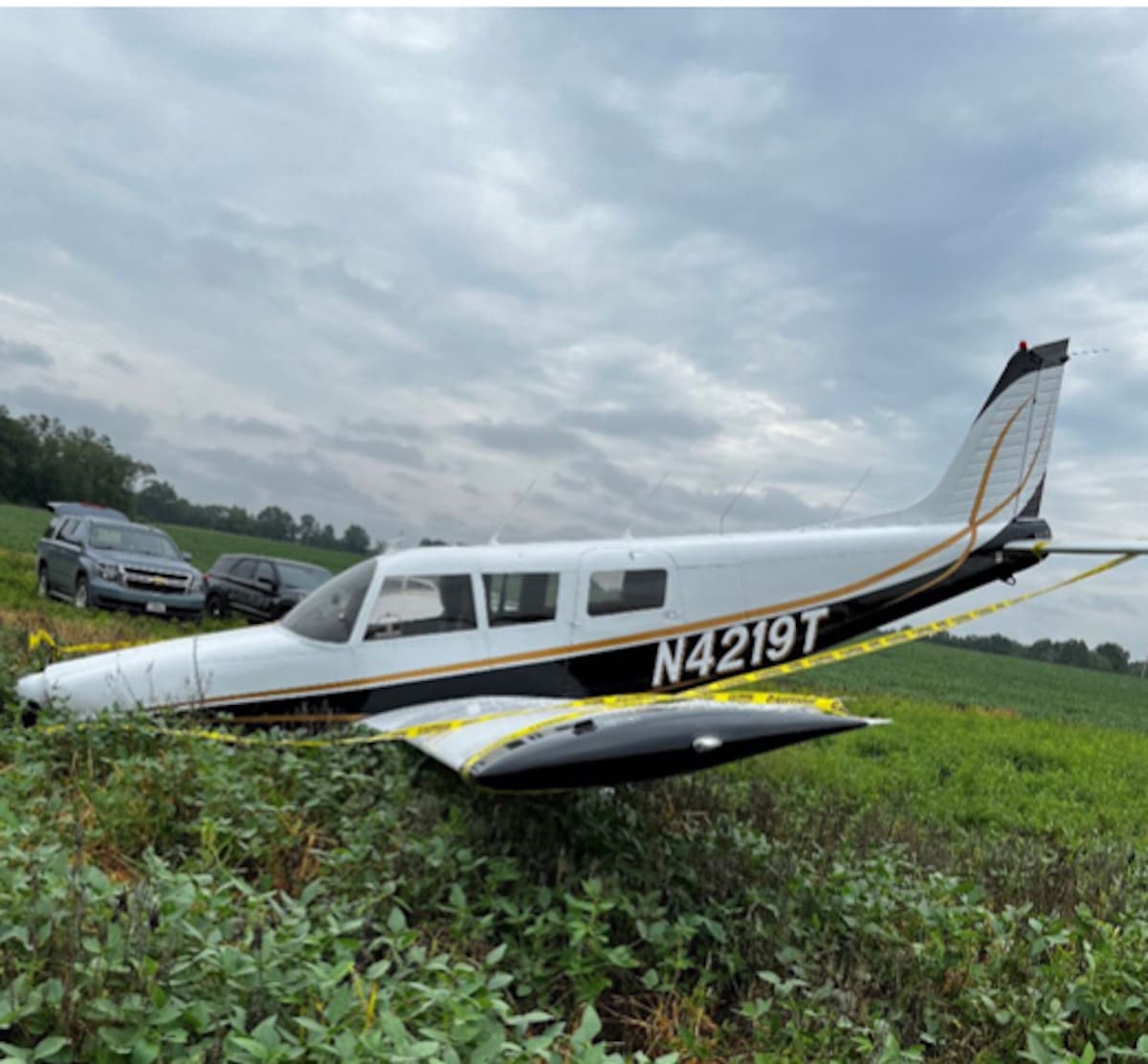
The flight instructor told investigators that prior to beginning the instructional flight, he visually confirmed there was fuel in each fuel tank of the Piper PA-32-300.
He did not use a fuel dip stick when he checked the fuel level, approximating the fuel level as 17 gallons. He said the flight would have required 8 gallons of fuel.
About 10 miles from the destination airport, with the fuel selector positioned to the right main fuel tank, the engine began to run rough. He then selected the right auxiliary fuel tank, and the engine began to run smoothly again.
About four miles from the destination airport and during the approach for landing, the engine began to run rough again. He then selected the left auxiliary fuel tank, but engine power was not restored.
With the engine at idle power, he tried to restore engine power by cycling through the remaining fuel tanks but was unsuccessful. He then performed a forced landing to a field near Moberly, Missouri, during which the engine ceased to operate.
The airplane sustained substantial damage to the fuselage.
Post-accident examination of the airplane revealed no leaks with the fuel system.
No useable fuel was found in the left and right main fuel tanks.
The flight instructor stated that after the accident, he checked the left auxiliary/tip tank and there was 7 gallon of fuel present.
The examination revealed no failures or malfunctions with the airframe and engine that would have precluded normal airplane operation.
Probable Cause: The flight instructor’s inadequate fuel management that resulted in fuel starvation and a total loss of engine power during an approach for landing.
To download the final report. Click here. This will trigger a PDF download to your device.
This September 2023 accident report is provided by the National Transportation Safety Board. Published as an educational tool, it is intended to help pilots learn from the misfortunes of others.
What is depressing and scary is how many of the accidents we read about here are from poor fuel management. This should be one of the easiest preflight checks and one of the most important. Lord give me strength and ability to understand their heads
It wasn’t a preflight problem but issues with fuel system management.
What in the world is with all these lack of fuel accidents?
I lot of these crashes caused by fuel mismanagement are listed on this site.
But, they represent about 6% of the 900 GA accidents each year.
The total is decreasing, so we’re getting better at keeping the aircraft flying.
Loss of control in flight is #1 with various causes, but mostly the pilot’s fault.!!
the Nall report, [ renamed not] is published annually on GA crashes.
Did he follow the checklist – switch tanks, turn on the electric fuel pump, check mixture, and alternate air on. The CFI’s report only mentions switching tanks.
Other things are quite irrelevant if there is no usable fuel remaining ….
“The flight instructor stated that after the accident, he checked the left auxiliary/tip tank and there was 7 gallon of fuel present.”
but there was, read carefully